The luggage is heaped in the middle of the floor. Three friends sit around it. Then the narrator of Three Men in a Boat makes an offer that sounds generous: “I said I’d pack.” George settles into an armchair with his pipe; Harris puts his legs on the table. They have accepted the offer perfectly. That is the trouble.[1]
J., as the narrator is known, had imagined a different arrangement. His friends would do the handling while he supplied expertise, corrections, and the occasional demonstration. Before a bag has been properly packed, Jerome K. Jerome has found a small social disaster inside an ordinary sentence: volunteering can be a disguised application for management.
First published in book form by J. W. Arrowsmith in 1889, Three Men in a Boat sends J., George, Harris, and the dog Montmorency on a Thames holiday.[1][2] Its comic voice makes those companions unusually easy to recognize. J. can describe another person's failings with exquisite accuracy; his own become much harder to name. Listen to his qualifications and changes of direction, and the apparent ramble begins to sound carefully rehearsed.
The offer and its explanation
In Chapter IV, the packing boast comes before the packing. J. prides himself on his knowledge, then adds a parenthesis expressing surprise at how many subjects he knows better than everyone else. The aside pretends to interrupt his self-praise. In practice, it extends the claim from one household skill to almost the whole of human knowledge.[1]
That small movement establishes the voice. J. sounds conversational because he appears to revise himself while speaking. Yet the revisions tend to leave him in a more flattering position. When George and Harris take his offer literally, he explains what he meant “of course.” Those two words quietly ask the reader to treat an unstated desire as something any reasonable person should have understood.[1]
Next comes a memory of a former housemate who enjoyed watching J. work. It sounds like evidence for the prosecution: here is another intolerable idler. But J.'s statement of his own superior principles ends with his desire to “get up and superintend.” The energetic alternative to sitting still turns out to be walking around with his hands in his pockets.[1]
The delay matters. We are given time to sympathize with the worker before discovering that his preferred solution is to become a more mobile spectator. Jerome lets the sentence perform the evasion. A less patient joke could simply call J. lazy; this one makes us hear how laziness acquires the vocabulary of duty.
Then objects answer him. He forgets the boots, searches for his toothbrush, and packs away something he still needs. Each reopening of the bag interrupts the fantasy of competence. When Harris mentions the missing boots, J. resents the timing of the observation. Even useful information can become an offence if it arrives from the wrong witness.[1]
Work as a treasured possession
Chapter XV gives the same habit a more expansive form. The friends disagree about who has done the rowing. J. assures us that he likes work, then explains that he can watch it for hours. The familiar language of industry turns, almost imperceptibly, into the language of collecting.[1]
He accumulates work. He keeps it in his study. He treasures old examples and dusts them. Tasks become objects whose excellent condition proves that nobody has touched them. His pride remains grammatically intact while its justification changes completely.[1]
This is more elaborate than a single punchline. Jerome keeps extending the wrong meaning of a respectable claim, and every extension sounds locally reasonable. A collector should preserve his possessions; a conscientious worker should take pride in his work. J. slides between those propositions until neglect looks like care.
The quarrel then distributes this flattering self-image around the boat. Harris thinks he has carried the others; George thinks the same about himself. J. supports each friend's criticism of the other in turn. His agreement becomes wonderfully available whenever it leaves his own contribution unexamined.[1]
We need not read him as a fool accidentally revealing everything. The narrator who preserves these exchanges also knows how to make them funny. Jerome gives J. enough awareness to entertain us with his vanity, while leaving the vanity recognizable. That balance helps explain the book's companionable tone: confession can win affection without amounting to reform.
A conversational voice with social consequences
The ordinary scale of these disputes mattered to the book's reception. In his account for the Jerome K Jerome Society, Jeremy Nicholas describes its origins in a proposed river guide, The Story of the Thames, whose comic episodes overtook its historical material. He also records the hostility of critics who associated Jerome's colloquial language with vulgarity and mocked the class of readers it attracted.[3]
Penguin's description places the book among the late Victorian “clerking classes.”[4] That context helps make sense of its particular pleasure. A modest holiday offers opportunities for command, distinction, and impressive speech, even when the immediate business is moving luggage or taking a turn at an oar. My reading is that J.'s inflated authority grows especially funny against this small practical scale. He needs very little territory before he can imagine himself in charge.
The distinction between Jerome and J. matters here. Nicholas identifies real friends behind the three men but also notes transformations: the model for the drink-loving Harris was a teetotaller.[3] These are composed performances, shaped from life. Their plausibility should not make us mistake every anecdote for a deposition.
When the voice floats away
There is another side to J.'s fluency. In Chapter III, the discussion of necessary supplies opens into a meditation on possessions that weigh down the boat of life. The prose gathers friends, comforts, flowers, reflected trees, and spiritual music into an increasingly elevated appeal. Then J. catches himself: “I beg your pardon, really. I quite forgot.” The practical list passes to George.[1]
The interruption makes a joke of the excursion, but it does not erase its wish for a less burdened life. This is part of the book's tonal risk. Nicholas finds some of its lofty passages excessive; their survival also shows that Jerome's river was meant to carry more than comic mishaps.[3]
Read beside the packing scene, the return to George has an extra sting. J. can tell us how lightly to travel through existence. Someone else still has to write the list. His imagination is active, generous, and distractible; it is also very good at carrying him away from the task in front of him.
That is why his voice remains pleasurable after we have spotted its tricks. We can enjoy the excursion and notice who gets left with the work. The bag waits on the floor, and J. has another explanation ready.
Sources
- Jerome K. Jerome, Three Men in a Boat (To Say Nothing of the Dog) (1889), Project Gutenberg — primary text, especially Chapters III, IV, and XV.
- The Jerome K Jerome Society, “09. Three Men in a Boat (to Say Nothing of the Dog)” — bibliographical record of the 1889 Arrowsmith edition and later printings.
- Jeremy Nicholas, “Three Men — The Facts” (2007), The Jerome K Jerome Society — real-life models, the river-guide project, critical reception, and narrative style.
- Penguin Classics, Three Men in a Boat, audiobook edition (2019) — publisher's account of the book's Victorian social setting and reception.
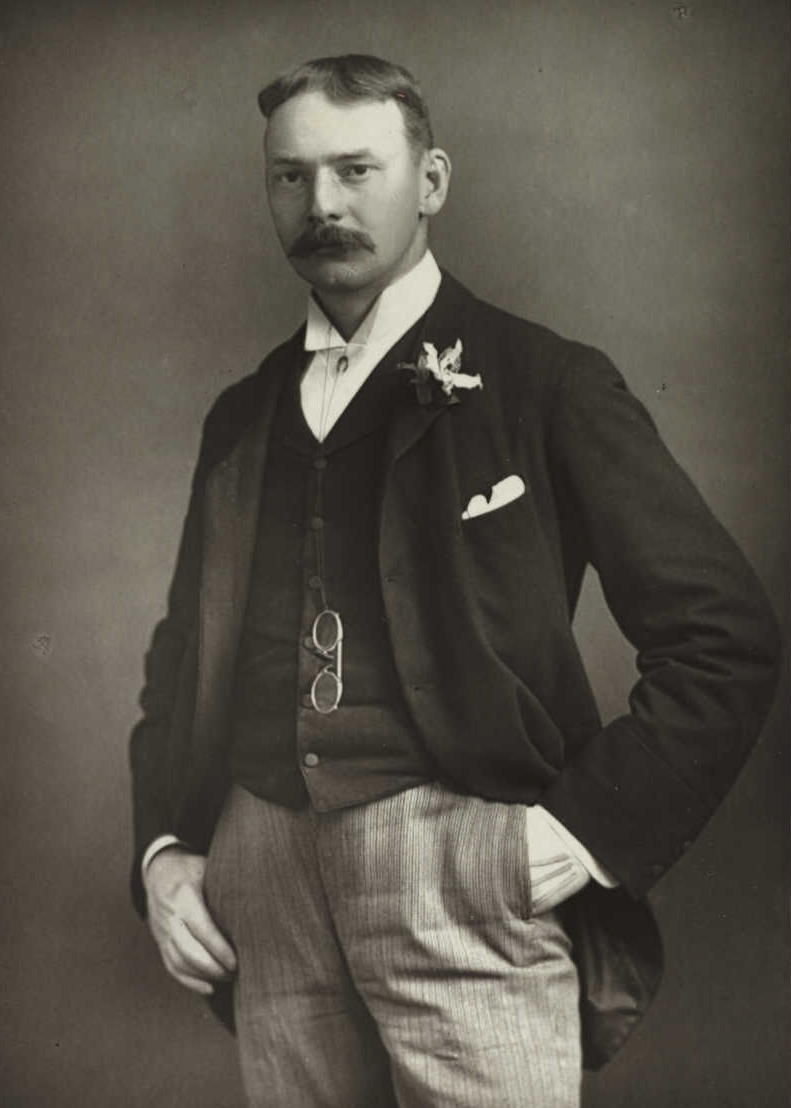
- Wikimedia Commons, “Jerome K. Jerome (7893553318).jpg” — William and Daniel Downey photograph from the National Media Museum collection, with provenance and publication context.