People often remember The Idiot by idea before they remember it by form: Prince Myshkin as innocence, Nastasya Filippovna as catastrophe, Rogozhin as dark double, and the whole book as Dostoevsky's impossible attempt to place a good man inside a corrupt society.[1][2][3] That memory is accurate as far as it goes, but it hides the novel's real engineering. The Idiot is not built like a straight ascent toward revelation. It is built as a sequence of arrivals, gatherings, and public tests that look as if they ought to resolve the plot, then instead scatter it into new embarrassment, pity, gossip, or panic.[1][2]
The opening already tells you what sort of machine you are entering. Dostoevsky begins "Towards the end of November, during a thaw" on a train coming into Petersburg, and before the chapter is over he has turned one third-class carriage into a compressed social map: illness, money, rank, curiosity, mockery, and sudden intimacy all arrive together.[1] The effect matters structurally. Myshkin does not conquer a world or master a mystery. He enters rooms where everyone is already talking, measuring, or misreading, and the novel keeps making him answer under pressure.
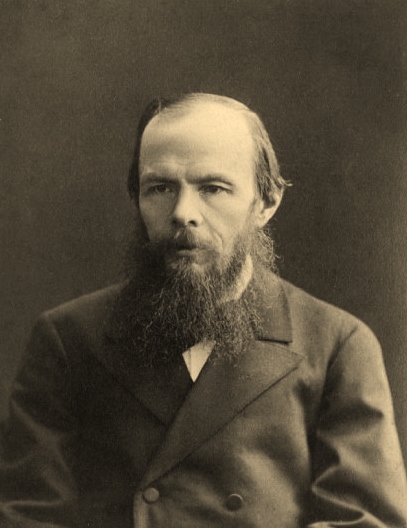
Image context: the lead image is an 1879 photographic portrait of Dostoevsky preserved on Wikimedia Commons. It works here because this essay reads The Idiot not as a vague "holy fool" legend but as a deliberate late-career experiment in how far exposure, interruption, and shame can organize a novel's movement.[3][5]
1. Part I works like a social detonation chamber
The first part is so concentrated that it can feel like a complete novella inside the novel's larger frame. In a short run of encounters, Myshkin moves from railway carriage to the Epanchins' house, to Gania's apartment, and finally to Nastasya Filippovna's name-day party.[1][2] Each room sharpens the same question: what happens when a man who insists on sincerity enters a society that treats conversation as ranking, flirtation, leverage, and pre-emptive cruelty?
Dostoevsky answers not by argument but by staging. The prince is examined, laughed at, recruited, pitied, and provoked before he has any stable place in the social field. Even his self-defense comes in the form of a structural signal: "I am not an idiot now."[1] The line matters less as wounded pride than as a key to the whole book's pacing. Myshkin can speak clearly, but he cannot control what kind of scene his clarity enters. By the time Part I reaches Nastasya's party, money, marriage, humiliation, and rescue fantasy are all in the room at once, and the novel proves that public spectacle, not inward contemplation, is its main accelerant.[1][2]
That is why Part I ends with such force. It does not close an argument; it blows the social arrangement apart. Rogozhin's money, Gania's ambition, Nastasya's self-exposure, and Myshkin's impossible offer of marriage all arrive in one theatrical knot.[1] Structurally, Dostoevsky has already shown his hand: the novel will keep bringing characters together under conditions that look climactic, then use the aftershock rather than the decision as its real material.
2. Parts II and III are built out of deferral, repetition, and public embarrassment
Readers sometimes experience the middle of The Idiot as baggy because they expect the plot to narrow after Part I. Dostoevsky does the opposite. Parts II and III keep reopening the field through letters, returns, rumors, promenades, explanations, and failed performances.[1][2] The book moves to Pavlovsk, but the change of setting does not simplify anything. It gives the novel more terraces, benches, drawing rooms, and public edges on which people can stage themselves badly.
This is where the form becomes especially visible. The middle books are not slack; they are recursive. A confession prompts an interruption. A proposal becomes a test. A family gathering becomes a duel of tones. Ippolit's long "Necessary Explanation" is typical not because it settles his character, but because it turns one more social event into a crisis of audience, pity, and self-display.[1] Dostoevsky keeps asking what happens when private torment is delivered as public performance and when the hearers cannot decide whether they are witnessing truth, vanity, illness, or manipulation.
Myshkin's role inside this structure is unusual. He is central, but he is not the usual kind of center. He does not impose order on the scenes; he receives their force. That is why the novel keeps pairing him with doubles and counterforces rather than giving him a governing plan. Rogozhin makes passion possessive, Aglaya makes idealization combative, and Nastasya turns self-condemnation into theater.[1][2] One of the useful things about later criticism of the novel is that it keeps returning to time, interruption, apocalypse, and unstable moral perspective rather than to neat plot design.[4] The book survives because its middle does not behave like filler. It behaves like pressure.
3. Part IV narrows the field and reveals what all the earlier crowding was for
After so many gatherings, Part IV feels cruelly simple. The talkative, overfull world of the earlier sections contracts around Rogozhin, Nastasya, and the prince.[1][2] That contraction is the payoff of the larger architecture. The novel has spent hundreds of pages teaching us that every social room in Petersburg and Pavlovsk misrecognizes goodness, turns feeling into spectacle, or mistakes pity for mastery. In the last movement, Dostoevsky strips away most of the audience and shows what remains when spectacle reaches its terminal form.
The ending is devastating precisely because it is so quiet. Rogozhin leads Myshkin into the darkened house, behind the curtain, and the novel converts all its previous noise into a death vigil.[1] Once that happens, the title returns with a structural cruelty that the opening had only announced. At the end, Schneider would look at the prince and cry, "An idiot!"[1] The phrase is no longer social insult or comic misunderstanding. It becomes the sign that Myshkin's compassion, exposed again and again to scenes built for rivalry and possession, has finally been broken by them.
This is why the ending should not be read as a detachable tragedy pasted onto a sprawling middle. It is the logical end of the book's repeated design. Every earlier party, visit, argument, and declaration has been training the novel to show that moral transparency does not master a theatrical society; it gets consumed by one.[1][2][4]
4. The best way to read the novel is by scene architecture, not by thesis alone
Dostoevsky's biography helps here. Britannica's summary of his life keeps returning to prison, debt, illness, public controversy, and the compression those forces put on his fiction.[3] The Idiot, published in 1868 and 1869, comes out of that late pressure.[1][2] The novel certainly wants to ask whether beauty, pity, or Christian love can survive modern social life. But it asks the question structurally, not abstractly. It keeps putting Myshkin into situations where timing, audience, money, class vanity, and wounded erotic pride will deform whatever pure intention he brings with him.[1][2]
So the most useful reading posture is architectural. Track the novel through its major rooms and thresholds: the train carriage, the Epanchins' drawing room, Gania's household, Nastasya's party, the Pavlovsk gatherings, Ippolit's performance, the last house on Gorokhovaya.[1] If you do that, The Idiot stops feeling like a famous problem novel with occasional brilliant scenes. It starts feeling like one of Dostoevsky's sharpest designs: a book that keeps postponing collapse in order to show how society itself manufactures the conditions of collapse.
That is why the novel still feels modern. It is not modern because Myshkin is an abstract saint for secular readers to admire from a distance. It is modern because Dostoevsky understands that the decisive pressure on a self may come from sequence, staging, and exposure: who is in the room, who is watching, who speaks first, who turns pain into spectacle, and how long goodness can survive once every feeling has acquired an audience.[1][2][4]
Sources
- Fyodor Dostoevsky, The Idiot (Project Gutenberg full text; cited for the four-part structure, opening train scene, and concluding vigil).
- Encyclopaedia Britannica, "The Idiot" (publication context, plot outline, and high-level account of Myshkin's role in the novel).
- Encyclopaedia Britannica, "Fyodor Dostoyevsky" summary page (biographical context on prison, debt, illness, and the pressures shaping the late novels).
- Northwestern University Press, Dostoevsky's "The Idiot": A Critical Companion (critical afterlife and the novel's continuing concerns with time, interruption, and moral perspective).
- Wikimedia Commons, "File:Dostoevsky 1879.jpg" (source page for the lead photographic portrait).