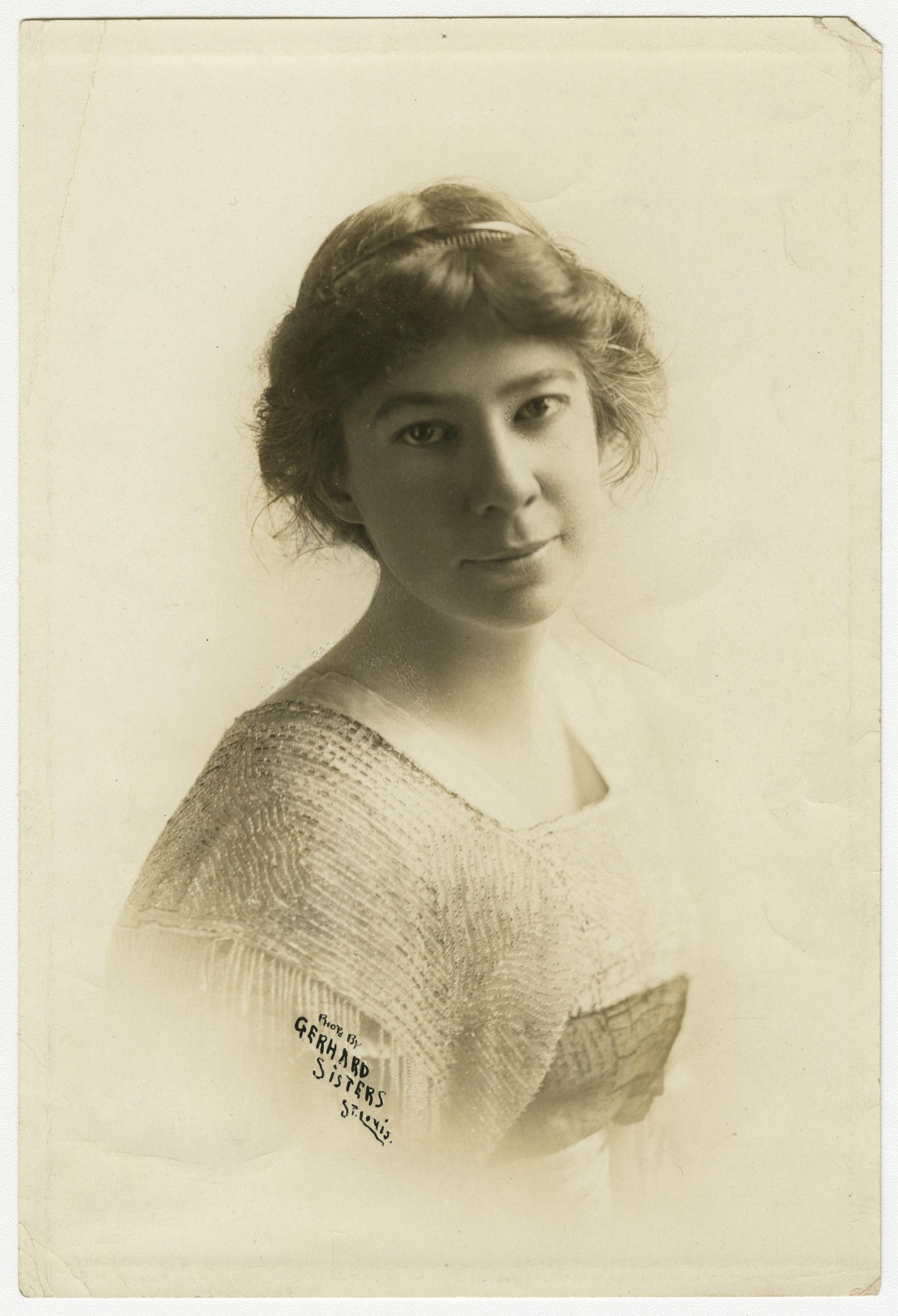
A beautiful evening can make unhappiness feel like bad manners. In Sara Teasdale’s “Spring Night,” a speaker stands among mist, lamplight, and shimmering water, surrounded by reasons to rejoice. She can describe every one of them. She cannot make herself satisfied. The poem’s discomfort lies in that gap: seeing clearly does not guarantee feeling as one ought.[3]
Teasdale made this a remarkably fertile problem. Her short, musical poems keep returning to beauty as something urgently needed, then testing how much it can give. Sometimes a moment of loveliness seems worth an entire troubled life. Sometimes a beautiful spring can unfold after people have disappeared. Read across these changes and her apparent simplicity becomes an exact way of staging incompatible desires.[3][4][5]
A poet among makers
Born in St. Louis in 1884, Teasdale grew up with the protections of a prosperous household and was educated at home until she was nine.[1] Yet an account of her working life should also leave the solitary room. In 1904 she joined the Potters, a circle of young women artists and writers encouraged by the teacher Lillie R. Ernst. Their handwritten, illustrated magazine, The Potter’s Wheel, brought poetry into company with photographs, plays, stories, and drawings. The Missouri Historical Society preserves material from this collaborative beginning.[2]
That context gives us a useful way to approach the finished lyrics: as things made for other people to encounter. Their ease of movement is an achievement of arrangement. A refrain can return with its emotional meaning altered; a rhyme can satisfy the ear while the sentence refuses reassurance.
Her first collection, Sonnets to Duse, and Other Poems, appeared in 1907. Rivers to the Sea followed in 1915, and Love Songs in 1917. The latter received the 1918 Columbia University poetry award that became the Pulitzer Prize for Poetry, as well as the Poetry Society of America’s prize. Teasdale’s command of traditional lyric forms brought substantial recognition during a period of formal experiment.[1]
The trouble with “should”
“Spring Night,” from Rivers to the Sea, begins by making its setting persuasive. The park’s lights are blurred and softened; reflections in the lake become gleaming blades. The scene is already being transformed by a responsive imagination. This speaker has no shortage of aesthetic feeling.[3]
Then the poem introduces an obligation: “My throat should ache with praise.” The bodily detail gives the thought its sting. Even gratitude is imagined as a feeling intense enough to hurt. The following line repeats the demand through another should, as though kneeling in joy were a duty she has neglected.[3]
The repeated question—“Oh, beauty, are you not enough?”—turns the landscape into someone who might answer. In the last stanza, phrases beginning I for whom briefly make the whole night seem arranged for the speaker. Yet the final question returns her to the desire for love. The lovely scene has neither vanished nor repaired her.[3]
I read the refrain as a small refusal of compulsory gratitude. Teasdale lets the speaker recognize abundance and remain unsatisfied. The poem’s pleasure depends on our feeling both things together.
The offer in “Barter”
“Barter,” near the beginning of Love Songs, sounds more certain. Its first two six-line stanzas open with the same announcement: “Life has loveliness to sell.” Waves, fire, children’s wonder, music, and affection accumulate like goods displayed within reach. The repeated opening gives the reader time to become accustomed to this generous seller.[4]
The third stanza changes the transaction. Description gives way to commands: spend, buy, count, give. By the last line, the price is “all you have been, or could be.” The grammar has moved from what life offers to what the reader must surrender. The future, as well as the past, becomes available for payment.[4]
This is exhilarating advice, and a severe bargain. A brief experience of peace can outweigh years of conflict; the poem asks us to accept that disproportion. Its regular stanzas make the proposition easy to carry away, while its closing demand remains enormous. Teasdale gives enthusiasm a finished shape without making its cost small.
Placed beside “Spring Night,” the confidence becomes more interesting. One lyric urges total commitment to loveliness; another gives the dissatisfied person a voice. Reading both allows their disagreement to remain audible.[3][4]
Spring carries on
Flame and Shadow appeared in 1920.[1] In its eighth section, “There Will Come Soft Rains” bears the subtitle “War Time.” The opening couplets attend to rain, swallows, frogs, blossom, and robins. Repeated consonants and paired rhymes make the scene feel busy with its own small sounds.[5]
Halfway through, the war enters as something these creatures will neither understand nor care about. The verse continues to rhyme. Teasdale does not break the song to announce catastrophe; its continuity is the disturbing discovery. The same formal pleasure that made the scene welcoming now makes human importance seem precarious.[5]
The conditional phrase “If mankind perished utterly” widens the absence beyond an individual lover or speaker. Spring is then personified, but personification supplies no sympathy. She would barely register the disappearance. Giving the season a human shape makes her lack of concern harder to evade.[5]
This is a wartime thought experiment, not a forecast. Its force comes from reversing the earlier poems’ arrangement. The person in “Spring Night” wants beauty to satisfy her; “Barter” asks a person to pay everything for it. Here the world can be beautiful without anyone left to need, admire, or purchase its pleasures. That possibility makes the poem’s soft sounds unsettling.[3][4][5]
No final settlement
It would be too tidy to turn these poems into a career-long march from hope to disillusion. Flame and Shadow itself opens with “Blue Squills,” where spring’s existence before and after the speaker produces a fierce wish to retain its beauty. The flower’s survival can sharpen desire as well as diminish human importance. Both responses belong to the same book.[5]
Teasdale continued publishing through Dark of the Moon and Stars To-night; her final collection, Strange Victory, appeared after her death in 1933.[1] The poems considered here offer a route into that larger body of work through its recurring questions. Listen for the small grammatical hinges: an obligation, a command, a condition. Each changes the relation between a person and the world she finds beautiful.
The misty park remains lovely when the speaker asks for more. The robin keeps singing when the poem imagines nobody left to hear. Teasdale’s music gives us time to stay with that difficult coexistence: beauty matters intensely to people, and its existence offers no assurance that people matter to it.[3][5]
Sources
- Academy of American Poets, “Sara Teasdale” — biography, publication chronology, and the awards for Love Songs.
- Missouri Historical Society Library and Research Center, Sara Teasdale Papers, A1605 — biographical sketch and the Potters’ collaborative magazine.
- Sara Teasdale, “Spring Night,” Rivers to the Sea (1915), Academy of American Poets — poem text and publication note.
- Sara Teasdale, Love Songs (1917), Project Gutenberg — primary text of “Barter,” especially its three stanzas and closing imperative.
- Sara Teasdale, Flame and Shadow (1920), Project Gutenberg — “Blue Squills” in section I and “There Will Come Soft Rains” in section VIII.
- Gerhard Sisters Studio, Photograph of Sara Teasdale, ca. 1917, Missouri Historical Society, A1605-00292 — archival photograph contributed through DPLA to Wikimedia Commons.