The famous sentence from A Room of One's Own can make the book sound simpler than it is. Woolf's argument is often reduced to a formula: money plus private space equals literary freedom. The formula matters. But the essay's lasting force comes from its structure, not only from its slogan. Woolf does not begin by announcing a thesis and defending it like a legal brief. She makes the reader move through thresholds: college grass, a locked library, meals, shelves, manuscripts, London streets, imaginary biographies, and finally the room that gives the essay its name.[1]
That movement is the book's form. A Room of One's Own began from lectures on women and fiction delivered at Cambridge women's colleges in 1928, then appeared as a Hogarth Press book in 1929.[2][3] Woolf turns that lecture occasion into a wandering first-person experiment. The speaker is never merely "Virginia Woolf" standing at a podium. She is a made narrator who tests what an argument can discover when it refuses to stand still.
This is why a form-and-structure reading is useful. The essay's politics are inseparable from its itinerary. Exclusion is not first explained as an abstract condition; it is staged as a bodily experience. A woman is told not to walk on the grass. She cannot enter a library without authorization. She eats differently in a men's college and a women's college. She reads histories in which women appear as symbols in literature but barely as agents in records.[1][2] The essay's architecture teaches the argument before the argument becomes quotable.
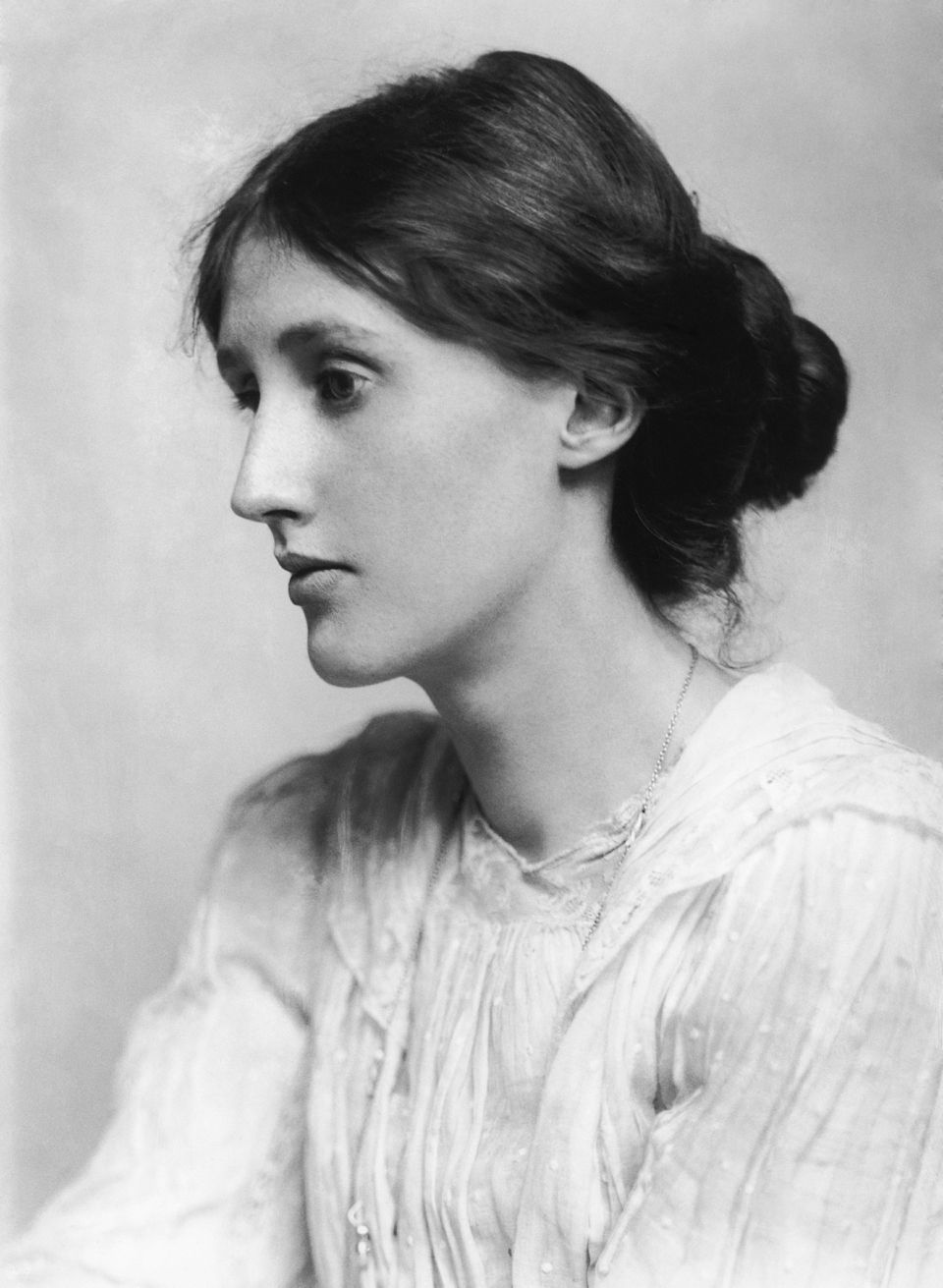
Image context: the portrait is not used as a decorative author icon. It anchors the piece in an archival photographic trace of Woolf while the article reads the essay's own architecture: how a writer builds an argument out of rooms, permission, interruption, and imagined company.[5]
The First Movement Is A Tour Of Permission
The opening pages are deceptively light. Woolf's narrator drifts near "Oxbridge," a fictionalized academic compound that lets Cambridge and Oxford stand together without becoming a narrow campus report.[1][2] She thinks, walks, and is interrupted. A beadle waves her off the grass. The library door becomes another boundary. These small incidents are structural, not anecdotal.
They make access visible. The narrator does not have to be imprisoned for the reader to feel the system. A path is available, then not available. A building exists, but the rule around it decides whether the mind may use it. The essay's early comedy depends on the tiny scale of the obstruction: a lawn, a door, a custom. Yet those tiny customs become the first proof that thought is never purely inward. It needs routes, rooms, time, food, and institutional permission.
The two meals sharpen the pattern. Woolf contrasts abundance at a men's college with the thinner meal available at a women's college, but the point is not culinary complaint. Food becomes infrastructure for thought. The body is not beneath the intellect; it is one of the conditions under which intellect either flourishes or pinches inward.[1][2] By making the reader sit through lunch and dinner before receiving the full thesis, Woolf builds material conditions into the essay's pacing.
That is the first formal lesson: the book makes deprivation spatial and sensory before it makes it theoretical. A gate, a table, a dish, a library rule, and an interrupted walk become part of one grammar. The reader learns that "women and fiction" is not only a matter of talent. It is a matter of arrangements.
The Middle Turns Research Into A Comedy Of Missing Records
The essay then changes rooms. The narrator goes to the British Museum reading room and looks for knowledge about women. What she finds is not absence alone but asymmetry: shelves of male opinion, confident theories, anger, classification, and a shortage of ordinary women's lives.[1][2] This is one of Woolf's most important structural moves. She does not simply say that history has ignored women. She dramatizes the act of searching inside an archive that speaks too loudly in the wrong voices.
The comedy is pointed. The narrator's reading becomes a kind of anti-research, a morning in which information multiplies but understanding does not. The pile of books proves that women have been discussed constantly, yet the discussion has often replaced knowledge. British Library scholar Rachel Bowlby stresses this breadth: Woolf ranges beyond literary criticism into education, sexuality, gendered value, and the everyday lives missing from serious inquiry.[2]
Structurally, this middle section clears space for invention. If the record will not provide enough evidence about women's creative lives, Woolf must show what that absence has cost. The invented figure of Shakespeare's sister is not a side tale; it is the essay's central experiment in historical imagination.[1][4] Judith Shakespeare gives narrative shape to a gap that the archive cannot fill. She is not proof in the ordinary sense. She is a disciplined counterfactual: a way of asking what equal genius would have become under unequal rules.
That invented biography is devastating because it sits between documentary failure and literary possibility. Woolf has shown the reader the shelves, then shown why shelves are not enough. Judith turns missing evidence into felt consequence. The essay's structure therefore moves from institution to archive to fiction, each stage revealing a different limit of access.
The Argument Keeps Changing Scale
One reason the essay still feels alive is that it refuses to stay at one scale. It moves from bodily comfort to legal exclusion, from college finance to literary form, from Shakespeare to Austen, from anonymous labor to the difficulty of writing women's friendship. The sentence "Chloe liked Olivia" matters because Woolf treats it as a tiny formal opening: a relationship between women represented for itself, not only as a route toward men.[1][2]
Yale's Modernism Lab frames the book as Woolf's most famous work of feminist literary criticism and emphasizes two later-facing concerns: recovering a female tradition of writing and questioning gender difference.[4] The structure bears that out. Woolf does not merely add women writers to an existing shelf. She asks what kind of shelf, sentence, room, and value system would let them appear differently.
That is why the essay's discussion of androgyny, tradition, and style can feel surprising if one expects only a demand for material support. The demand remains firm. The Morgan Library's first-edition record notes the Hogarth Press publication date, the first English edition, and the modest print run of 3,040 copies.[3] Yet inside that compact book, Woolf lets the argument widen. Money and a room are not the end of criticism; they are the conditions under which criticism and fiction can stop being cramped by fear, anger, flattery, and dependence.
The essay's scale shifts are also ethical. Woolf wants readers to notice unknown women behind counters, women in houses, women absent from histories, women writers who wrote under pressure, and future women who may write otherwise.[1][2] The book's architecture keeps expanding the room until it is both literal and social.
The Ending Is Not A Slogan But An Assignment
The closing movement returns to the title's formula, but by then it has changed. The reader has passed through enough blocked spaces to understand why a room is not just a room. It is privacy, continuity, permission, and the ability to leave a page on a desk without having to hide it.[1] The annual income is not luxury as ornament; it is protection from intellectual interruption.
Woolf's final tone is therefore stranger than simple triumph. She does not claim that the room will automatically produce genius. She claims that without material freedom, the question of genius has been rigged before it begins. The structure of the essay has made that claim hard to dismiss because the reader has watched every stage of the rigging: education, money, archive, family expectation, literary value, social permission, and sentence form.
The ending also turns outward. The room is private, but the assignment is collective. Future writing depends on women who can work, inherit, revise, contradict, and speak without shrinking the page to fit someone else's comfort. The famous room is not a retreat from the world. It is a base from which a different relation to the world becomes possible.
That is the real structure of A Room of One's Own: a thought walks until it discovers the conditions under which walking, thinking, reading, and writing might belong to it. The door opens only at the end because Woolf has made us feel every earlier door that did not.
Sources
- Virginia Woolf, A Room of One's Own (Wikisource validated transcription of the 1929 Hogarth Press edition used for close reading).
- Rachel Bowlby, "Virginia Woolf's A Room of One's Own." British Library Discovering Literature, contextual essay on the work's feminist criticism, material support argument, and range beyond "women and fiction."
- The Morgan Library & Museum, "A room of one's own / Virginia Woolf" - catalog record for the 1929 Hogarth Press first English edition and publication details.
- Pericles Lewis, "A Room of One's Own." Yale Modernism Lab, overview of Woolf's feminist literary criticism, Judith Shakespeare, female tradition, and gender difference.
- Wikimedia Commons, "File:George Charles Beresford - Virginia Woolf in 1902 - Restoration.jpg" - archival photographic portrait used as the article image source.