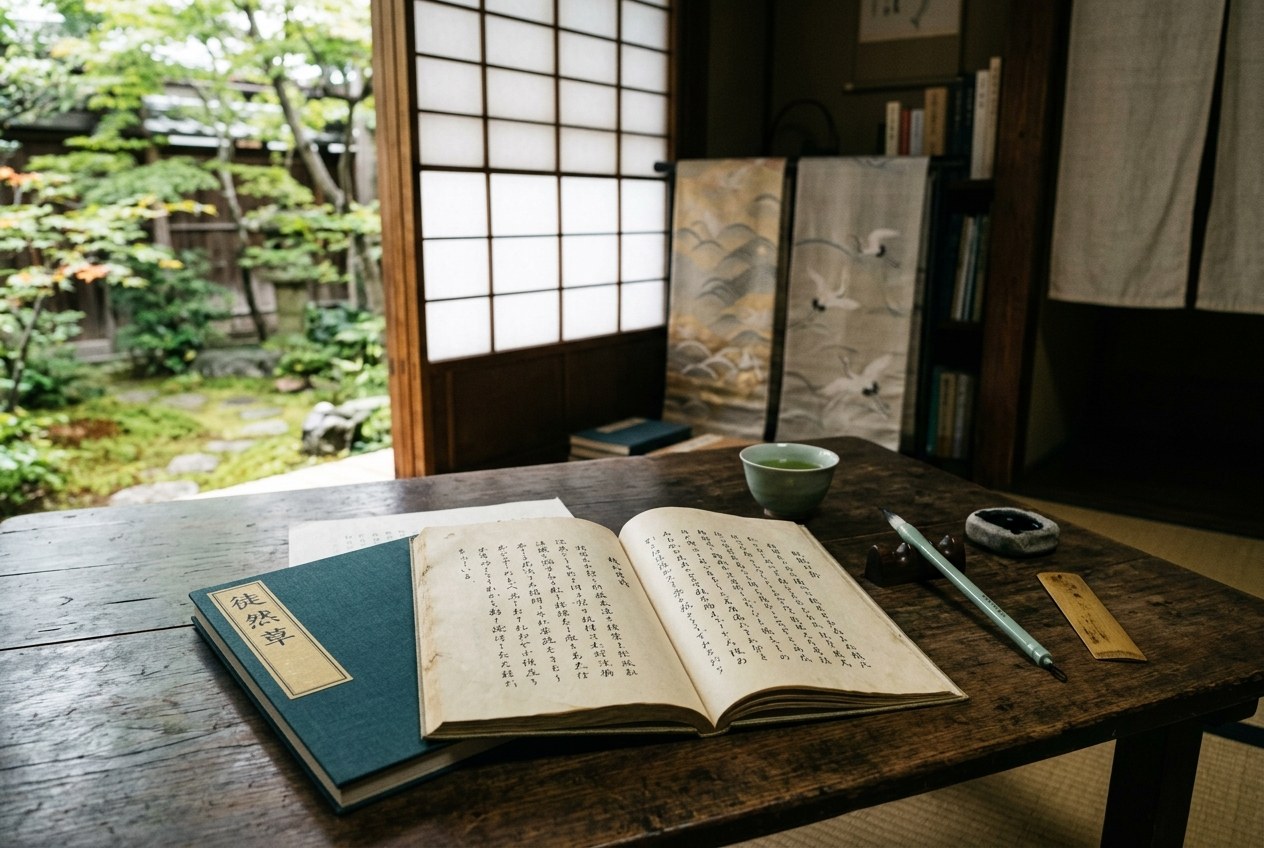
The easiest way to underestimate The Pillow Book and Essays in Idleness is to call them notebooks and then hear only looseness. Both books belong to the Japanese zuihitsu tradition, often rendered as miscellany or "random jottings," but randomness is the wrong emphasis. What looks like drift is a disciplined way of catching experience before it hardens into argument. Sei Shonagon writes from the late Heian court around the year 1000; Kenko writes in the early fourteenth century, after aristocratic court culture has lost much of its political centrality.[2][3] Between them, the form changes temperature.
Shonagon's fragments are quick, social, and cuttingly present-tense. Kenko's are quieter and more openly haunted. Put together, the two books show zuihitsu doing opposite kinds of work with the same basic tools: list, anecdote, aside, remembered scene, aesthetic judgment. Shonagon makes attention sparkle under pressure. Kenko makes attention feel answerable to disappearance.
Lists As Social Instruments
In The Pillow Book, a list is not a private filing system. It is a social instrument. Shonagon's headings can sound disarmingly simple: "Things that certainly won't come" or "Things that make a Bad Impression."[1] The pleasure lies in how fast a category becomes a theater. A title opens, and suddenly etiquette, timing, taste, rivalry, embarrassment, and flirtation are all moving inside it.
That speed matters. Britannica notes that the entries in Makura no soshi are not organized chronologically but under headings such as amusing or vexatious things, and that the book is a major zuihitsu example.[3] Shonagon's order is therefore not the order of diary time. It is the order of sharp recognition. She groups life by the feeling or judgment it produces, which lets small incidents become repeatable social knowledge.
This is why the famous charge that Shonagon is merely snobbish misses the craft. She can be snobbish, and often deliciously so, but the snobbery is part of a larger literary intelligence. At court, value is made through surfaces: paper, sleeves, poems, handwriting, timing, titles, glimpsed rooms, and the ability to answer with the right line at the right moment. Her lists are not escapes from that world. They are instruments for surviving and mastering it. They teach the reader how courtly attention sorts the visible world into delight, irritation, shame, and prestige.
Fragments After The Party
Kenko inherits the same permission to move by fragment, but the mood has altered. Columbia's Asia for Educators page frames Essays in Idleness as a work written around 1330 by a former courtier and Buddhist monk in an age of warfare and social change, with aristocratic culture losing its old central place.[2] Google Books' bibliographic page similarly presents Kenko's essays as brief, congenial, anecdotal pieces suffused with Buddhist acceptance and a principle that beauty is tied to perishability.[4]
That context changes what a stray note can do. Shonagon's fragment often feels like a bright social event preserved at the instant of perception. Kenko's fragment often feels like a rescued remnant. His best-known aesthetic claim in the Columbia excerpt is brutally compact: "Truly the beauty of life is its uncertainty."[2] The sentence turns incompletion from a defect into a condition of beauty. The flower matters not because it stays, but because it goes.
This is the crucial difference. Shonagon's categories sharpen presence; Kenko's categories expose transience. When he praises rain-hidden moons or "gardens strewn with withered blossoms," he is not simply preferring melancholy scenery.[2] He is arguing that perception deepens when possession fails. A perfect view can be consumed. A partial view asks the mind to complete, remember, and relinquish.
The Same Form, Different Ethics
The comparison becomes clearest if we ask what each writer thinks attention is for. In Shonagon, attention is a form of rank, wit, and self-command. To notice well is to belong more brilliantly to a difficult world. A poorly timed letter, an ugly object in an elegant setting, a failure of poetic tact: these are not minor because court life itself is built from minor signs. Her book often feels like a manual of social perception disguised as personal preference.[1][3]
In Kenko, attention becomes a spiritual and aesthetic practice. He is not indifferent to taste; he can be exacting about houses, gardens, rooms, and conduct. But his judgments keep bending toward impermanence. The house is pleasing partly because it remembers that the world is temporary. The moon is moving partly because clouds or longing interrupt it. The incomplete thing releases more feeling than the finished display.[2][4]
That does not make Kenko deeper and Shonagon shallower. It makes the pair more interesting. Shonagon is the writer of instant discrimination; Kenko is the writer of delayed recognition. She shows how an experience flashes into value inside a living court culture. He shows how value changes when the culture that taught discrimination has itself become vulnerable to memory, war, and religious reflection.
Why Translation Pages Matter Here
The modern reader usually meets both books through translation, and that fact should make us cautious. Open Library's record for Waley's Pillow-Book and Tuttle's page for Keene's Essays in Idleness remind us that these works arrive through editorial choices, publication histories, and different English ideas of fragmentary prose.[5][6] A translated zuihitsu is never just a transparent window. It is also a made reading order.
That is especially important with Shonagon because the book itself is not a single smooth memoir. Waley's Project Gutenberg text is explicitly a selected translation from 1928, and the preliminary notes say he translated about a quarter of the work.[1] The reader is therefore already encountering Shonagon through selection. Yet even in selection, the energy of the form remains visible: the headings, the sudden social miniature, the confidence that taste can be a mode of thought.
Kenko presents a different translation problem. His prose is often quoted for aphoristic wisdom, which can make him sound like a treasury of detachable sayings. But Essays in Idleness works best when its aphorisms stay attached to mood, occasion, and setting.[2][4] The fragment is not a fortune-cookie unit. It is a small pressure chamber where Buddhist impermanence, courtly memory, and practical taste briefly occupy the same space.
Reading Them Together
Read side by side, the books make zuihitsu feel less like a genre of casualness than a technology of attention. Shonagon proves that the passing moment can be made brilliant by exact social naming. Kenko proves that the passing moment can be made profound by refusing to pretend it will last. Both writers distrust heavy architecture. Neither needs a plotted novel or systematic treatise to make a world.
The difference is in what the world asks of the writer. Shonagon's world asks for presence: be quick, be precise, know what is graceful, know what is ridiculous, and do not miss the human comedy of a bad sleeve, a delayed messenger, or an elegant reply. Kenko's world asks for relinquishment: look hard, but understand that the looking itself is shaped by loss. His fragments are not less worldly than hers; they are worldly under the sign of vanishing.
That is why these books still feel modern. They understand that thought often arrives before it has a thesis. A list, a complaint, a room, a blossom after rain, an overheard embarrassment: each can hold more truth than a finished argument if the writer knows how to place it. Shonagon and Kenko do not make stray notes respectable by turning them into essays in the modern schoolroom sense. They make stray notes necessary by showing that consciousness itself often moves by glints, interruptions, and returns.
Their shared lesson is simple and severe: attention is never neutral. In The Pillow Book, it preserves the living voltage of a courtly present. In Essays in Idleness, it discovers beauty where permanence has already failed. One book teaches the pleasure of noticing before the moment slips away. The other teaches that the slipping away may be the reason the moment was beautiful at all.
Sources
- Sei Shonagon, The Pillow-Book of Sei Shonagon, translated by Arthur Waley. Project Gutenberg HTML edition, 2025 release of the 1928 publication.
- Columbia University Asia for Educators, "Kenko's Essays in Idleness" (context and excerpts from Donald Keene's anthology translation).
- Encyclopaedia Britannica, "Pillow Book" (overview of Makura no soshi, zuihitsu form, and relation to Kenko's Tsurezuregusa).
- Google Books, Essays in Idleness: The Tsurezuregusa of Kenko (bibliographic page for Donald Keene's translation, with publisher summary).
- Open Library, The Pillow-book of Sei Shonagon, translated by Arthur Waley (bibliographic record for the 1928 edition).
- Tuttle Publishing, Essays in Idleness by Kenko Yoshida, translated by Donald Keene (publisher PDF description).