Most “which Odyssey translation should I read?” advice still collapses into a soft binary—faithful versus readable—as if form, ethics, and narrative pressure were separable knobs. They are not. What your translation does in its first ten lines already defines how it will treat agency, violence, class language, and pace for the next three hundred pages. A useful selection method is to compare opening strategy first, then choose by reading purpose.
This guide uses one high-leverage test zone: Book 1’s invocation and early line-shaping, with supporting notes from major reviews and translator statements.[1][2][3][4]
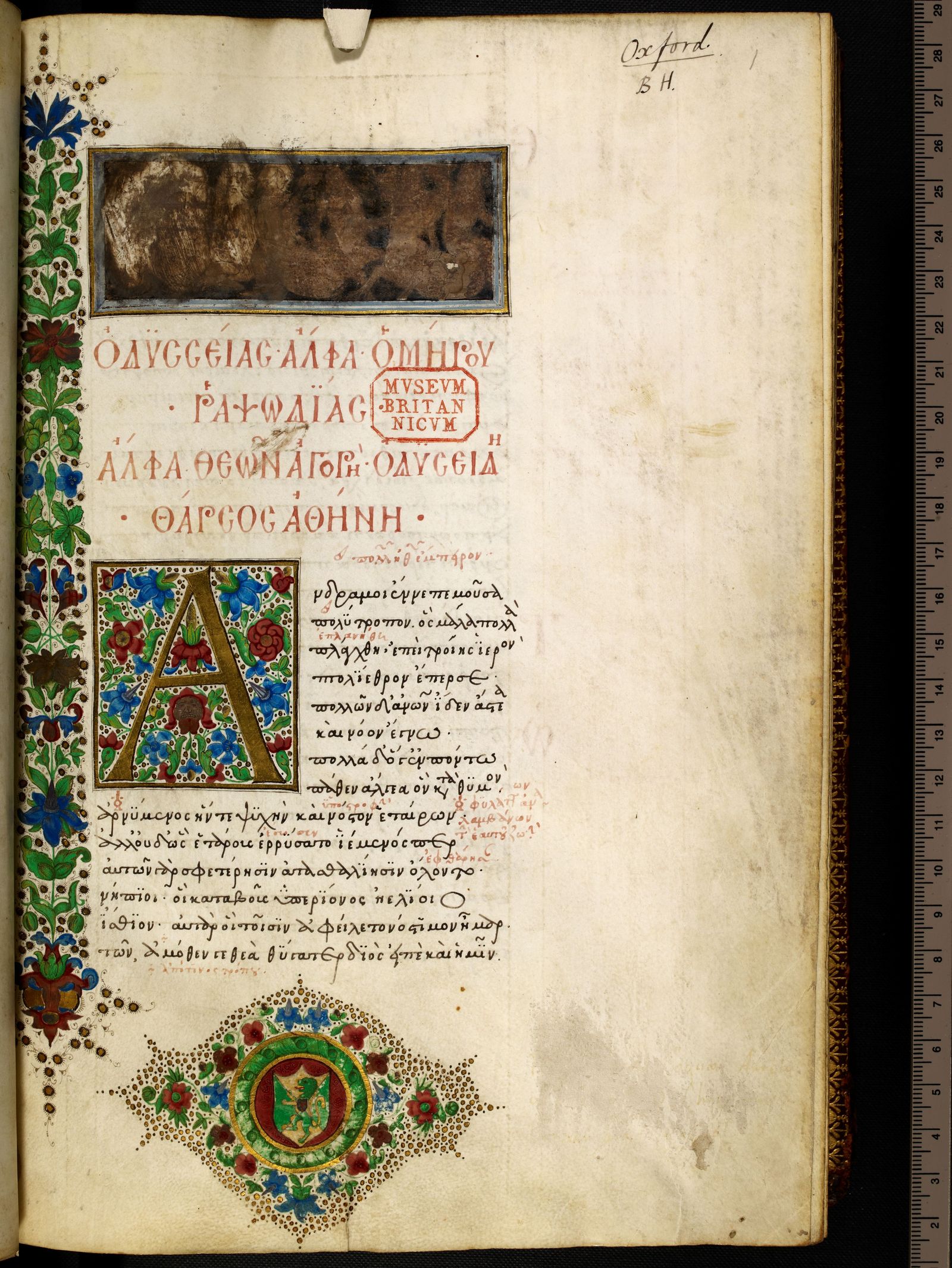
Image context: a historical Odyssey manuscript folio, included to foreground the transmission problem every modern English version is solving in a different way.
1) Opening line as contract: what each translator promises
The first move in Homer is compact and dangerous: announce a protagonist whose identity is inseparable from turning, shifting, and surviving through indirection. Different translators solve that compactness with different reader contracts.
A widely cited comparison from Bryn Mawr Classical Review shows how Robert Fagles and Richmond Lattimore weight this opening field differently.[2]
- Fagles opens with propulsion and idiomatic force: “the man of twists and turns,” then keeps momentum with variable line lengths.
- Lattimore opens with structural fidelity: “the man of many ways,” retaining a six-beat cadence and a line-for-line discipline that preserves repeated formula texture.
The practical implication is immediate. Fagles sells velocity and dramatic readability; Lattimore preserves a stronger feeling of inherited oral architecture. If a reader wants to feel how formulas recur and accumulate, Lattimore’s recurrence density matters. If a reader wants narrative pull with modern poetic lift, Fagles often wins the room.
2) Wilson’s intervention: clarity plus ethical lexicon control
Emily Wilson’s version changes the selection problem because she does not only adjust rhythm; she also adjusts moral vocabulary. In critical reception and interviews, two claims recur: line-count discipline and plain-register precision.[1][3][4]
Reviewers repeatedly note that Wilson preserves overall line-count constraints while using iambic pentameter and contemporary syntax.[1][4] But the sharper editorial point is lexical ethics: where older translations sometimes choose elevated euphemism, Wilson often chooses social specificity (for example, preferring terms that foreground enslavement rather than domestic gentility in servant language debates).[3][4]
That choice is not a cosmetic modernization pass. It changes reader alignment inside scenes of punishment, command, and household order. Once diction stops cushioning hierarchy, Odyssean “homecoming” feels less like pure restoration and more like contested power management.
3) Why the old “fidelity vs readability” frame misses the real decision
The older argument assumes a single axis: literalness on one end, smoothness on the other. The evidence suggests at least three separate axes:
- Prosodic strategy — strict six-beat/hexameter echo, variable modern long line, or pentameter regularity.[1][2]
- Formula handling — how aggressively repeated epithets and structures are retained versus redistributed for English flow.[2][5]
- Ethical register — whether class and gendered terms are elevated, neutralized, or made explicit in present-day English.[3][4]
Once you separate these axes, translation choice becomes tractable. You are not asking “best Odyssey overall.” You are selecting which distortions you are willing to accept for your purpose.
4) A use-case map that actually works
A) First complete read for narrative immersion
Pick Wilson or Fagles depending on your tolerance for rhetorical flourish.
- Choose Wilson if you want speed, syntactic transparency, and lower archaic drag.[1][3]
- Choose Fagles if you want a larger, performative voice and elastic dramatic cadence.[2]
B) Close study of Homeric formula and recurrence
Start with Lattimore, then cross-check selective books with Wilson.
- Lattimore keeps a stronger signal of repeated structures and traditional phrase-work, which helps classroom annotation and motif tracking.[2][5]
- Wilson as a secondary pass can reveal where “accuracy” and “interpretive pressure” diverge in modern diction choices.[1][4]
C) Seminar discussion on translation ethics (gender, class, violence)
Use Wilson + one earlier comparator (Fagles or Fitzgerald).
- The contrast makes lexical ideology visible without requiring Greek at the outset.[2][3][4]
5) A concrete way to compare before committing
Read the same three passages in two translations before you pick a full edition:
- Book 1 invocation (identity and tempo contract)
- A recognition scene (intimacy, restraint, and emotional syntax)
- The hanging/aftermath sequence in Book 22 (ethical lexicon stress test)
Score each passage on three dimensions: pulse (can you hear narrative motion), precision (can you track agency cleanly), and pressure (does the language keep moral friction visible). The version with the most stable score profile for your goal is your translation.
6) Bottom line for 2026 readers
The question is no longer “Which translation is correct?” The useful question is “Which reading contract do I need for this pass?”
- If you want oral-structure signal and recurrence discipline, begin with Lattimore.
- If you want high-energy Anglophone epic voice, begin with Fagles.
- If you want contemporary clarity plus explicit social vocabulary choices, begin with Wilson.
For most readers doing a serious first encounter in 2026, the best workflow is staged: Wilson (full read) → Lattimore (selected books) → Fagles (performance-check passages). That sequence gives you narrative entry, structural depth, and rhetorical breadth without pretending one English solution can carry every Homeric function at once.
Sources
- Emily Wilson, The Odyssey page (edition notes, meter framing, review links)
- Bryn Mawr Classical Review (1997), review of Robert Fagles translation with opening-line comparisons to Fitzgerald and Lattimore
- NPR (2017), “Emily Wilson's 'Odyssey' Scrapes The Barnacles Off Homer's Hull”
- Bryn Mawr Classical Review (2018), review of Wilson translation and diction/interpretation discussion
- Wikipedia, “Odyssey (Richmond Lattimore translation)” (publication and style summary with references)
- Wikipedia, “Odyssey (Robert Fagles translation)” (publication context)
- Image source (Wikimedia Commons, Odyssey manuscript)