
Octavia Butler is often praised now for having seemed ahead of time. That praise is understandable, especially when readers return to Parable of the Sower and find climate stress, gated insecurity, predatory politics, and religious invention arranged with unnerving clarity.[4] But the sharper way to read Butler is not as a prophet. It is to watch how she turns genre into a chamber where social facts cannot stay abstract. Race, sex, class, disability, dependence, appetite, fear, labor, and power all have to become conditions of a body under pressure.[2][3]
That is why this interview, circulated as "Octavia Butler interview - transcending barriers," is worth an annotated viewing. It is not a polished keynote with a single quotable thesis. It is a conversation in which Butler repeatedly lowers grand claims back into craft: who gets imagined, what a reader is forced to feel, why science fiction gave her room, and how much work sits behind a story that later feels inevitable.[1][2]
The context matters. Butler was born in Pasadena in 1947, published Patternmaster in 1976, made Kindred a time-travel slavery novel in 1979, and by the 1990s had written the Parable books that now feel almost too available to the present.[2][3][4] Britannica notes the key public markers: Hugo recognition for "Speech Sounds," Hugo and Nebula recognition for "Bloodchild," the 1995 MacArthur fellowship, and the 2000 PEN lifetime achievement award.[5] Yet the official author biography also emphasizes decades of obscurity, early morning writing, and day jobs before the later canonization.[2] The interview is valuable because it keeps both facts in view: the public achievement and the stubborn private discipline.
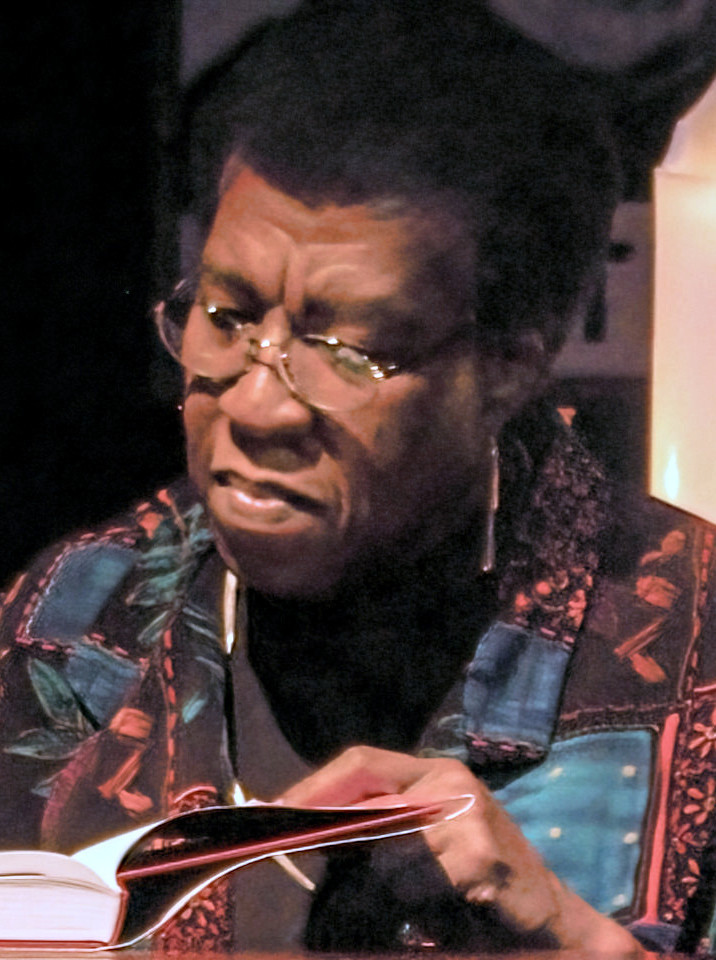
Image context: the static image is a documentary photograph, not an illustration or diagram. Butler is shown signing after an event, which is exactly the public-facing edge of the literary life discussed here: books move through rooms, readers, questions, and institutions after years of solitary drafting.[6]
Genre Becomes a Permission Structure
One of the interview's strongest lessons is that science fiction offered Butler a permission structure, not a hiding place. The point was not to leave history behind. The point was to make history strange enough that a reader could not rely on inherited habits. That is visible in Kindred, where the speculative device is brutally simple: Dana is pulled from 1970s California into the antebellum South, and the distance between modern selfhood and slavery collapses into immediate danger.[3]
The official Kindred page describes the novel as a story that crosses racial and gender divides while confronting slavery's ongoing impact on the present.[3] The interview helps explain why that crossing is not just a premise. Butler's method is to remove the reader's comfortable separation from the problem. Time travel is not spectacle; it is coercive contact. Dana cannot analyze slavery from a safe century. She has to survive it, negotiate it, fear it, and recognize how her own future is entangled with people who can harm her.
That move clarifies Butler's larger literary importance. She uses the furniture of genre to make moral distance fail. Alien encounter, post-apocalyptic travel, telepathy, bodily dependency, and time displacement are all forms of pressure. They make social arrangements felt as vulnerability rather than opinion. This is why the interview's craft talk matters more than any prediction game built around Butler's plots.
Barriers Are Material, Not Decorative
The interview title foregrounds barriers, and the word is apt because Butler's fiction rarely treats exclusion as a symbolic background. Barriers become literal architecture, labor patterns, genre expectations, publishing expectations, bodily limits, and readerly assumptions.[1][2] Her official biography notes that her dystopian novels were not commercially easy in the decades when she was writing them, precisely because they centered Black injustice, global warming, women's rights, and political disparity before those concerns became marketable shorthand.[2]
The best annotation to carry through the video is this: listen for how often Butler turns a cultural problem into a formal problem. If readers have been trained not to expect Black women at the center of speculative futures, then character design is not neutral. If genre has been treated as a field of conquest, gadgets, and heroic abstraction, then a novel organized around dependence or unwanted intimacy changes the grammar of the field. If a reader thinks the future is remote, Butler's plots make the future arrive through water, work, hunger, sex, migration, and family.
That is also why her prose can look plainer than its effects. Butler's sentences often refuse decorative fog. They make conditions legible, then let the situation tighten. In Parable of the Sower, Lauren Olamina's hyperempathy is not merely an interesting trait; it converts social violence into an involuntary bodily event.[4] In Kindred, Dana's repeated returns make historical knowledge insufficient unless it becomes practical endurance.[3] The interview's calm tone can make this method easy to miss. Butler is not making genre respectable by sanding off its extremity. She is making extremity ethically exact.
Change Is Not Consolation
The familiar Earthseed formulation "God is Change" can be misread as uplift. In Butler's work, change is not automatically progress, justice, or healing. It is the condition under which every character must act. The official Parable page frames Lauren's story as both a fight for survival and the birth of a new faith amid climate, economic, and social breakdown.[4] That combination is crucial. Belief does not arrive after safety. It is improvised under threat.
The interview makes that point indirectly by refusing the fantasy that imagination is soft. Butler's imagined worlds are often harsh because they test what people will trade for survival. The Parable books are not powerful because they predicted isolated details of the 2020s. They are powerful because they understand the chain by which ordinary vulnerability becomes political material: water scarcity, debt, policing, drugs, fire, walls, charismatic authority, and the collapse of public trust.[4][5]
That is the line between prediction and literary design. Prediction asks whether the writer guessed right. Literary design asks how the book trains attention. Butler trains attention toward feedback loops: fear produces walls, walls produce abandonment, abandonment produces movement, movement produces new communities, new communities produce new coercions and hopes. The result is not a single warning but a way of reading crisis as a system of pressures.
The Work Behind the Voice
The last reason to watch the interview closely is that Butler's public composure sits on top of a long apprenticeship in discipline. Her official biography notes the years when she wrote before work and then took jobs such as telemarketer, potato chip inspector, and dishwasher.[2] That labor history matters because the interview can otherwise sound deceptively effortless. Butler speaks with the economy of someone who has already done a long private argument with herself.
For readers, the practical lesson is to stop treating Butler as a writer who simply had the right themes. Themes do not make Kindred work. Themes do not make Lauren Olamina's journal form feel credible. Themes do not explain why Butler's alien and post-apocalyptic situations keep returning to consent, dependence, reproduction, coercion, appetite, pedagogy, and community. The achievement is structural: she builds worlds where an idea has consequences for bodies, and bodies force ideas to reveal their cost.
That is what this video preserves. It gives us Butler not as a monument but as a working literary intelligence: careful, unsentimental, funny in flashes, and alert to the fact that imagination is only serious when it changes what a reader can no longer ignore.[1][2]
Sources
- Fast Forward: Contemporary Science Fiction, "Octavia Butler interview - transcending barriers," YouTube video.
- Octavia E. Butler Estate, "The Author" (official biography and awards overview).
- Octavia E. Butler Estate, Kindred official book page.
- Octavia E. Butler Estate, "The Parable Series" official book page.
- Encyclopaedia Britannica, "Octavia E. Butler" (biographical and works overview, updated April 30, 2026).
- Wikimedia Commons, "File:Butler signing portrait.jpg" (real photograph of Octavia Butler signing, source for article image).