Moll Flanders is one of those characters readers can misremember as pure motion: a woman born in Newgate, passed through households, marriages, schemes, thefts, prison, transportation, wealth, and penitence. The title itself encourages that breathless outline, while Broadview's edition page places the 1722 novel beside criminal biography, women, crime, prisons, and Virginia.[2] But the liveliest thing in Moll Flanders is not the event count. It is the accounting mind underneath the events.
Defoe builds Moll as a character who learns early that survival is never only emotional. It has prices, inventories, names, rooms, clothes, routes, witnesses, and timing.[1] She does not simply want to live. She wants to live in a form that can pass as security, then gentility, then respectability, then finally repentance. That sequence is what makes her more interesting than a stock rogue. Moll can be funny, alarming, calculating, pitiable, self-protective, and spiritually evasive in the same paragraph. She is not a hypocrite because she feels nothing. She is dangerous because she feels and counts at once.
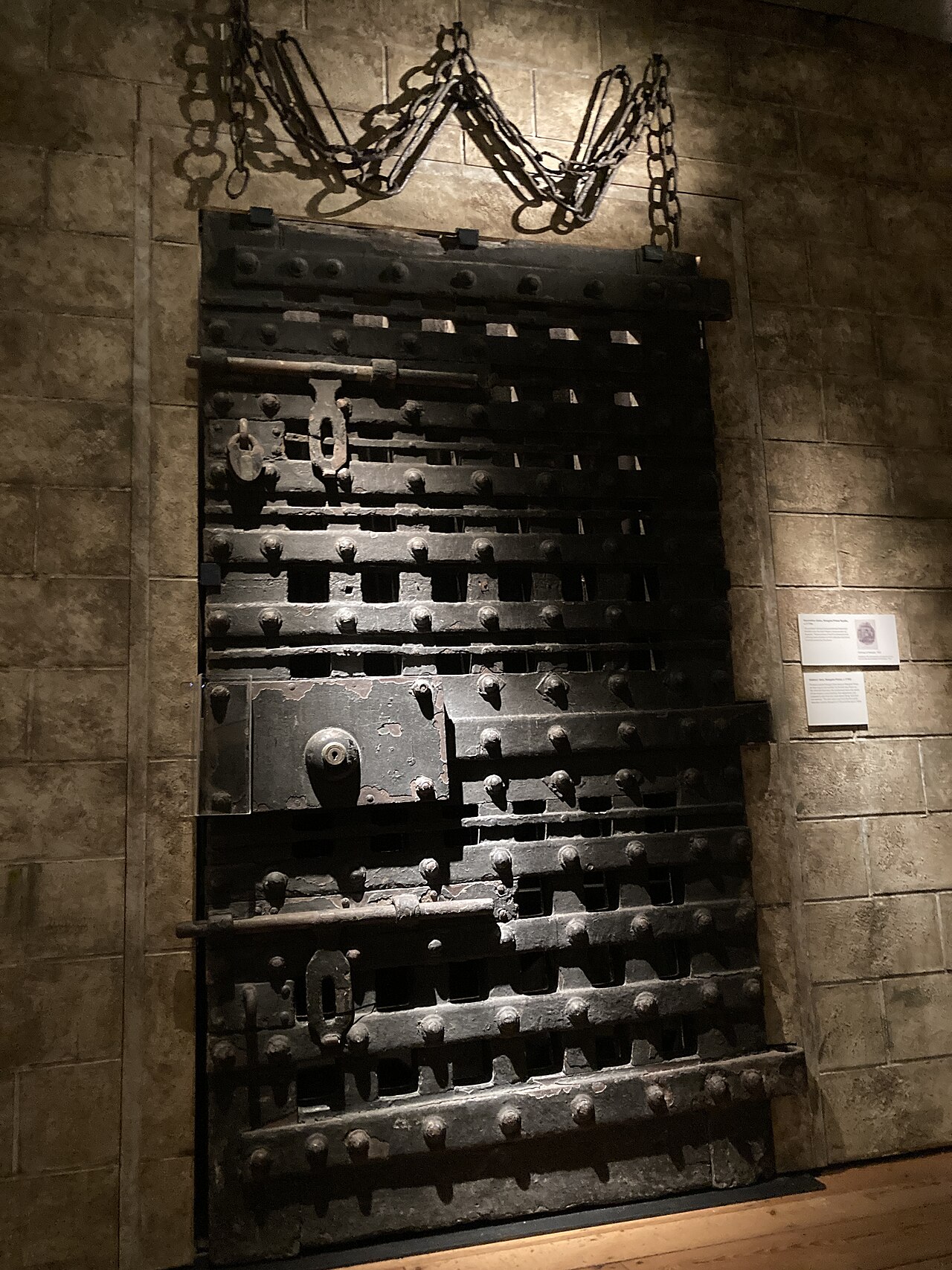
Image context: the cover uses the photographed Newgate door rather than a generic book cover. That keeps the essay close to the novel's pressure system. Moll's life begins under the sign of prison, and Defoe keeps returning her to institutions and thresholds where identity is decided by who can name, confine, buy, marry, expose, transport, or forgive her.[3][4]
1) Moll's first fantasy is not romance but status made durable
The childhood wish to become "a gentlewoman" is one of the novel's smallest and sharpest character keys.[1] It sounds naive only if we treat gentility as decoration. For Moll, the word means exemption from being handled by others. She wants not elegance in the abstract but a position from which labor, sexual vulnerability, and dependence will not keep pushing her downward.
That is why Defoe's long first-person form matters. The novel does not give us a neat moral diagram from outside. It gives us a narrator continually translating experience into usable lessons.[1][3] In the early household scenes, Moll is not yet a mature strategist, but she is already learning that affection, service, money, and sexual attention are entangled. The brothers who notice her do not enter a world of innocent courtship. They enter a world where a young woman without property must read every offer as both promise and threat.[1]
Broadview's edition page is useful here because it stresses the novel's relation to criminal biography, Defoe's wider writings, and contemporary materials on women, crime, prisons, and Virginia.[3] Moll belongs to that crowded social world. Her character is formed not by one fall from innocence but by repeated training in how institutions price a woman with few protections. Her genius is adaptive. Her moral problem is that adaptation becomes almost indistinguishable from identity.
2) Marriage teaches her to read intimacy as a balance sheet
The most modern thing about Moll is how unsentimentally she understands marriage as an economic instrument, even when she wants emotional shelter too. Her husbands are not simply a comic sequence. They are tests of how much security a woman can extract from a system that formally honors marriage while materially exposing wives to male debt, disappearance, family secrecy, and social suspicion.[1][2]
This is where Moll's character gets hard to judge cleanly. She deceives, but she is also repeatedly forced to negotiate inside arrangements built by other people's concealments. The Virginia marriage, with its discovery of incestuous kinship, is melodramatic in outline but practical in effect: the domestic refuge she had counted on becomes another account that cannot be reconciled.[1] Defoe keeps making her recalculate after every apparent settlement.
That habit of recalculation is the book's character engine. Moll does not only ask, "Was I wrong?" More often, she asks what can still be preserved after wrong, bad luck, or exposure has arrived. Money becomes emotional weather. A banked sum changes the texture of a sentence. A missing sum changes the future. Even when Moll speaks of conscience, she often speaks near figures, goods, inheritances, and the mechanics of getting from one circumstance to another.[1]
The result is not a shallow character. It is a character whose depth has been trained in the wrong medium. Moll is intensely attentive, but attention keeps becoming inventory. She notices people as possible helpers, lovers, marks, rivals, informants, and exits. That does not make her inhuman. It makes her a person whose social world has taught her that unpriced feeling is rarely safe.
3) Theft releases the intelligence that respectability had tried to domesticate
The theft chapters can feel like a different book because the pace changes. Moll becomes mobile, inventive, fast, and frighteningly competent.[1] Yet this is not a break in character. It is the same arithmetic under harsher conditions. Marriage had taught her to assess risk behind polite surfaces. Crime lets that assessment become open technique.
Defoe is careful not to make theft glamorous for long. Moll's skill depends on social reading: where a bundle is left, which household is distracted, how a crowd moves, when fear will outrun memory.[1] She becomes expert at the ordinary negligence of others. That expertise gives the narrative much of its energy, but it also tightens the moral trap. The more efficiently Moll survives, the easier it becomes for survival to justify itself.
The novel's interest in criminal biography matters here.[3] Moll is both exemplary and evasive: she tells a cautionary life while also giving the reader the pleasures of tactics, disguise, and escape. Defoe does not entirely solve that tension, and the tension is part of the character. Moll's voice asks to be read as warning, but her intelligence keeps producing admiration before the warning can settle. She makes prudence look criminal and criminality look prudential.
That is why she still feels alive. Her wrongdoing is not presented as pure appetite. It often begins as emergency management, then becomes professional habit, then becomes a kind of self-respect built from successful evasion.[1] Moll is never more herself than when she is making a practical distinction that a moralist would prefer to collapse. She knows the difference between panic and plan, exposure and secrecy, cash and illusion. She also knows how often those distinctions are all that stand between a woman and ruin.
4) Newgate finally makes the old arithmetic fail
Newgate is not just a setting. It is the place where Moll's talent for postponement meets an institution designed to stop motion.[1][3] London Museum's record of a c. 1890 Newgate photograph notes the prison's gallows function from 1783 and its demolition in 1904, long after Defoe's novel but still close to the carceral geography his readers would have recognized.[3] For Moll, Newgate is more intimate still. It is birthplace, threat, and return.
The power of the prison chapters lies in how they interrupt her usual skill. Moll can still narrate, remember, bargain, and calculate, but calculation no longer produces a clear exit.[1] The old habit of turning danger into manageable sequence starts to break. The title's promise that she will be a "transported felon" and "died a penitent" belongs to this late pressure.[1] Whether one trusts the penitence completely is part of the novel's enduring unease.
Moll's repentance is compelling because it is not written as a simple personality transplant. Defoe lets practical and spiritual motives remain uncomfortably close.[1][3] Fear of death, prison shock, reunion, transportation, property recovery, and moral language all arrive in the same late field. A tidier novel would separate conversion from interest. Moll Flanders keeps asking whether such separation is possible for a person who has spent her whole life learning that material conditions decide moral room.
This is the fairest way to read Moll's ending. It is neither fake repentance nor pure sanctity. It is a belated reordering of a mind that can never entirely stop counting. She does not become less interesting when she becomes penitent. She becomes more difficult, because the old arithmetic remains audible inside the new moral vocabulary.
5) Why Moll still matters
Moll endures because Defoe refuses to make character a single essence. She is a sinner, survivor, narrator, merchant of herself, student of danger, and late penitent. She is also one of the early English novel's great experiments in first-person pressure: what happens when a life asks to be understood through the very voice that spent decades managing its own exposure?[1][2]
The answer is not comfort. Moll teaches readers to feel the force of necessity without letting necessity become innocence. She shows how a person can be shaped by poverty, gendered vulnerability, and institutional violence while still making choices that harm others. She also shows how moral judgment changes when every choice has a price attached. Defoe's achievement is that he does not ask us to stop judging Moll. He asks us to judge her with the ledger open.
That is why the character's central drama is arithmetic. Moll counts because counting keeps her alive. She counts money, years, reputations, husbands, risks, and chances of escape. Only late does she begin to ask what all that counting has failed to measure. The question arrives after the damage, but it arrives. In that delay, Moll Flanders finds its most unsettling life.
Sources
- Daniel Defoe, Moll Flanders (Project Gutenberg ebook and full text).
- Broadview Press, Moll Flanders, ed. Paul A. Scanlon (edition page, contexts, appendices, and critical framing).
- London Museum, "Newgate Prison" (c. 1880-1890 albumen print record and prison-site context).
- Wikimedia Commons, "File:The door of Newgate prison.jpg" (source page for the article image).