Chapter 99 of Moby-Dick looks, at first glance, like a pause chapter: Ahab stops at the doubloon he had earlier nailed to the mast, studies its figures, and then other crew members drift past to give their own readings.[1] But the scene is more active than that summary suggests. Melville turns one gold coin into a machine for producing character, hierarchy, theology, jokes, greed, prophecy, and madness. The point is not that the doubloon contains one secret message waiting for a sharp reader to decode it. The point is that the Pequod has become a floating world in which every mind must turn the same object into its own evidence.[1][2]
That helps explain why the chapter stays memorable inside a novel already crowded with sermons, cetology, legal digressions, and chase scenes. Moby-Dick endures partly because it can enlarge a tiny shipboard detail until it begins carrying the scale of the whole book.[3][4] In "The Doubloon," Melville does that without leaving the deck. He makes interpretation itself visible as social behavior.
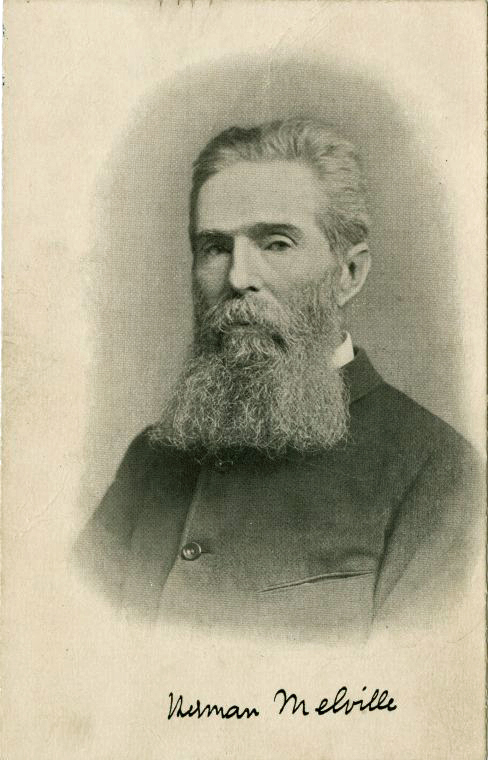
Image context: the cover uses a real 1885 photographic portrait of Herman Melville rather than a whaling print or a generic sea photograph. That choice suits this essay because Chapter 99 feels less like nautical spectacle than like authorial control at full maturity: a novelist stages a small object, then lets an entire crew reveal itself around it.[5]
1) The scene begins with motion, arrest, and a change in pressure
Melville does not open the chapter by explaining what the doubloon "means." He begins with Ahab's pacing.[1] The captain moves back and forth between the binnacle and the mainmast, pausing at each terminus so that compass and coin become two fixed points in his private orbit. That setup matters. The chapter is not born as detached symbolism; it emerges from habit, command, and a body wearing a track into the deck.
When Ahab stops before the coin, the narrative pressure changes. The doubloon is no longer merely a promised reward for the first sighting of the whale. It becomes a surface for obsessive reading. Ahab's interpretation is the least generous and most revealing of the scene because he cannot look outward for long. He turns mountain, tower, cock, sun, and storm into one expanding self-description until, at the center of the speech, everything collapses into the blunt phrase "all are Ahab."[1]
That line is not just egotism in the ordinary sense. It is interpretive annexation. Ahab does not ask what sort of world the coin came from or what kind of symbolic order it might sustain outside his will. He recruits its imagery into his monomania. Even his most apparently philosophical sentence, about the round gold reflecting each reader, becomes another confession of enclosure: the object "mirrors back" the viewer's "mysterious self."[1] The coin does not free him into meaning. It traps meaning inside the shape of his obsession.
2) The doubloon matters because it forces one object through many minds
If the chapter ended with Ahab, it would be a strong soliloquy and nothing more. What makes it unforgettable is the widening chorus that follows.[1] Starbuck reads the coin through Protestant gravity and consolation. The valley between the peaks becomes a dark vale under providential light. He wants the object to speak "wisely, mildly, truly" even while it saddens him.[1] Stubb, by contrast, refuses devotional solemnity and starts clowning with zodiac signs, almanacs, and the life cycle of man. Flask cuts through both styles and sees only market value: sixteen dollars, or nine hundred and sixty cigars.[1]
Melville is not simply giving each crewman a cute personality vignette. He is showing that interpretation aboard the Pequod is inseparable from station, temperament, and appetite. Starbuck moralizes, Stubb improvises, Flask counts, the Manxman prophesies, Fedallah silently acknowledges the sun, and Pip later shatters the whole enterprise.[1] The ship does not contain one hermeneutic community. It contains several, all leaning on the same nailed object for different psychic uses.
The chapter becomes sharper once you bring in the textual note preserved by the Melville Electronic Library. Its annotated chapter page explains that Melville's description of the Ecuador doubloon does not map perfectly onto the actual coin's official details; some elements are omitted, and others are misperceived or transformed.[2] That is not an embarrassment at the edge of the scene. It is central to the scene's intelligence. Even before the crew starts projecting meanings onto the coin, the coin has already come to us through partial seeing. Exact numismatic fidelity is not the governing ambition. The governing ambition is to make a material object rich enough that imperfect readers can overread it in public.
3) Pip gives the chapter its cleanest answer
The most unsettling interpretation arrives late and sounds absurd until it doesn't. After all the elaborate readings, Pip steps up and repeats one grammatical sequence: "I look, you look, he looks; we look, ye look, they look."[1] On the surface it is childish, damaged, even comic. But it is also the chapter's sharpest compression of what has just happened.
Pip does not decode the coin's imagery. He does something stranger. He strips the whole scene down to subjects and acts of looking. That move is devastating because it shows what all the earlier speeches had in common. Ahab, Starbuck, Stubb, Flask, and the rest were not uncovering a stable symbolic core hidden in gold. They were performing the conjugations of perception. One object; many viewers; many grammars of desire, fear, faith, profit, and delirium.[1]
This is why Pip's little chant lands harder than another grand monologue would. It demotes symbolism from oracle to process. The doubloon does not speak first. The watchers do. Melville had already built that truth into the chapter's social staging: each figure approaches in turn, says more about himself than about the coin, and leaves the object behind for the next consciousness to claim.[1]
4) Why this passage still feels alive
Britannica's broad description of Moby-Dick emphasizes the novel's "virtuosic" writing and its unusual capacity to keep generating interpretation across generations.[3] Chapter 99 shows why that is true at deck level. Melville does not protect symbol from comedy, bookkeeping, superstition, or damaged speech. He lets them all crowd in. The result feels modern because the chapter understands that shared objects do not produce consensus just because everyone can see them.
It also matters that the scene takes place on a working ship under command pressure. The doubloon is not sitting in a seminar room. Ahab nailed it there as bounty, incentive, and lure.[1] Profit and prophecy are already fused before anyone starts talking. That makes the chapter more than a free play of ideas. It is a study in how interpretation operates inside hierarchy. Even meaning has wages attached to it.
The late Melville visible in the Library of America portrait and career sketch is useful background here.[4] By the time posterity made Moby-Dick canonical, readers had learned to admire its excesses. But "The Doubloon" shows that one of Melville's deepest strengths was precision of arrangement. He does not need a whale breach or a stormfront to make the novel's whole pressure legible. He needs one nailed coin, one captain who cannot stop reading himself into the world, and one crew forced to look after him.
That is why the passage keeps its bite. The doubloon does not resolve into a master symbol. It becomes a social instrument that measures how each mind bends the world toward its own shape. The chapter's real drama is not what the coin means in the abstract. It is what happens when a ship full of unequal people must keep looking at the same shining thing.[1][2][3][4]
Sources
- Herman Melville, Moby-Dick; or, The Whale (Project Gutenberg HTML text, Chapter 99 "The Doubloon").
- Melville Electronic Library, "99 The Doubloon" (annotated chapter page with notes on the Ecuador coin details).
- Encyclopaedia Britannica, "Moby Dick" (publication, plot, and afterlife overview).
- Library of America, "Herman Melville" (career context and major works overview).
- Wikimedia Commons, "File:Herman Melville 1885.jpg" (source page for the lead image).