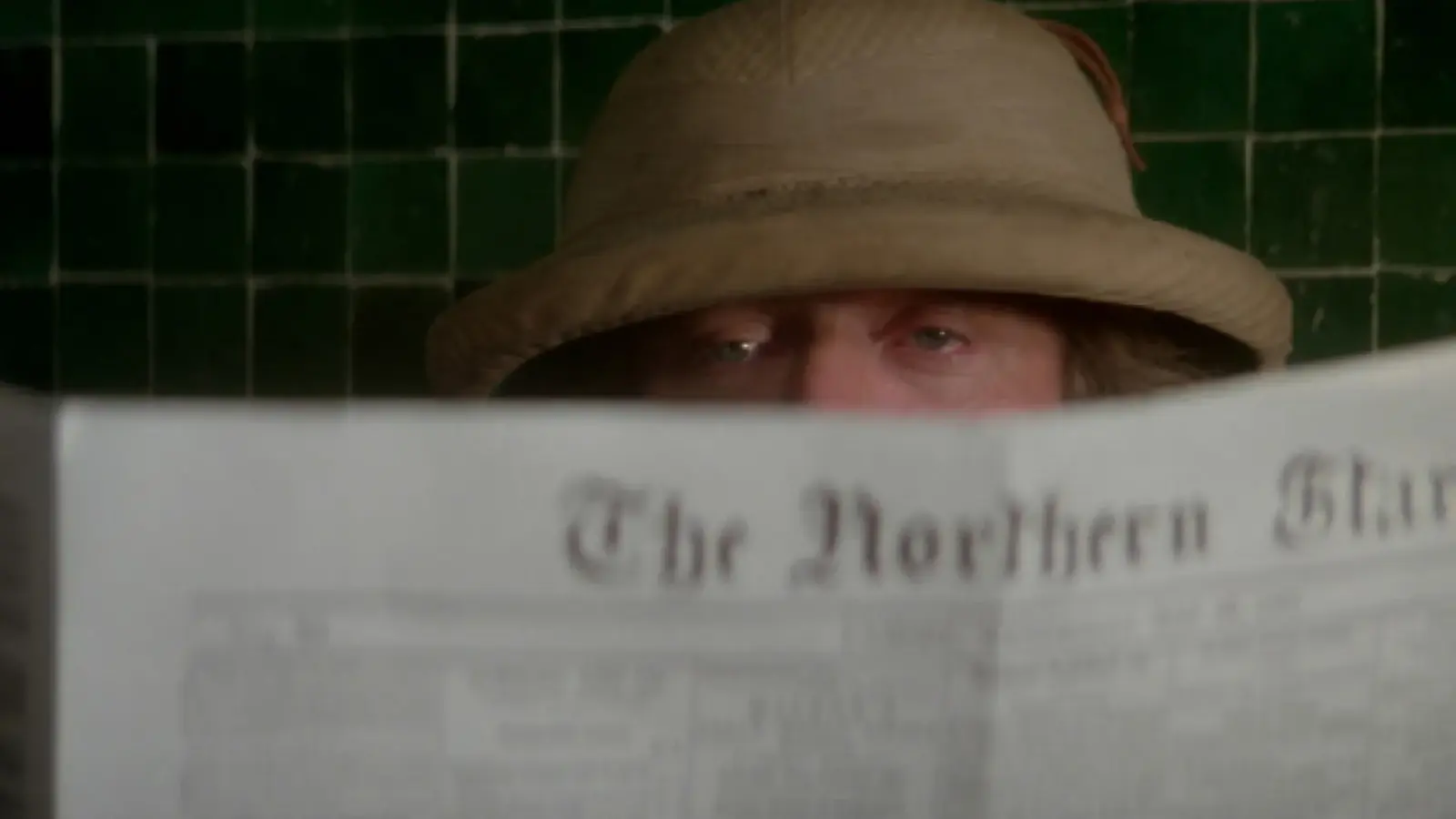
Peachey Carnehan needs someone to keep looking at him. Back from Kafiristan, injured and barely recognizable, he sits in a newspaper office and tries to explain how he and Daniel Dravot became kings. The editor offers a drink and asks for events in order. Carnehan asks for something harder: “Keep looking at me, or maybe my words will go all to pieces.” In Rudyard Kipling’s “The Man Who Would Be King,” attention helps hold the adventure together.[1]
John Huston’s 1975 adaptation, written with Gladys Hill, gives that adventure the faces of Michael Caine and Sean Connery. It also gives the listening journalist a name: Christopher Plummer plays Kipling. The frame survives the journey to cinema. Yet retaining a listener within a film does not necessarily keep the audience in his position. We can follow the men into a landscape that the printed story makes us receive through a troubled voice.[3][4]
This essay discusses the endings of the story and its film adaptation.
A voice held together
First published in 1888 in The Phantom Rickshaw and Other Eerie Tales, the story spends considerable time establishing the journalist’s acquaintance with the two adventurers before their expedition begins. That elaborate approach has divided readers. The Kipling Society’s guide records Charles Carrington’s admiration for the framing technique alongside Kingsley Amis’s objection that its elaboration had been mistaken for depth. Their disagreement points to a useful reading question: what work does the office perform that the mountain adventure cannot do alone?[2]
Start with the wrist. When Carnehan returns, the journalist takes hold of it and notices the damage to his hand. Carnehan immediately redirects him: “No, don’t look there. Look at me.” His wound can wait; his account cannot. The request distinguishes examining a body from attending to the person trying to speak through it.[1]
The prose keeps testing that distinction. Carnehan loses his place while remembering sparks caught in Dravot’s beard. The journalist supplies a location to get him moving again, but gets the route wrong, and Carnehan corrects him. This is a subtle arrangement of authority. The listener can prompt the story without knowing it; the distressed speaker can falter without surrendering his superior knowledge of what happened. Neither occupies the comfortable position of an all-seeing narrator.[1]
Later, the two climates of the story become almost physically incompatible. Carnehan remembers the cold before the men’s capture. The journalist sits sweating under kerosene lamps. When he briefly shifts his eyes, the narration breaks again. The office is therefore an active part of the telling: its heat, light, and bodily discomfort interfere with the mountains being recalled.[1]
Read this as a dramatization of difficult testimony, rather than a clinical diagnosis. Kipling gives us pauses, repetitions, damaged hands, and abrupt movements between first-person speech and references to “Peachey.” Those are observable features of the writing. Their effect, in this reading, is to make the story depend on a relationship that could fail at any moment.
The conquest grows visible
Huston’s adaptation changes that relationship even while retaining the journalist. In her study of the film, Vivian Kao describes the wide views that make the two travelers small against enormous terrain, and the closer framing that emphasizes their companionship. Her argument is that the film’s pleasure in their resourcefulness can draw attention away from their purpose as conquerors. She reads that tension through the film’s Vietnam-era context; it is a critical interpretation, not proof of a single authorial intention.[4]
The comparison offers a way to think about adaptation beyond whether an episode was kept. A landscape can occupy the screen with an apparent completeness that a halting account cannot supply. The viewer receives distances, bodies, and movement; the reader repeatedly encounters the labor of getting words out. The difference concerns where each version asks us to spend our attention.
The film’s named Kipling also changes the invitation. An anonymous journalist becomes a recognizable author-character, anchoring the adventure to the person whose work we are watching adapted. That is a form of literary recognition, but it cannot make the depicted expedition an independently verified event.[4]
Nor should the comparison turn the original into an innocent corrective to the film. Kipling’s journalist introduces Indian railway passengers and princely states through contemptuous colonial categories. Dravot and Carnehan approach other people’s territory as an opportunity for their own advancement. The story exposes disastrous ambition while giving the adventurers the overwhelming share of its speech.[1]
Carnehan’s suffering deserves attention; it does not make the people he helped subdue disappear. Keeping both thoughts available is part of reading the frame carefully. We can recognize the immediate obligation to an injured man without accepting his version of himself as someone who caused no harm.
Two kinds of half an hour
Near the end, Carnehan says that Dravot fell from the rope bridge for “half an hour.” The impossible duration makes the fall continue inside the telling. A moment that would end quickly in measured time refuses to finish for the surviving friend.[1]
Then the story makes an unexpectedly quiet return to the same unit. After Carnehan leaves the office, the journalist finds him wandering in the midday heat and takes him to a missionary. He later learns that Carnehan has died. The asylum superintendent asks whether he really spent “half an hour bareheaded in the sun at midday.” The repeated duration moves from a survivor’s account of catastrophe into an institution’s explanation of his death.[1]
That echo is easy to miss because the story has already produced its most spectacular evidence: Dravot’s severed head and gold crown. The journalist recognizes the head. This matters. His experience cannot simply be dismissed as hearing an extravagant tale from an unreliable stranger. But recognition establishes a narrower fact than complete knowledge of the expedition. It confirms a dead acquaintance; it cannot independently confirm every action narrated in the mountains.[1]
By the final exchange, even that evidence has slipped out of reach. Asked whether Carnehan possessed anything when he died, the superintendent knows of nothing. The story closes with an account preserved and an inquiry stopped, rather than a mystery tidily solved.[1]
An adaptation can retain the crown, the catastrophe, and the man who listens. Reading Kipling afterward restores another source of suspense: whether one person can stay attentive long enough for another person’s words to survive. The great fall happens far away. The small, uncertain act that gives us access to it happens across a desk.
Sources
- Rudyard Kipling, “The Man Who Would Be King.” Project Gutenberg text; especially Carnehan’s return to the newspaper office, the rope-bridge account, and the closing asylum inquiry.
- John McGivering and George Kieffer, “The Man Who Would Be King.” The Kipling Society Readers’ Guide; publication history and the contrasting assessments of Charles Carrington and Kingsley Amis.
- British Film Institute, The Man Who Would Be King (1975); director, screenplay credits, and principal cast.
- Vivian Kao, “Kipling in Vietnam: John Huston and ‘The Man who Would be King.’” Kipling Journal 378, June 2019, pp. 27–40; especially pp. 31–34 on the author-character, framing, and imperial adventure.
- American Film Institute, “The Man Who Would Be King (1975) – AFI Movie Club,” April 16, 2025; film context and source of the photographic still.