A wife becomes a fox. Her husband finds a way for them to keep playing cards. That second event is the useful entrance to David Garnett's Lady into Fox: once you have accepted the impossible, watch the ingenuity required to get through an ordinary evening. Richard Tebrick arranges the cards on a sloping board so that Silvia can play with her claws. She wins. For a little while, their marriage has found a new working shape.[1]
First published in October 1922, this short novel moves from a startling woodland incident into the fine adjustments of living together. Its emotional changes happen through sleeves, saucers, locked doors and food. Read with those things in view, and a premise that sounds like a literary joke becomes an unsettling account of how love recognizes someone who has changed.[1]
This guide discusses early and middle scenes, leaving the ending for your first reading.
Give the narrator his miracle
Begin with the opening voice. The narrator calls Silvia's transformation an “established fact,” vouched for by respectable witnesses. He sounds like a local historian with unusually good access to the neighbors. He considers possible explanations, including Silvia's maiden name, Fox, but declines to make any of them settle the matter.[1]
The assurance is funny because it comes attached to such an unreasonable claim. Yet it also creates the book's freedom: the story can spend its energy on consequences. You can stop waiting for a hidden spell to explain everything. Notice instead which details the narrator regards as proof, which he treats as uncertain, and how often he volunteers a judgment about proper conduct.
His confidence deserves attention rather than automatic trust. He can be perceptive about the physical needs of a fox while remaining preoccupied with whether a woman behaves respectably. In the passage about Silvia's refusal to play cards on Sunday, he even pauses to defend her Protestant credentials. The solemn explanation becomes part of the comedy: her species has changed, but apparently her religious denomination must be kept in order.[1]
Follow the cards, then the clothes
The early domestic scenes repay slow reading. When Tebrick dresses Silvia in a flowered silk jacket and settles her among cushions, he finds comfort in her apparent modesty. The narrator slips in a qualification: these actions show him, “or so he thought,” that his wife remains herself. That small interruption makes room between Silvia's behavior and her husband's interpretation of it.[1]
The card game offers a more promising arrangement. The obstacle is practical: paws cannot hold a hand of cards. A sloping board solves it, and the couple can enjoy something together again. When they play cribbage, Tebrick moves her pegs as well as his own. Cooperation depends on admitting that the old method needs changing.[1]
Keep that scene in mind when Silvia starts resisting her clothes. At the frozen pond, she tears off her jacket and pushes it through a hole in the ice. Tebrick eventually promises to stop making her dress or sit at table, provided she stays with him. His concessions matter, and so does their condition.[1]
I read these episodes as different attempts to preserve intimacy. The cards accommodate a changed body. The jacket initially makes that body resemble its former self. Neither object has a fixed moral meaning: Silvia first welcomes the clothing, then rejects it. Following her changing response keeps the reading more alive than deciding at the outset that every household comfort is a prison.
Notice when care becomes an experiment
A later episode sharpens the problem. Tebrick brings home snowdrops and a rabbit, hoping to discover which will command Silvia's attention. She greets the flowers with evident pleasure. He then leaves her alone with both, timing his absence by his watch.[1]
The scene begins with the familiar materials of a gift and becomes a test. That shift is the thing to watch. Tebrick wants reassurance, but he has arranged the encounter so that her appetite can count as evidence against her. Her appreciation of the flowers cannot protect her from the verdict he will draw from what happens next.
The narrator elsewhere asks the reader to consider the bodily necessities of Silvia's new condition. Tebrick keeps finding those necessities emotionally unbearable. The resulting tension is painful because his affection is substantial. He works, worries and makes sacrifices for her; he also wants her conduct to certify that the wife he remembers is still available to him.[1]
A useful question to carry through the book is therefore very small: whose need does this act of care answer? Sometimes the answer is both of theirs. Sometimes protection and reassurance pull in different directions. You do not have to acquit or condemn Tebrick before turning the page.
Choose an edition that keeps Ray Garnett's pictures
The book's original illustrations belong to its reading experience. The Gutenberg text linked below includes the wood engravings credited to R. A. Garnett, or Ray Garnett. Her domestic scenes make the fox's presence look composed and almost ordinary; placed beside the prose, they let you linger over arrangements that the narrative will soon disturb.[1]
Publication history helps explain the deceptively inviting format. In his study of Ray Garnett's illustrations, J. Lawrence Mitchell quotes the correspondence with Chatto and Windus: the publisher initially hesitated over the story's shortness, while David Garnett explicitly warned that it was intended for adults. The small illustrated volume was a deliberate vehicle for an adult difficulty.[2]
Its early recognition was substantial: the University of Edinburgh lists Lady into Fox as the James Tait Black fiction winner for 1922.[3] You need no tour of Garnett's literary friendships to begin it. An edition preserving the pictures gives you a more useful companion on a first pass.
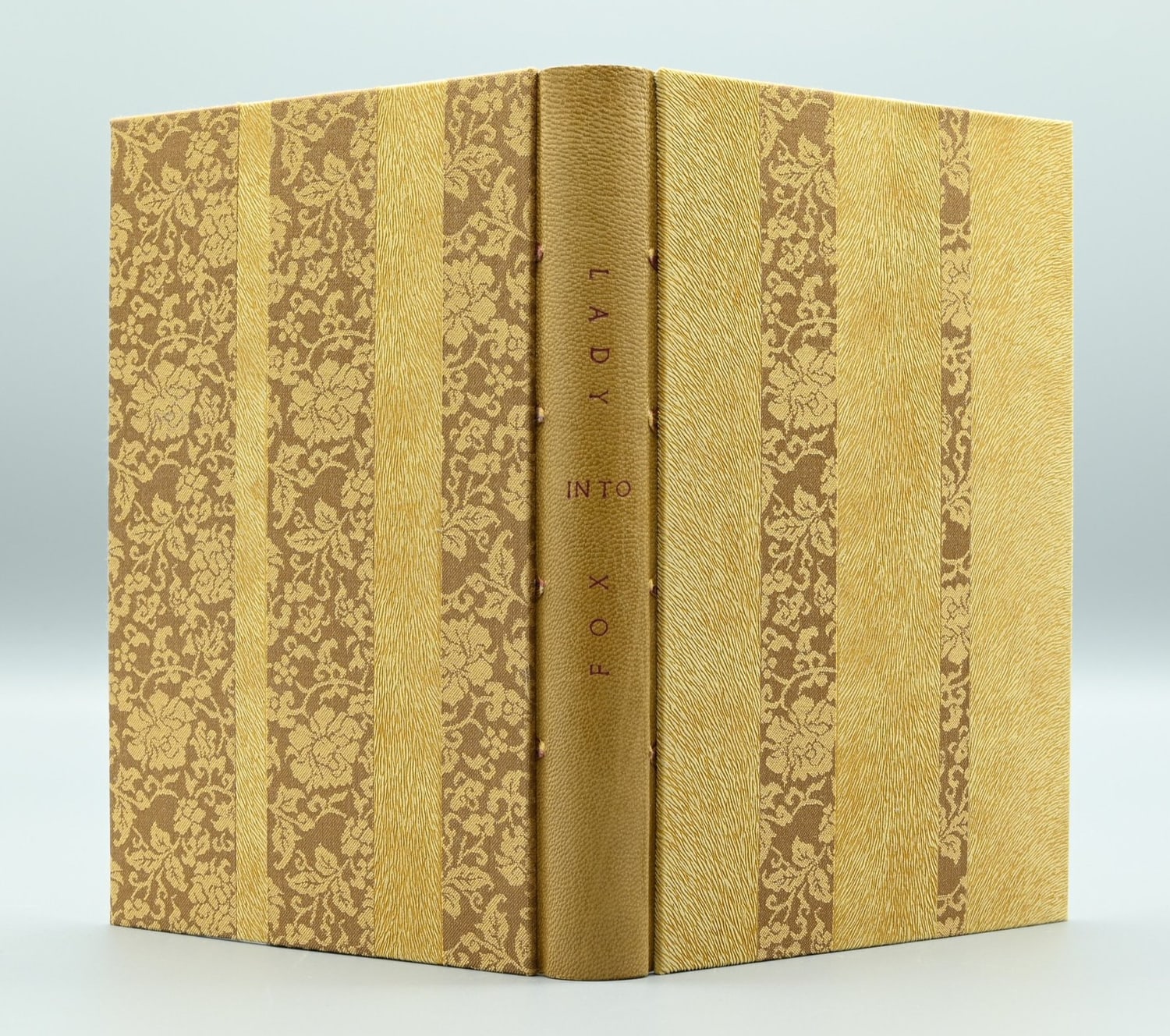
Hanmer's binding offers a later reader's response in physical form: the changing textures carry the transformation across the book's surface. Her description identifies the copy as a first edition now in the University of Chicago's collection.[4] It is an apt object to return to after reading a story so attentive to the surfaces through which we recognize a familiar person.
For the first reading, let the tale keep moving. For the second, go back to the sloping card board and the timed experiment with the rabbit. In one scene, Tebrick changes the conditions so that Silvia can participate. In the other, he arranges the conditions to find out whether she still qualifies. The distance between those two gestures is where Garnett's little book begins to grow.
Sources
- David Garnett, Lady into Fox (first published October 1922), illustrated by R. A. Garnett — complete primary text, including the opening, card games, pond and rabbit episodes. Project Gutenberg.
- J. Lawrence Mitchell, “Ray Garnett as Illustrator,” The Powys Review, no. 10 (1981/1982), pp. 9–28, especially pp. 14–15 — publication correspondence and the illustrated book's intended adult readership.
- University of Edinburgh, “Fiction winners,” The James Tait Black Prizes — entry for David Garnett's Lady into Fox, 1922.
- Karen Hanmer Book Arts, “Lady Into Fox (1922)” — photographs, materials and provenance of Hanmer's 2024 binding of a first edition.