
The most durable James Baldwin clips are often treated as civic evidence first and literary evidence second. They circulate because he speaks with unusual force about race, state violence, and American self-deception, and the historical urgency is real enough.[1][4][5] But the 1969 Dick Cavett segment below still matters for a more technical reason as well. It shows Baldwin moving essayistic pressure into television without flattening his thought into slogan. The clip is not memorable only because Baldwin is right, or because the studio audience can feel the room tightening. It is memorable because he makes a talk show carry the cadence of a serious prose argument.[1][2][3][5]
That is what makes this video a useful literature object rather than only a political clip.[1][2][4] By the time Baldwin sat down with Cavett, he had already built the prose authority that runs through Notes of a Native Son and The Fire Next Time, and the public image of Baldwin as television intellectual was already hardening.[2][3][5] The Cavett exchange catches him refusing to separate those roles. He answers a question about Black optimism, but his deeper move is formal. He breaks an overgeneralized category, changes the scale of the question, and turns the studio's polite give-and-take into a sequence of sentences that expose the country's own language about progress.[1][3][5]
The result is a compact lesson in Baldwin's public method. He does not decorate the conversation with literary glamour from outside. He writes the room while speaking inside it. Each answer widens, folds back, and presses harder, until television stops feeling like a neutral delivery device and starts feeling like one more page on which Baldwin can test what America is willing to hear.[1][2][5]
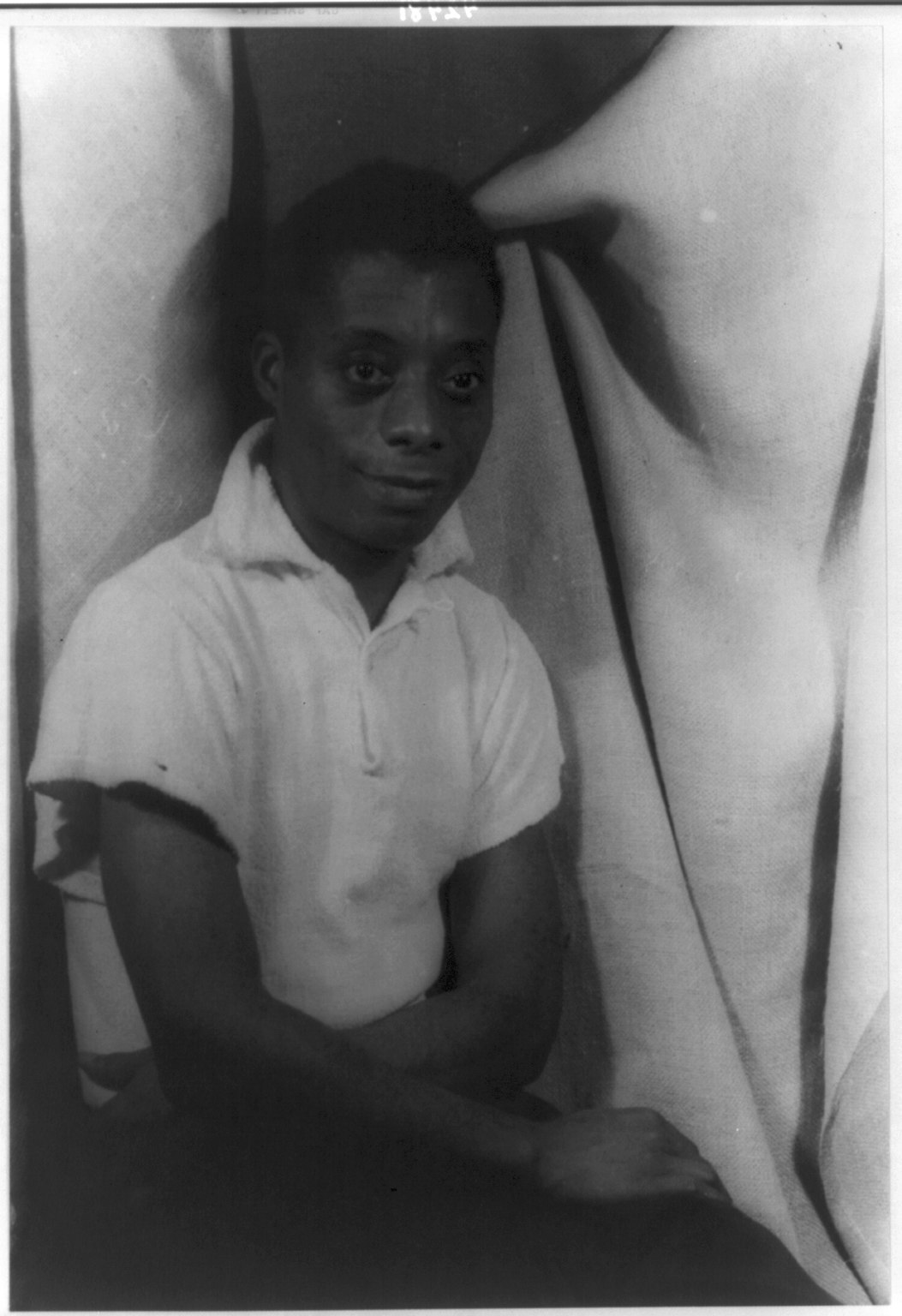
Image context: the cover uses an archival Library of Congress portrait of Baldwin preserved on Wikimedia Commons.[6] It is not a TV still, but it fits this article because the clip's force comes from concentrated presence rather than studio choreography. Baldwin's strongest television appearances work through the same compression this portrait holds: a face, a hand, a pause, and a sentence already leaning toward the listener.
Baldwin begins by dismantling the category that television wants to stabilize
The clip opens with a question that television could easily have simplified into a representative answer: why are Black Americans not more optimistic if conditions are supposedly improving?[1] Baldwin's first move is to attack the category itself. He immediately marks the phrase "the Negro" as a false bundle and starts naming different people, occupations, and public surfaces that the category tries to flatten into one figure.[1] That matters because it prevents the show from staging him as a spokesman for a single, manageable object. Before Baldwin explains anything, he forces the studio language to reveal its own laziness.
This is classic Baldwin technique. The Academy of American Poets summary places him across poetry, novels, essays, and plays, but the deeper through-line is his distrust of dead public wording.[4] On Cavett, you can hear that distrust operating in real time. He does not answer the premise straight on because the premise has already smuggled in a fake social unity. That is a literary move as much as a political one: diagnose the sentence before you accept the question.
The first minute also shows why Baldwin remained such a difficult television guest. He accepts the civility of the format just enough to keep talking, then uses that civility against itself.[1] The audience gets wit, rhythm, and conversational ease, but those qualities are carrying demolition work. Baldwin is loosening the language that lets liberal progress talk congratulate itself with token evidence such as visibility in sports, politics, or commercials.[1][5]
Around the one-minute mark, the clip shifts from Black morale to the fate of the country
The central turn comes early. Baldwin says the real issue is not finally what will happen to Black people here; the real issue is what will happen to the country.[1] That shift is the hinge of the entire clip. It removes Black life from the status of a minority grievance and redefines the question as a national reckoning. In literary terms, Baldwin changes the scale of the sentence. What looked like one demographic prompt is rewritten as a judgment on the republic's imagination.
This is one reason The Fire Next Time remains such a useful parallel source.[3] Baldwin's prose often refuses to let white America imagine race as a local disturbance at the margins. He keeps forcing the subject back toward national structure, national fantasy, and national danger.[3][5] On Cavett, that pressure arrives without the insulation of print. You watch him enlarge the frame in front of the host and audience, and the enlargement is itself the argument.
The television medium sharpens the effect. On the page, Baldwin can build this movement through paragraph design and tonal accumulation.[2][3] In the studio, he has only timing, voice, and the confidence to repeat the scale change until it lands. That is why the clip still feels so authored. It is not a loose topical chat that happens to contain quotable lines. It is a spoken composition whose form depends on Baldwin's ability to keep moving from anecdotal prompt to civilizational diagnosis without sounding abstract.[1][5]
The middle stretch turns rhetoric into a public anatomy of double standards
Once the scale has widened, Baldwin starts exposing the moral asymmetry embedded in public rhetoric.[1] Around the middle of the clip, he notes that demands for liberty sound heroic when voiced by white actors in the national script, yet criminal when spoken by Black people in the same language.[1] He is not merely making a complaint about media bias. He is mapping how the country distributes innocence through familiar phrases. The words do not change. The permitted speaker changes.
That attention to who is allowed to occupy a sentence belongs to Baldwin the writer as much as Baldwin the activist.[2][4][5] His books repeatedly ask who gets interiority, who gets complexity, who gets to appear as a troubled citizen rather than a threat. The Cavett segment condenses that entire literary concern into broadcast tempo. He does not need a long essay to show how language and power fuse; he lets the examples pile up until the double standard becomes audible in the room itself.[1]
The clip's later remarks about history, policing, and property deepen the same structure.[1] Baldwin keeps resisting the sentimental story that television progress equals civic repair. The set looks integrated. The host is curious. The conversation remains measured. Yet Baldwin's sentences keep returning to institutions, force, and historical arrangement, reminding viewers that representational inclusion does not dissolve the deeper order that governs whose life is protected and whose speech is treated as danger.[1][5] That is why the clip never collapses into inspirational footage. It stays analytic.
Why this is literature on television
The literary value of the Cavett clip lies in the relation between cadence and thought. PBS notes Baldwin's years as a teenage preacher and records his own later claim that the pulpit helped turn him into a writer.[5] You can hear that training here, though it has been stripped of church consolation. The sentences gather, pivot, widen, and return; each answer sounds improvised, but the movement is too controlled to be accidental. Baldwin speaks like a writer who trusts syntax to carry moral pressure.
That matters in 2026 because many circulating "writer clips" now survive as detachable verdicts. Baldwin's Cavett appearance survives differently.[1][2][5] It keeps the shape of an argument. A reader who never opens the transcript can still feel how the talk is built: premise, interruption, scale shift, historical test, institutional landing. The clip therefore teaches something about Baldwin's prose that biography pages alone cannot.[2][4][5] His authority never came from eloquence as ornament. It came from the ability to make one sentence change the size of the room.
Sources
- The Dick Cavett Show, "James Baldwin Discusses Racism" (official YouTube clip; description notes original air date of May 16, 1969).
- Penguin Random House, "James Baldwin" (author page).
- Penguin Random House, The Fire Next Time by James Baldwin.
- Academy of American Poets, "About James Baldwin."
- PBS American Masters, "James Baldwin Biography and Quotes."
- Wikimedia Commons, "File:Portrait of James Baldwin LCCN2004662552.jpg" (source page for the lead portrait).