
Long sentences are often praised as athletic feats: look how long the writer can delay the full stop without losing balance. Jamaica Kincaid offers a more interesting account. Her sentence grows because a fact has not finished meeting its contradictions. It needs room for what happened before, for what the speaker does not yet understand, and for the second truth waiting behind the first.[1]
That account emerges in Kincaid's April 2026 conversation with Dean Nelson at Point Loma Nazarene University's Writers Symposium By the Sea. The event ranges across her arrival in the United States, The New Yorker, biblical stories, mothers, artificial intelligence, and the origin of “Girl.” Yet a craft lesson keeps surfacing: an odd question becomes a long sentence; colonial poetry supplies its music; truth changes when viewed from another angle; and implies an unrevealed past; but refuses to discard the contradiction.[1][6]
The official UCTV recording is worth watching because Kincaid's answers enact that method. She takes detours, resists a host's request for a quick destination, and lets an anecdote discover its shape in public. The analysis below supplies the argument and textual context on its own; the video adds timing, comedy, and the visible pleasure of a mind declining to travel in a straight line.
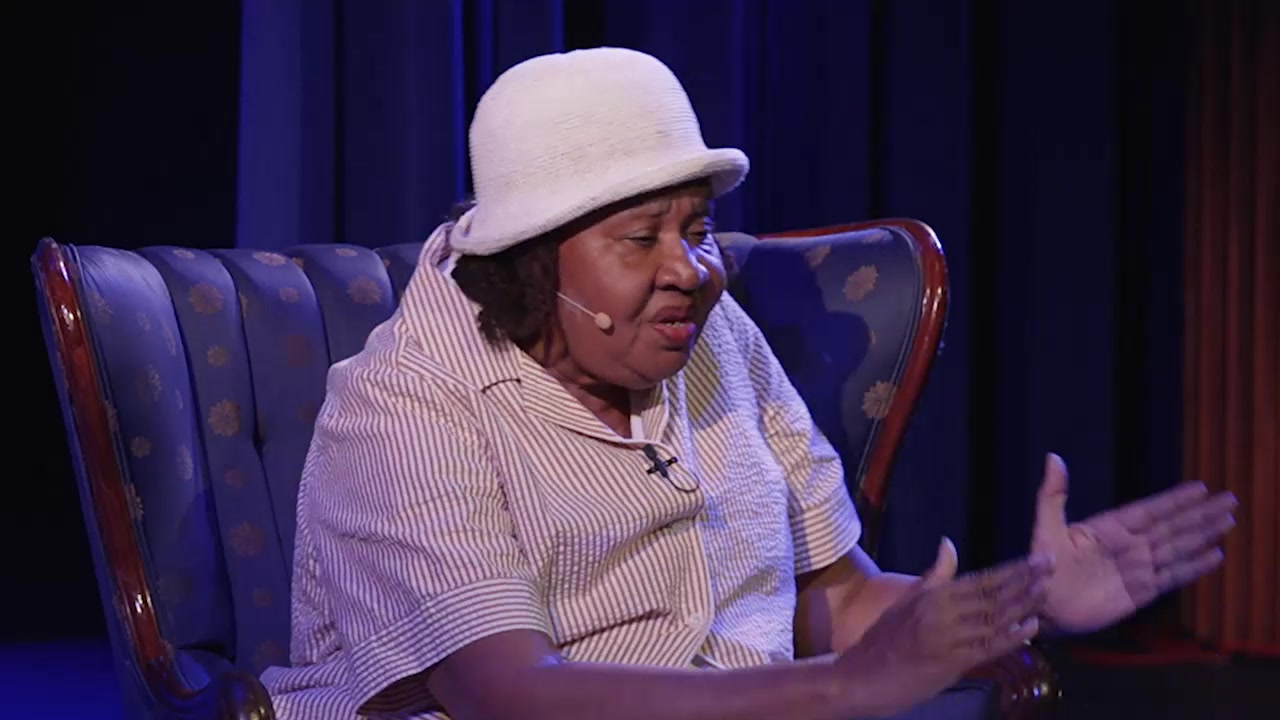
Image context: the cover is a frame from the same institutional recording, captured as Kincaid uses her hands to describe how conjunctions move thought. It is a public literary event, not a generic author portrait.[6]
The Conversation
The embed contains the complete 68-minute UCTV program. The most relevant sequence begins around 12:53, returns at 18:40 and 25:57, and becomes a sustained discussion of “Girl” from about 34:21 to 39:53.[1][6]
12:53 — A Strange Question Earns a Long Sentence
Kincaid's first craft principle arrives disguised as mischief. Reading The Odyssey, she became preoccupied with the absence of fish from a story spent at sea. The question is deliberately small beside gods, war, homecoming, and epic reputation. That is precisely its value. A missing ordinary thing can expose the habits by which readers accept a literary world without testing its material edges. Such questions interest her, she says, and “I will then write a long sentence about it.”[1]
The sequence clarifies an earlier provocation in the interview: a writer should not compose in order to please a projected reader. Kincaid is not arguing that readers are worthless. She says the way to please a writer is to read the work. Her order of operations is the point. The sentence must first answer the pressure of the writer's question; an audience encounters the result afterward.[1]
That makes length a consequence rather than a style preset. The sentence continues not because continuation is automatically musical, but because the question has not yet revealed all its implications. A fish can lead from food to realism, from realism to what an epic excludes, and from exclusion to the authority readers grant a canon. The long sentence is the route of that discovery.
18:40 — Inherited Music, Unfamiliar Country
When Nelson asks whether British books produced Kincaid's complex syntax, she corrects the category. The influence came from poetry, she says—not from Dickens or George Eliot, but from Milton, Wordsworth, and Coleridge. As a seven-year-old, punished by having to copy the first two books of Paradise Lost, she became fascinated by Lucifer rather than chastened by the assignment. The discipline misfired productively.[1]
Kincaid then makes the inheritance less comfortable. Poetry was central to the English colonial curriculum in Antigua, and much of it described English things she had never seen. Its remoteness forced an act of imagination. My inference from her account is not that colonial schooling secretly redeemed itself. It is that literary inheritance can be coercive in origin without determining what a later writer will do with its rhythms. Kincaid keeps the syntactic amplitude and changes what it must carry.[1]
That distinction matters in “Girl.” Its clauses name salt fish, dasheen, benna, doukona, pepper pot, khaki, red ants, menstruation, sex, work, and reputation—not an imported pastoral landscape. The inherited sentence has been made answerable to Antiguan materials and to a girl's education in the risks of becoming visible.[2] A Harvard profile of Kincaid teaching fiction records the corresponding rule she gives students: learn convention, then challenge its claim over the work.[5]
25:57 — A Prism Needs More Than One Clause
The interview's most useful abstract claim comes when Kincaid distinguishes truth from a lie. Truth, she says, is “more like a prism”: turn it, and another color appears. A lie is inert because it permits no change of angle. Truth instead forces the writer through moral positions that do not line up cleanly—the right act for a compromised reason, love entangled with refusal, protection delivered as control.[1]
Her example is Lucy. The protagonist's attachment to her employer, Mariah, intensifies both when Mariah resembles Lucy's mother and when that resemblance becomes intolerable. Those responses do not cancel each other. The sentence has to preserve both because the relationship is constituted by both.[1]
This is why Kincaid's repetitions are not merely incantatory decoration. A return can change the pressure on the repeated word. Mother, home, England, love, and freedom acquire another face as the syntax turns them. The sentence becomes a moral instrument: it does not average competing truths into a safe middle but keeps them close enough to trouble one another.
34:21 — “Girl” Enters Through Someone Else's Poem
The origin story of “Girl” is itself a Kincaid sentence. Asked how she decided to write the story as one continuous sentence, she begins with writer Ved Mehta, his treatment of young women working at The New Yorker, and a Christmas gift she refused to read because she disliked the giver. The book was Elizabeth Bishop's Geography III. One Sunday, Kincaid finally opened it, read “In the Waiting Room,” and immediately wrote “Girl.” She describes the encounter as a door opening.[1]
Bishop's poem follows a nearly seven-year-old child in a dentist's waiting room as an aunt's cry, a magazine's colonial photographs, and the surrounding adult bodies destabilize the boundary of the self. Its frightening recognition is compressed into “you are an I, / you are an Elizabeth.” The child becomes singular and collective at the same instant.[3]
Kincaid does not imitate Bishop's stanza pattern or scene. The formal kinship is deeper. Bishop lets one voice discover that it is also an aunt's voice and part of an uneasy we. “Girl” fits a mother's instructions and a daughter's two brief objections into one typographic current. The daughter is crowded, but she is not absent. Each interruption begins with but, so dissent enters inside the inherited syntax rather than waiting politely for a new paragraph.[2][3]
The result has resisted a stable genre label. Scholarship indexed by ERIC describes “Girl” as crossing from short fiction toward poetry because its structure and poetic language violate the expected borders of both forms.[4] That label is most useful when it directs attention back to the reading experience: household knowledge arrives as rhythm; dialogue looks like monologue until the smaller voice breaks through; a list develops narrative stakes without a conventional plot.
38:40 — And Keeps a Before Alive
Kincaid's sharpest explanation begins with the King James Bible and her use of repetition in Mr. Potter. A story can begin with and, she says, because the conjunction announces that something came before—something not yet clear or revealed. But performs the companion task: it introduces a contradiction that is important and true as well.[1]
This grammar illuminates “Girl” even though semicolons do most of its visible joining. Every instruction sounds as if it continues an education already underway. The reader never receives the first lesson, the mother's own apprenticeship, or a full account of the society whose judgment she anticipates. Those missing antecedents remain active inside the commands. The story begins in grammatical midstream because gender, work, colonial schooling, and maternal fear began before this particular exchange.[2]
The final turn gives but its full force. The girl asks what happens if a baker will not let her test a loaf. Her mother responds by imagining “the kind of woman who the baker won't let near the bread.”[2] The reply is cruel, comic, and frightened at once. It converts a practical problem into a verdict about reputation. Yet the girl's question has exposed a limit in the mother's system: perfect instruction cannot guarantee access when someone else controls the bread.
The sentence therefore carries discipline and survival knowledge together. It teaches cooking, sewing, gardening, bodily care, social performance, desire, and caution; it also transmits a punitive suspicion of the girl becoming a woman. Reading the mother only as oppressor loses the useful knowledge. Reading her only as protector excuses the violence. Kincaid's syntax denies both simplifications by refusing the clean break that would keep love in one sentence and injury in another.
What the Recording Adds
Around 35:28, Nelson interrupts the route from “Girl” to Mehta and asks what the blind writer has to do with the story. Kincaid answers, “I'm getting to it.” The room laughs, but the detour is the answer. The Bishop book cannot be separated from the objectionable giver; the refusal cannot prevent the poem from eventually becoming a gift; influence arrives through resentment, delay, reading, and sudden formal permission.[1]
On the page, that sequence can look efficiently designed. In the recording, it remains exploratory. Kincaid pauses, remembers the book's title, corrects the interviewer, and insists on completing the arc. When she later gestures through and and but, syntax stops being an abstract diagram and becomes a way of moving thought through time.[1][6]
Kincaid's long sentence thus begins before its first printed word. It bears an inheritance the reader has not seen, advances by questions that have not been settled, and makes enough room for truth to change color. Its achievement is not that it avoids the period for an impressively long time. It is that no period arrives early enough to lie.
Sources
- UCTVInsight, “A Conversation with Jamaica Kincaid,” official YouTube video of the 2026 Writers Symposium By the Sea, released April 13, 2026.
- Jamaica Kincaid, “Girl,” The New Yorker, June 19, 1978 — primary text.
- Elizabeth Bishop, “In the Waiting Room,” Academy of American Poets — primary poem text and publication record.
- Reem Ahmad Rabea and Nusaiba Adel Almahameed, “Genre Crossing in Jamaica Kincaid's ‘Girl’: From Short Fiction to Poetry,” Advances in Language and Literary Studies 9, no. 3 (2018) — ERIC record and abstract.
- Harvard Gazette, “Tending Her Gardens” (March 16, 2000) — profile of Kincaid's teaching, biography, and approach to literary rules.
- University of California Television, “A Conversation with Jamaica Kincaid — Writer's Symposium By the Sea 2026” — event record, program description, and source video for the documentary still.