The fruit gets an extension. The solitary person gets no date at all. In Rainer Maria Rilke’s “Herbsttag,” usually called “Autumn Day” in English, the speaker asks God for two more southerly days to finish ripening the harvest. Then the poem turns toward whoever has no house, whoever is alone, and a future of reading, writing, and restless walking. Its small cruelty lies in that unequal distribution of time: the fruit has a task it can complete; the person has hours to inhabit.[1]
How long those hours last depends partly on the translator. The German says lange: a long time. That word gives solitude duration without supplying its endpoint. Remove it, and the sentence can sound like a lifetime verdict. Preserve it, and the uncertainty remains uncomfortable. Nobody promises that company will arrive.
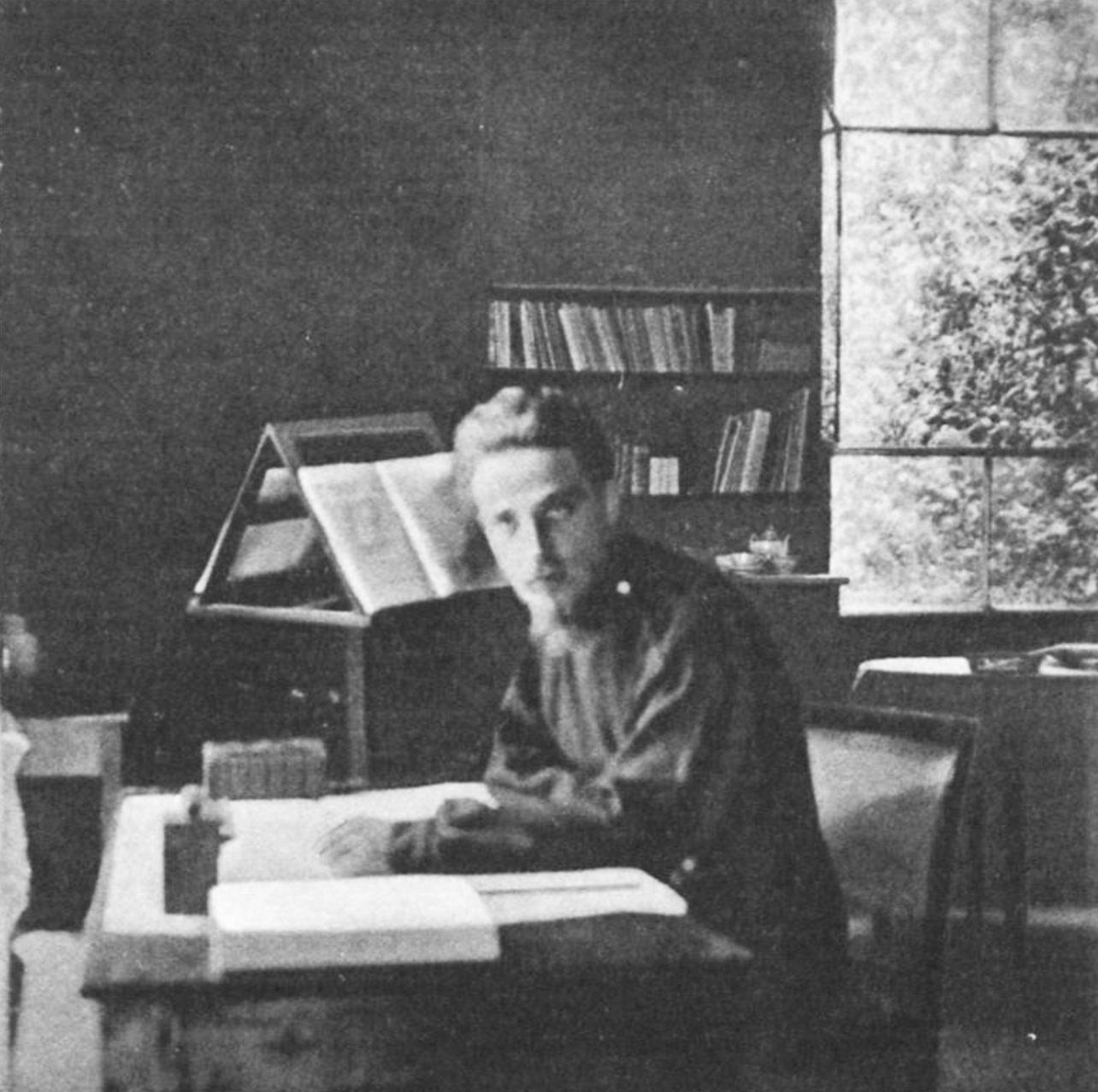
Rilke wrote the poem in Paris on September 21, 1902; it appears in the enlarged 1906 edition of Das Buch der Bilder. The dated contents of his Ausgewählte Werke and the digitized 1906 text let us distinguish composition from the edition we are reading.[1][2] The photograph above belongs to another setting: Rilke’s studio in Rome in 1904. It places the writer in a working environment during these years; it does not document the poem’s Paris composition.[5]
The poem begins with an address to the Lord, then a remarkably brisk series of instructions. Set a shadow across the sundials. Release the winds. Command the last fruits to fill. Grant them a little more warmth; press them toward completion. These are requests made by someone who can still imagine time being administered. Even the season’s ending might be adjusted if the petition reaches the right authority.[1]
That makes the last stanza’s change of grammar sting. The instructions stop. Statements about what will happen replace them. The speaker no longer asks for an intervention on behalf of the people now entering the poem. Nobody says: give this person two more days to find a room, finish a house, meet someone. The harvest receives a request for additional time; the human future receives a forecast.
The first human sentence concerns building. Someone who has no house now will build none anymore. The next concerns remaining alone. Their parallel openings encourage us to hear them as equivalent sentences of exclusion, but their endings differ. One shuts down an undertaking. The other stretches an existing condition into an unspecified future.[1] English can preserve that difference, or let the force of the first statement spread into the second.
Stephen Mitchell’s version makes the second sentence stark: “Whoever is alone will stay alone.” Galway Kinnell and Hannah Liebmann retain “for a long time”; Mary Kinzie chooses “indefinitely so.” The versions are collected in the Teachers & Writers comparison packet.[3] Mitchell’s repetition makes the condition sound self-renewing. Kinnell and Liebmann keep duration explicit. Kinzie’s adverb gives us an endpoint we cannot determine, with a faintly administrative chill. Each choice changes the pressure under which the remaining actions occur.
The differences continue into the next line. Edward Snow’s “will stay awake” sustains a condition; Kinzie’s “waking up” makes an event of it.[3] The distinction matters to the scene we imagine: a person keeping vigil or passing sleepless hours, versus someone emerging from sleep and taking up a book. Neither choice merely supplies an English synonym. Each quietly directs a body through the room.
Return to the German and the room becomes less settled. Wachen supports wakefulness or keeping watch, without telling us whether the person is alert by choice or unable to sleep. Reading follows, then writing long letters. These activities can belong to loneliness, concentration, or the effort to endure an evening. The poem does not name their psychological cause.[1]
The letters are particularly awkward for a reading that makes solitude total disconnection. A letter is directed outward, even if we never learn its destination. The text gives us no recipient and no reply. To infer a successful exchange would be wishful; to treat the writer as having no imagined addressee would also go beyond the page. What we can see is the labor of addressing someone across an absence.
And the word for length has returned. The person will remain alone lange, then write lange Briefe. Duration passes into the size of the writing.[1] The first length is something endured; the second is something made. That echo allows a modest possibility within the bleakness: empty time may become sentences. It supplies no evidence that those sentences cure anything. A long letter can measure the distance it tries to cross.
Rilke also prevents remaining from becoming simple stillness. The German future auxiliary recurs through the stanza, carrying the person from being alone into wakefulness, reading, writing, and wandering. The final movement runs back and forth along tree-lined avenues while leaves drift.[1] There is activity everywhere, but little progress that can be measured. A person can keep moving without reaching the place they need.
The verse itself makes a small excursion. The penultimate line sets up the back-and-forth motion, then carries us over its edge before giving us the restless wandering. The final word returns to the rhyme heard in remaining and writing. To my ear, that recurrence gives the walking a circular quality: the stanza travels, yet keeps finding familiar sounds. This is a formal interpretation, rather than evidence of what any actual walk meant to Rilke.
The poem’s English afterlife makes these small decisions unusually visible. Erika Luckert’s Teachers & Writers lesson uses competing translations to teach revision, asking students to explain what a preferred wording does to their reading.[4] It is an apt classroom use because this lyric can change its emotional weather without changing its furniture. A house, a book, letters, an avenue: all remain recognizable while grammar alters the life conducted among them.
For this poem, I would keep the little word for duration and the repeated movement into the future. They let the closing stanza remain severe without deciding everything in advance. The fruit can reach ripeness. The letter can grow longer. The person continues down the avenue, with no appointment at its end.
Sources
- Rainer Maria Rilke, “Herbsttag,” Das Buch der Bilder, enlarged second edition (1906), p. 48. German text transcribed and proofread against the digitized edition, Wikisource.
- Rainer Maria Rilke, Ausgewählte Werke, vol. 1, Gedichte, contents p. 419 (PDF p. 2). German National Library scan recording the poem’s composition in Paris on September 21, 1902.
- Teachers & Writers Magazine, “Translations of Rainer Maria Rilke’s ‘Herbsttag.’” Comparison packet: Kinnell and Liebmann on PDF p. 2, Mitchell on p. 3, Snow on p. 6, and Kinzie on p. 7.
- Erika Luckert, “Revision by Translation,” Teachers & Writers. Lesson plan using “Herbsttag” to explore how translation choices change a poem.
- “Rilke im Studio al Ponte im Garten der Villa Strohl-Fern in Rom 1904.” Archival photograph, photographer unknown; Wikimedia Commons file record citing the University and State Library Düsseldorf’s digitized source.