The opening of The Tale of the Heike is so famous that it can be mistaken for a motto. Bells sound; flowers fade; the proud fall. The risk in translation is to make it too clean, as if the passage were merely announcing a Buddhist theme before the real action begins. But the opening does something stranger and more durable: it makes historical decline audible before it makes it explainable.
That matters because Heike is not a lyric pasted onto a war story. It is a medieval Japanese narrative about the Genpei War of 1180-1185 and the fall of the Taira, or Heike, clan, but its first move is not a date, a genealogy, or a battlefield.[2][4] It begins with the "Gion shoja" bells and the "shogyo mujo" truth of impermanence.[1][3] In other words, the tale teaches the ear before it teaches the chronology.
The Bell Is Already An Argument
English versions often begin with the sound of the Gion Shoja bells. The phrase is compact, but it carries several pressures at once. "Gion Shoja" points through Japanese Buddhist usage toward Jetavana, the monastery associated with the Buddha, so the bell is not just an atmospheric temple detail. It is a transmission device. The sound carries doctrine, memory, and warning.
The challenge is that English likes to separate metaphor from explanation. A translator can say the bells "echo" impermanence, "toll" it, "resound" with it, or "proclaim" it. Each verb changes the passage. "Echo" makes doctrine feel already known and returning. "Proclaim" makes the bell almost sermon-like. "Toll" imports a funerary English atmosphere that is powerful but slightly domesticating. The original's strength is that the sound does not merely decorate the claim. It performs it. A bell fades as it rings; its meaning is inseparable from disappearance.
Michael Watson's 2025 study of the Gion shoja passage is useful because it treats this opening as a translation problem in its own right, comparing many renderings rather than treating the first lines as a fixed emblem.[3] That is the right scale of attention. The passage is short, but it asks whether English should preserve the foreign names, explain them, soften them, or let readers feel the weight of unfamiliar terms before paraphrase catches up.
Flowers Make Power Perishable
After the bell comes the flower. The sala flower reveals that the prosperous must decline.[1][3] This is easy to flatten into universal wisdom: everything passes. But Heike is sharper than that. The line is not about abstract mortality alone. It is about public success becoming fragile at the exact point it looks most radiant.
That is why the flower matters. A doctrine stated without an image would be too stable. A flower is beautiful because it is perishable; it makes decline visible without requiring an argument. If the bell teaches impermanence through vanishing sound, the flower teaches it through fading color. The opening balances ear and eye, but the ear comes first.
The Penguin Classics page for Royall Tyler's translation emphasizes that his version tries to recreate the oral epic as performed, and that point changes how the opening should be read.[2] The first lines are not only words on a page. They are an entrance into cadence. They tell a listener how to receive the coming story: not as neutral history, and not as pure heroic celebration, but as the sound of power already beginning to lose itself.
Pride Needs A Smaller Scale
The famous movement from bells and flowers to proud people is crucial. The proud do not last. The mighty are compared to a spring-night dream and to dust before wind.[1][3] A weak translation will make this feel like a neat moral ladder: nature image, moral lesson, example. A stronger one keeps the images active enough that the lesson never hardens into slogan.
"Spring-night dream" is not simply a pretty way to say illusion. Spring is the season of bloom, softness, erotic charge, and quick change. Night shortens certainty. A dream gives experience without possession. The proud are not only punished; they are revealed to have been dreamlike even while they seemed solid.
The dust image performs the opposite motion. Where the dream is inward and unstable, dust is external, dry, and exposed. Wind does not debate dust. It disperses it. The opening therefore gives power two endings: it dissolves like a dream and scatters like matter without weight. Together, those images make the fall of the Heike feel inevitable without making it simple.
Why Performance Changes Translation
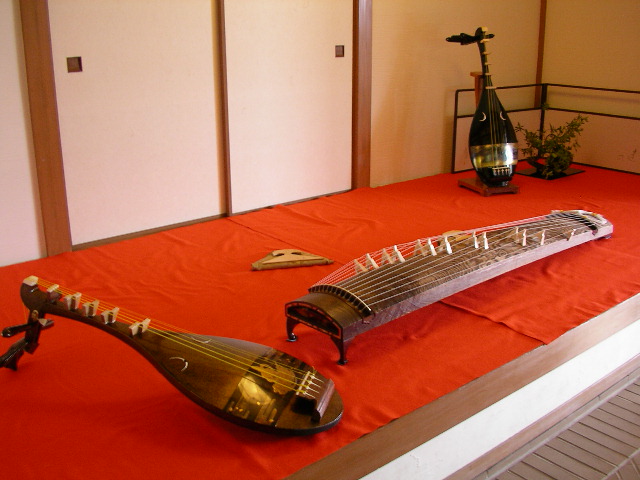
The UCLA Asia Pacific Center's account of biwa performer Yoko Hiraoka's presentation gives the oral background in practical terms: the tale was recited and passed down by biwa-hoshi, blind monks who accompanied the narrative with the biwa.[4] That does not mean every surviving text is just a transcript of performance. It does mean that the translator should hear the opening as an address to listeners, not only as a paragraph for silent reading.
This is where the image of the biwa becomes more than decoration. A real-world photograph of a biwa beside a koto keeps the article close to the instrument culture that carried Heike into rooms, voices, and acts of listening.[6] The point is not to treat an object as proof of textual origin; it is to keep the opening's sound before the reader, so the famous lines remain performance-adjacent rather than purely typographic.
That performance history affects word choice. A translation that over-explains the first sentence can kill the bell before it rings. A translation that over-exoticizes the names can turn the opening into museum glass. The better path is tension: preserve enough foreignness for the sound-world to remain specific, but make the movement of the lines clear enough that the reader feels the doctrine arrive through rhythm.
The First Lines Prepare The Whole Book
The Kyoto National Museum's description of a Muromachi-period Heike handscroll notes the tale's power in visual form: sparse monochrome ink can still depict scenes from the epic with force.[5] That visual afterlife is important because the opening itself is already pictorial and musical. Bells, flowers, dreams, dust: none is a battle scene, yet all prepare the emotional field in which battles will be judged.
The Heike opening therefore does not ask the reader to admire defeat from a safe distance. It asks the reader to listen for the instability inside magnificence. Once that listening has begun, the later rise and collapse of the Taira cannot be understood as mere political reversal. Their fall has been placed inside a rhythm older than their power.
That is why the passage remains difficult to translate. Its language is ceremonial, but it must not become pompous. Its doctrine is Buddhist, but it must not become an explanatory footnote. Its images are famous, but they must not become dead ornaments. The translator has to keep the line moving from sound to sight to human arrogance to dream to dust, without letting any one stage take over.
Read that way, the opening is not a preface to The Tale of the Heike. It is the tale in miniature. Power appears; sound fades. Beauty blooms; color goes. Pride stands; time passes through it. The first thing the narrative gives us is not a hero, a villain, or a battle standard. It gives us a bell whose note cannot stay. Everything that follows is already vibrating inside that disappearance.
Sources
- Internet Archive, A. L. Sadler, trans., The Heike Monogatari (Transactions of the Asiatic Society of Japan, 1918-1921 scan and OCR stream).
- Penguin Random House, The Tale of the Heike, translated by Royall Tyler (publisher page describing the edition, oral-epic orientation, and publication details).
- CiNii Research, Michael Watson, "Hearing the bells of Gion Shōja: Transcultural and intralingual translations of Heike Monogatari" (2025 bibliographic record and abstract, DOI 10.24620/0002000647).
- UCLA Asia Pacific Center, "Biwa and the Tale of Heike" (2007 event report on Yoko Hiraoka, biwa performance, and the biwa-hoshi transmission context).
- Kyoto National Museum Collection Database, "The Tale of the Heike (Heike Monogatari)" (Muromachi-period illustrated handscroll description and object context).
- Wikimedia Commons, "Biwa & Koto.jpg" (real-world photograph of traditional Japanese instruments used for the cover).