Many first-time readers are told that Great Expectations is a twist novel: wait for the benefactor reveal, keep an eye on Miss Havisham, and then admire how neatly Dickens snaps the hidden machinery into place. That advice undersells the book. The real pleasure comes earlier and deeper. Dickens is not mainly teaching you how to solve a mystery. He is teaching you how a mind gets bent by fear, then by shame, then by money, and how long it takes to unlearn the wrong version of improvement.[1][4][5]
That is why the cleanest entry route is not plot-first but pressure-first. Read the novel through three linked zones: the marshes, where Pip learns dread and guilt; Satis House, where he learns class shame; and London, where he learns that money does not clarify a life if the imagination behind it is still deformed.[1][5] Once those zones are in focus, the book stops feeling like a Victorian obligation and starts feeling like live prose about self-invention under bad instruction.
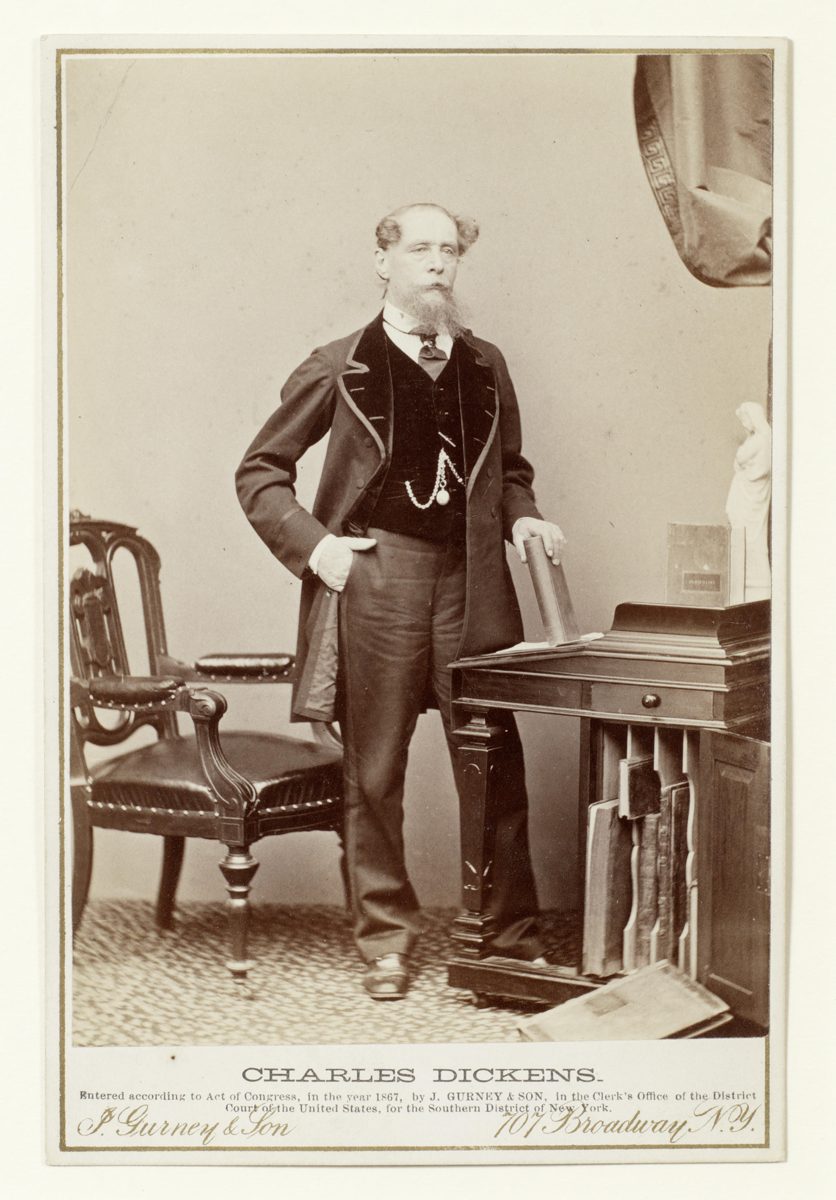
Image context: the lead image uses a real 1867 photographic portrait of Charles Dickens by Jeremiah Gurney. It suits this piece because the novel's hard question is not whether Pip can rise, but whether he can learn to see Joe, Magwitch, and himself without the distorting lens of gentility.[6]
1) Start with the right expectation: this is a novel of re-education
The opening scene tells you almost everything about the novel's method. Pip is a child in a graveyard, the marshes reduced to "a long black horizontal line," the sky cut into "angry red lines," and the first adult force he meets is a convict who turns hunger, pity, and terror into one fused experience.[1] Read that scene slowly. Dickens begins not with drawing-room wit or social ascent, but with a boy whose imagination is trained under pressure from the first page.
That pressure does not disappear when Pip enters society. It gets refined. By the time he reaches Satis House, fear has turned into comparison, and comparison into shame. The book's most useful self-diagnosis is still one of its simplest: "It is a most miserable thing to feel ashamed of home."[1] That sentence is the real hinge of the novel. Once you hear it, the story ceases to be a ladder narrative and becomes an education in misvaluation. Pip does not only want more money. He wants to become the kind of person who would never again feel the humiliation Estella teaches him to feel.[1][4]
So the basic reading contract is this: younger Pip misreads advancement as purification, while older Pip narrates from the far side of that error. The novel's emotional power comes from watching those two versions of Pip occupy the same prose.[1][5]
2) Pick one of three entry routes and stay with it long enough to build momentum
If you try to read Great Expectations as if every chapter should deliver the same kind of pleasure, you will flatten it. The better move is to choose an entry route and keep it for the first hundred pages.
- Route A: the marsh-and-guilt route. Stay close to the convict opening, the churchyard, the forge, the hulks, and the repeated return of prison language. This route works best if you want atmosphere, childhood fear, and the way guilt stains Pip's imagination before class ambition fully arrives.[1][5]
- Route B: the shame-and-gentility route. Follow Satis House, Estella's vocabulary, Pip's embarrassment about Joe, and his growing disgust with whatever looks "coarse and common." This route makes the novel's class education legible very quickly.[1][4]
- Route C: the revised-loyalty route. Read Joe and Magwitch as the book's two hard correctives. Joe gives Pip untheatrical care without glamour; Magwitch gives him money tied to crime, risk, gratitude, and mistaken fantasy. This route makes the benefactor reveal matter less as surprise than as moral rearrangement.[1][5]
All three routes work. The point is commitment. Great Expectations rewards cumulative rereading rather than quick extraction, and modern reading communities still return to it that way: by lingering over how humor, disappointment, aspiration, and love keep changing weight across multiple passes.[2][3]
3) What to annotate so the book opens up instead of merely moving
Use a very small annotation system.
- Hands and work. Track Joe's forge hands, Magwitch's laboring body, Jaggers's professional grip, and Pip's changing relation to manual work. Dickens keeps asking what kinds of touch carry dignity and what kinds merely advertise status.[1]
- Names and titles. Pip wants to become a "gentleman," but the word is unstable all the way through the novel. Mark every time rank, breeding, "commonness," and address terms do evaluative work.[1][4]
- Money and accounting. Great expectations are always attached to ledgers, allowances, debts, patronage, and the fantasy that money can erase origin. Annotating sums and obligations keeps the novel's moral economy visible.[1]
- Crime language. The convict opening is not an isolated Gothic shock. Victorian Web's reading remains useful here: guilt and criminal taint keep returning to Pip's imagination long after he thinks he has moved beyond the marshes.[5]
This is enough. You do not need to annotate every symbol or every secondary character. Dickens is giving you a repeated stress pattern, and these four signals catch most of it.
4) Where readers usually stall, and the reset that works
Many readers lose traction in the London middle. The plot widens, the social world thickens, and Pip can start sounding less interesting precisely because he is becoming more socially legible. That is not a flaw in the book. It is one of Dickens's tests. Pip becomes harder to love when he becomes easier to present.[1][4]
The reset is simple:
- Write three lines on what Pip thinks gentility will erase.
- Write three lines on who keeps returning despite that fantasy: Joe, the convict world, debt, legal language, memory.
- Resume reading with one question in view: what is the novel refusing to let money clean up?[1][5]
That question turns the middle stretch back into an engine. You stop waiting for the next revelation and start measuring the durability of the old contaminations.
5) One line that reframes the whole novel
If you keep only one sentence beside you, keep this one: "It is a most miserable thing to feel ashamed of home."[1]
Why this line? Because it names the book's moral injury without disguising Pip's complicity. Dickens does not let Pip blame Estella alone, or Miss Havisham alone, or poverty alone. Shame enters from outside, but it also gets welcomed, arranged, and turned into aspiration from within.[1][4] The adult narrator can diagnose that process with pain because he knows how thoroughly he collaborated with it.
Once that line is in place, Joe reads differently. He is not only the book's good heart. He is the measure Pip repeatedly fails. Magwitch reads differently too. He is not only a plot device from the marshes returning in dramatic form. He is the person who proves that money can arrive as love, guilt, danger, and misrecognition all at once.[1][5]
6) Why Great Expectations keeps renewing
The novel keeps renewing because it understands a modern humiliation with unusual precision: people rarely want status for status alone. They want the fantasy that a new surface can cancel an old exposure.
That fantasy is why the book remains readable in 2026 without museum glass around it. The Dickens Project's 2024 Great Expectations week is useful evidence of the novel's afterlife because its strongest discussions kept circling rhetoric, friendship, loss, and uncertain endings rather than mere plot solution.[2] The Dickens Museum's contemporary framing is useful for a similar reason: it treats rereading as part of the novel's design rather than an afterthought.[3] Great Expectations improves when you come back older, because the second reading usually shifts your loyalty away from the machinery of advancement and toward the quieter forms of fidelity that Pip sees too late.
So the best way in is also the best way back in: read for fear, then shame, then revision. If you do that, the novel's payoff is not the revelation of who funded Pip. It is the slower recognition of who kept offering him forms of value that his own ambition could not yet read.
Sources
- Charles Dickens, Great Expectations (Project Gutenberg full text).
- The Dickens Project, "Dickens Universe 2024: A Spirited Celebration of Great Expectations".
- Charles Dickens Museum, "The Dickens Reader and finding your Great Expectations".
- Victorian Web, "The Cause of Shame".
- Victorian Web, "Criminally Self-Conscious: Pip's 'Great Expectations'".
- Wikimedia Commons, "File: Charles Dickens by Gurney, 1867.jpg" (lead image source).