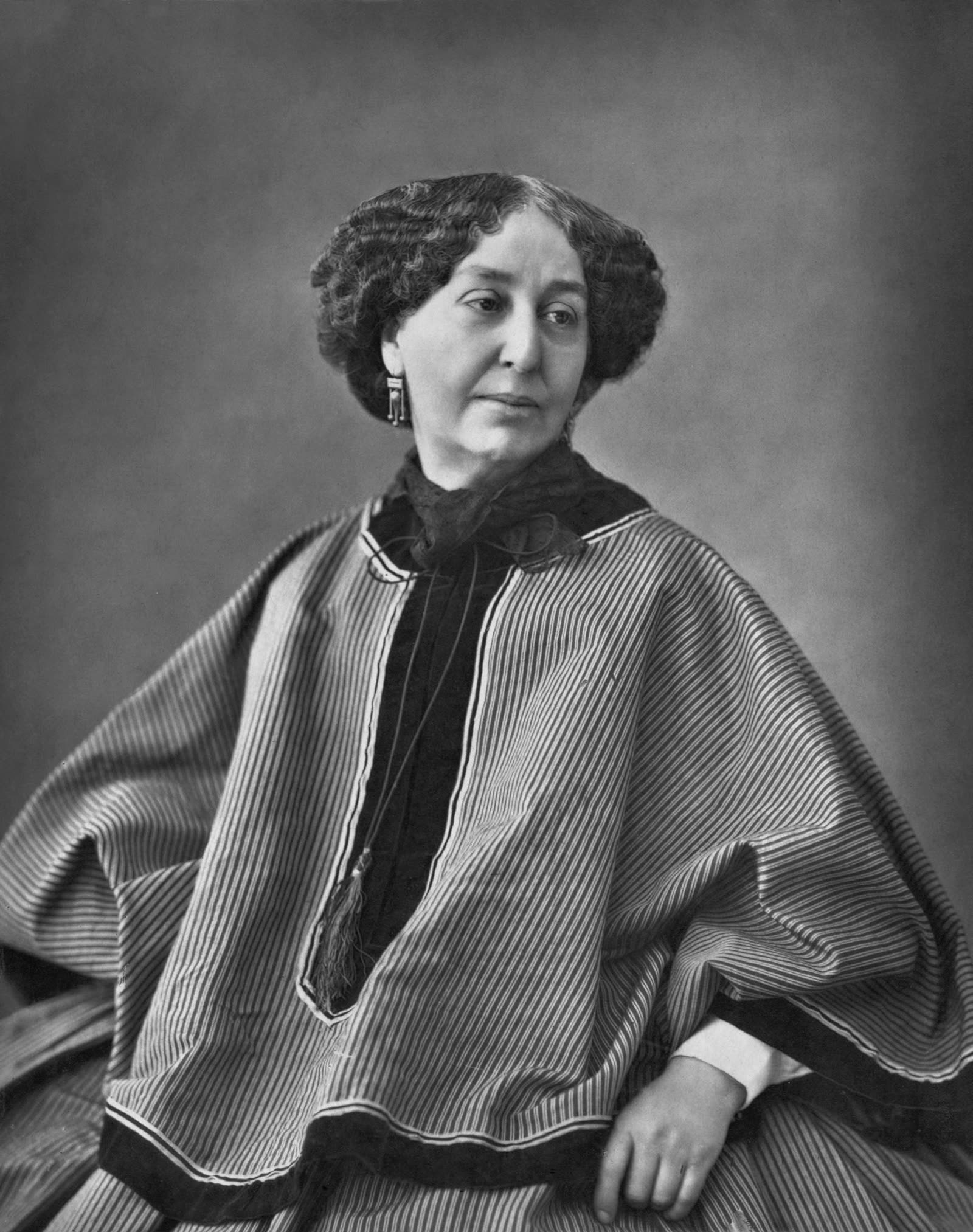
George Sand is easy to turn into a costume before she becomes a writer: the male pen name, the trousers, the cigars, the lovers, the Paris legend. That version is not false, but it is too portable. It lets the afterlife admire an icon of defiance while skipping the harder literary question Sand kept asking: what has to be arranged in the world before freedom becomes more than a mood?
The work answers through systems. In Indiana, freedom runs into marriage, property, colonial distance, and the absence of lawful exit. In Mauprat, freedom has to be educated out of inherited violence. In The Devil's Pool, freedom looks rural and tender, but only because Sand is testing whether labor can be represented without contempt. Even the letters to Flaubert show a writer for whom friendship, rooms, deadlines, theater work, health, and daily errands were part of the same thinking apparatus as novels.[1][2][3][6]
Image context: this is a real photographic portrait by Nadar, not a generated author icon or a decorative bookish placeholder. The image matters because Sand's face has often carried the burden of legend. A work-centered reading should let the photograph stand at the threshold, then move past persona toward the machinery of the books.[7]
The Name Was a Working Device
Sand's public self-invention began inside constraint rather than pure performance. The official history of the George Sand estate notes that Aurore Dupin inherited Nohant in 1821, married Baron Dudevant eight months later, and saw management of the property pass through marriage to her husband.[5] That legal and domestic setting matters. "George Sand" was not simply a stylish mask. It was a way to work, publish, travel, and occupy the literary market with a margin of maneuver that a separated woman needed in practice.
The same estate history says she took the name in 1832 with Indiana, then spent much of her life at Nohant, where she wrote most of a large output across novels, stories, plays, criticism, political articles, autobiography, and correspondence.[5] Project Gutenberg's author page now lists a hundred free eBooks associated with Sand, a crude but useful reminder of scale: she was not a single-scandal novelist whose importance rests on biography alone.[4]
That scale should change how the pen name reads. It was not only a provocation aimed at gender convention, though it certainly disturbed convention. It was a production system. Sand made a name that could carry labor, payment, argument, serial publication, and long public continuity. The persona opened the door; the workload kept walking through it.
Indiana Turns Desire Into Jurisdiction
The temptation with Indiana is to read it only as a fiery protest against marriage. Sand herself complicates that. In the later preface preserved with Project Gutenberg's text, she remembers writing it in 1831 as "my first novel" and says some readers chose to find an "argument against marriage" in it, a charge she says she was "not so ambitious" to design.[1] The denial should not be taken as retreat. It points to the novel's sharper method: Sand does not need to paste a thesis over the book because the conditions of the plot are already argumentative.
Indiana Delmare is not merely unhappy in love. She is trapped in an arrangement where desire, law, age, money, household authority, and colonial geography all press on the same body.[1] Her yearning is therefore never private in the clean romantic sense. Every feeling has a jurisdiction attached to it. A husband can command. A lover can promise without carrying equivalent risk. A woman's reputation can become a social sentence before her own account has force.
That is what makes Sand's early fiction more practical than its melodramatic surfaces may first suggest. The novel does not say, simply, that passion is pure and convention is cruel. It asks what happens when passion enters a world where women have too few recognized instruments for self-defense. Indiana's longing may be rash, but the rashness is not the whole story. Sand's real subject is the gap between inward awakening and external permission.
Mauprat Makes Freedom Learn
If Indiana tests the law around desire, Mauprat tests the education of desire. Project Gutenberg's bibliographic page frames the 1837 novel as a story in which Bernard Mauprat, raised among violent relatives, is pushed toward transformation through Edmee's influence and through questions of women's education.[2] That summary catches the hinge. Sand does not make moral change look instant. She makes it grammatical, social, and difficult.
Bernard begins inside a brutal inheritance. The old Mauprat world is clan, force, insult, enclosure, and masculine appetite licensed by family mythology.[2] In a weaker romance, love would civilize him by magic. Sand refuses that shortcut. Edmee's importance lies not only in being loved but in refusing to let love become a kidnapping of her will. She becomes the figure through whom Bernard discovers that desire must pass through discipline before it can claim moral seriousness.
The practical note matters again. Freedom is not doing whatever one wants at maximum intensity. In Mauprat, that is simply another name for inherited violence. Freedom becomes real only when the self can be revised, taught, delayed, and made answerable to another person's consent. Sand turns romance into pedagogy without draining it of feeling.
The Country Is Not an Escape Hatch
Sand's rural writing is sometimes treated as a retreat from the more obviously scandalous early novels. The Devil's Pool suggests the opposite. The Project Gutenberg text gives the book as an 1846 pastoral novel, and its preface, dated Nohant, April 12, 1851, makes Sand's artistic program explicit.[3] She is not fleeing politics by looking at peasants, fields, children, and marriage customs. She is asking what kind of art can represent ordinary labor without making poverty ugly for the comfort of the comfortable.
Her phrase for the novel's vocation is a "mission of sentiment and love."[3] That can sound soft until the surrounding argument is taken seriously. Sand objects to art that terrifies the rich with threatening images of the poor and thereby increases fear rather than fellow-feeling.[3] Her pastoral method is not ignorance of hardship. It is a counter-method: make the objects of social concern lovable enough that readers cannot keep them at the level of problem or menace.
This is why Nohant matters as more than scenery. The estate history describes the house as Sand's essential living environment, a meeting place for children, friends, artists, and political commitments, and says she remained attached to republican values and the democratic hopes of 1848.[5] The country in Sand is not a postcard. It is a workshop where household, landscape, class, labor, hospitality, theater, and politics keep touching.
The Letters Keep the Door Open
The Sand-Flaubert correspondence gives a late-life counterweight to the solitary genius myth. Project Gutenberg's edition presents the letters as a major exchange between two nineteenth-century writers, and the texture of the correspondence shows how much Sand's literary life depended on relation: encouragement, disagreement, illness, hospitality, deadlines, plays, gossip, and practical help.[6]
One line from Sand to Flaubert is especially revealing: "All the doors between us two are not yet open."[6] It is a sentence about friendship, but it also sounds like a principle of reading Sand. Her fiction keeps opening doors between categories that polite culture prefers to keep separate: desire and law, romance and money, rural feeling and social theory, private life and public authorship, tenderness and discipline.
Flaubert often stands in literary history as the austere master of style; Sand is too easily cast as the abundant heart. The letters make that opposition smaller than either writer deserves. Sand's warmth is not vagueness. It is an ethic of connection that includes judgment, correction, and work. Her novels had been making the same case for decades: the self does not become free by floating away from social bonds. It becomes free, if it does, by changing the terms under which bonds are made.
The Afterlife Should Return to the Work
The reason to keep reading Sand now is not that her life was colorful, though it was. The reason is that her strongest books understand freedom as infrastructure before they understand it as slogan. A name has to circulate. A marriage has to be survivable or escapable. A lover has to answer to consent. A household has to become more than jurisdiction. A rural worker has to be seen without condescension. A friend has to be addressed through doors that are still opening.
That is a more demanding legacy than the poster version of George Sand. The poster says: she broke rules. The novels say: breaking rules matters only if one can build forms of life less false than the rules were. Sand's romanticism is durable because it is not content with flame. It keeps asking for arrangements: rooms, names, educations, letters, estates, customs, and plots in which desire has to learn how to live among other people.
Read that way, George Sand does not become smaller when the legend is stripped back. She becomes more useful. The scandal can introduce her, but the work explains why she lasted.
Sources
- George Sand, Indiana, Project Gutenberg HTML text, including the 1832 and 1842 prefaces.
- George Sand, Mauprat, Project Gutenberg HTML text for the 1837 novel.
- George Sand, The Devil's Pool, Project Gutenberg HTML text, including Sand's Nohant preface.
- Project Gutenberg, "Books by Sand, George," author page and public-domain title list.
- Maison de George Sand, "History of the George Sand estate," official Nohant house history and biographical context.
- George Sand and Gustave Flaubert, The George Sand-Gustave Flaubert Letters, Project Gutenberg HTML text.
- Wikimedia Commons, "File:George Sand by Nadar, 1864.jpg," source page for the archival portrait used as the lead image.