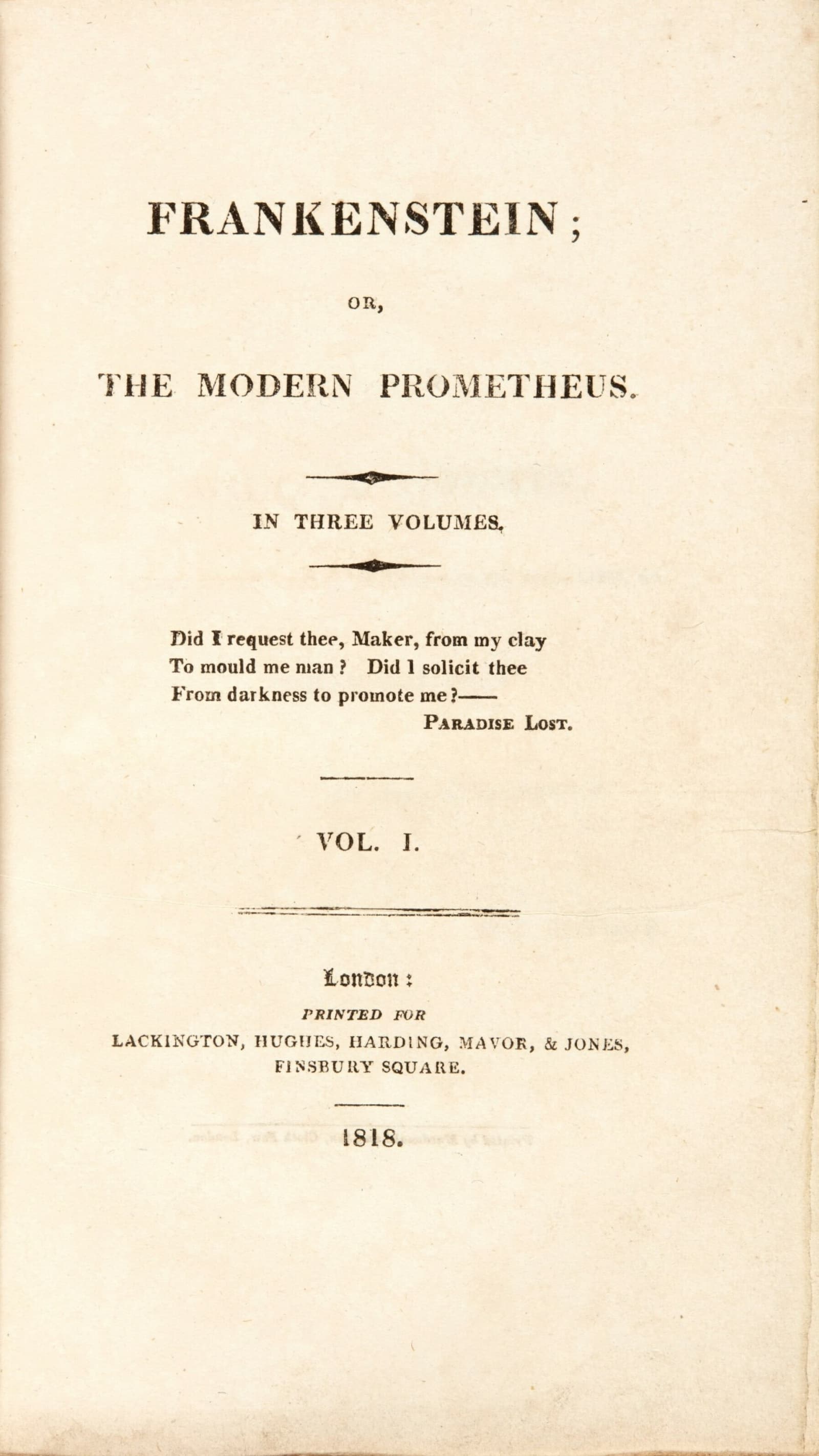
Mary Shelley’s Frankenstein is often remembered as a warning about “playing God,” but the novel’s real power is formal: it keeps converting abstract ethics into recurring material images. If you track three motifs—fire, ice, and eyes—you can see how the book builds a full moral system from scene-level details.
The result is not a single slogan about science. It is a moving structure: desire ignites, responsibility freezes, and recognition fails.
1) Fire: the double image of knowledge
Victor narrates creation as a technical culmination: on the “dreary night of November” he gathers “the instruments of life” to infuse a “spark of being” (Chapter 5). The language is practical and almost liturgical. Fire first appears as controlled power: an image of method, intention, and mastery.
But the novel quickly destabilizes that confidence. In the Creature’s own learning story, fire becomes the most compact lesson in moral ambivalence:
“How strange, I thought, that the same cause should produce such opposite effects!” (Chapter 11)
Heat saves him from cold; embers burn his hand. Fire cooks food; fire also destroys shelter. By placing this discovery in the Creature’s voice, Shelley reverses the usual hierarchy of teacher and taught: the “monster” articulates a more mature epistemology than his maker. He learns, immediately, that power is relational and that utility always comes with cost conditions.
That is why fire in Frankenstein is not merely Promethean theft. It is the novel’s image of mixed consequences. Technical success without relational responsibility is shown, scene by scene, as structurally unstable.
2) Ice: ambition’s stage and accountability’s delay
The book begins and ends in polar space, and that framing is not decorative. In Walton’s letters, Arctic ice is attached to heroic appetite—“What can stop the determined heart and resolved will of man?” (Letter 3). Ice initially functions as frontier glamour: a blank surface on which ambition writes itself.
By the ending, the same environment carries a different charge. The frozen landscape becomes an external version of Victor’s ethical delay: vast, hostile, and thinly traversable. He spends much of the novel postponing responsibility until loss forces confession. In that sense, ice is not only weather; it is tempo.
Shelley’s frame narrative makes this explicit. Walton hears Victor’s story while pursuing a near-identical dream of exceptional achievement. The Arctic setting turns into a recursive warning mechanism: the reader watches one aspirant absorb another aspirant’s wreckage.
So the ice motif does two jobs at once:
- it keeps the novel’s scale epic,
- and it marks the cost of waiting too long to name cause and blame.
3) Eyes and seeing: the politics of recognition
Few visual details in English fiction are as famous as the “dull yellow eye” opening in Chapter 5. That moment is usually read as gothic shock, but Shelley threads eye-language throughout the novel to stage a deeper question: who gets to be seen as human?
Victor’s first reaction is not to renegotiate care but to flee the being he assembled. Later, when deaths accumulate, he reaches the clearest sentence of responsibility in the book:
“I, not in deed, but in effect, was the true murderer.” (Chapter 9)
That line matters because it shifts ethics from intention to consequence. The eye motif and this confession belong together. Victor sees what he has done only after refusing to be seen by the Creature as creator, witness, and answerable partner.
The Creature’s own language confirms that failed recognition is the plot’s central wound. His “I ought to be thy Adam, but I am rather the fallen angel” (Chapter 10) is not decorative biblical borrowing. It is a claim about misclassification: he is interpreted as pure threat before any social contract can form.
In other words, Shelley uses seeing as a legal and moral act. Misrecognition is not a side effect in Frankenstein; it is an engine.
4) Why these motifs still travel
Reception history helps explain why this motif system survives adaptation drift. The 1818 publication context, the surviving notebooks, and the long film afterlife all show that Frankenstein is unusually portable because its symbols are simple but not simplistic.
- Fire can be read as electricity, industry, code, or biotech technique.
- Ice can be wilderness, institutional coldness, or strategic isolation.
- Eyes can be physiognomy, surveillance, stigma, or the demand to be recognized beyond first glance.
That portability is also why the monster’s image in popular cinema can drift far from the novel while the emotional structure remains familiar. Even when adaptation changes plot machinery, the symbolic circuitry still runs: power, abandonment, retaliation, remorse.
5) A practical way to reread the novel
If you return to Frankenstein with this motif map, read each major turning point by asking three questions:
- What kind of power is being “lit” here, and who bears the burn risk?
- Where is responsibility being deferred into cold distance?
- Who is being seen, mis-seen, or refused recognition?
Those questions keep the novel from collapsing into either anti-science cliché or creature-only sympathy. Shelley’s design is harder than that. She gives us a world where making is easy, answerability is delayed, and moral catastrophe begins at the speed of one avoided look.
Sources
- Mary Shelley, Frankenstein; or, The Modern Prometheus (1818 text), Project Gutenberg
- Shelley-Godwin Archive, Frankenstein; or, the Modern Prometheus (manuscript + composition resources)
- Charles E. Robinson (intro excerpt), The Frankenstein Notebooks Introduction, Shelley-Godwin Archive
- Encyclopædia Britannica, Frankenstein; or, The Modern Prometheus (publication context and afterlife overview)
- Encyclopædia Britannica, Frankenstein (1931) film by James Whale (adaptation history anchor)
- Library of Congress, Frankenstein; or, The modern Prometheus (1882 edition record)
- Wikimedia Commons image source — Frankenstein 1818 edition title page.jpg