The first translation problem in The Dream of the Rood is the title. "Rood" is not just an old word for cross. In the poem it has to keep several bodies alive at once: a felled tree, an execution instrument, a battle standard, a relic, a sign, and a witness. A smooth modern title like The Dream of the Cross tells the reader the theology too quickly. "Rood" delays recognition. It lets the object arrive as wood before it hardens into doctrine.[1][2]
That delay is the poem's central power. The dreamer sees a dazzling tree covered with gold and gems, but also blood and wounds. Then the object speaks. The poem survives most fully in the late tenth-century Vercelli Book, while related runic passages are carved on the Ruthwell Cross in Scotland and another witness appears on the Brussels Cross reliquary.[3] Those material facts matter for translation because this is not only a text about an object. It is a poem that kept moving between manuscript, carved stone, liturgy, and devotional memory.[2][3][4]
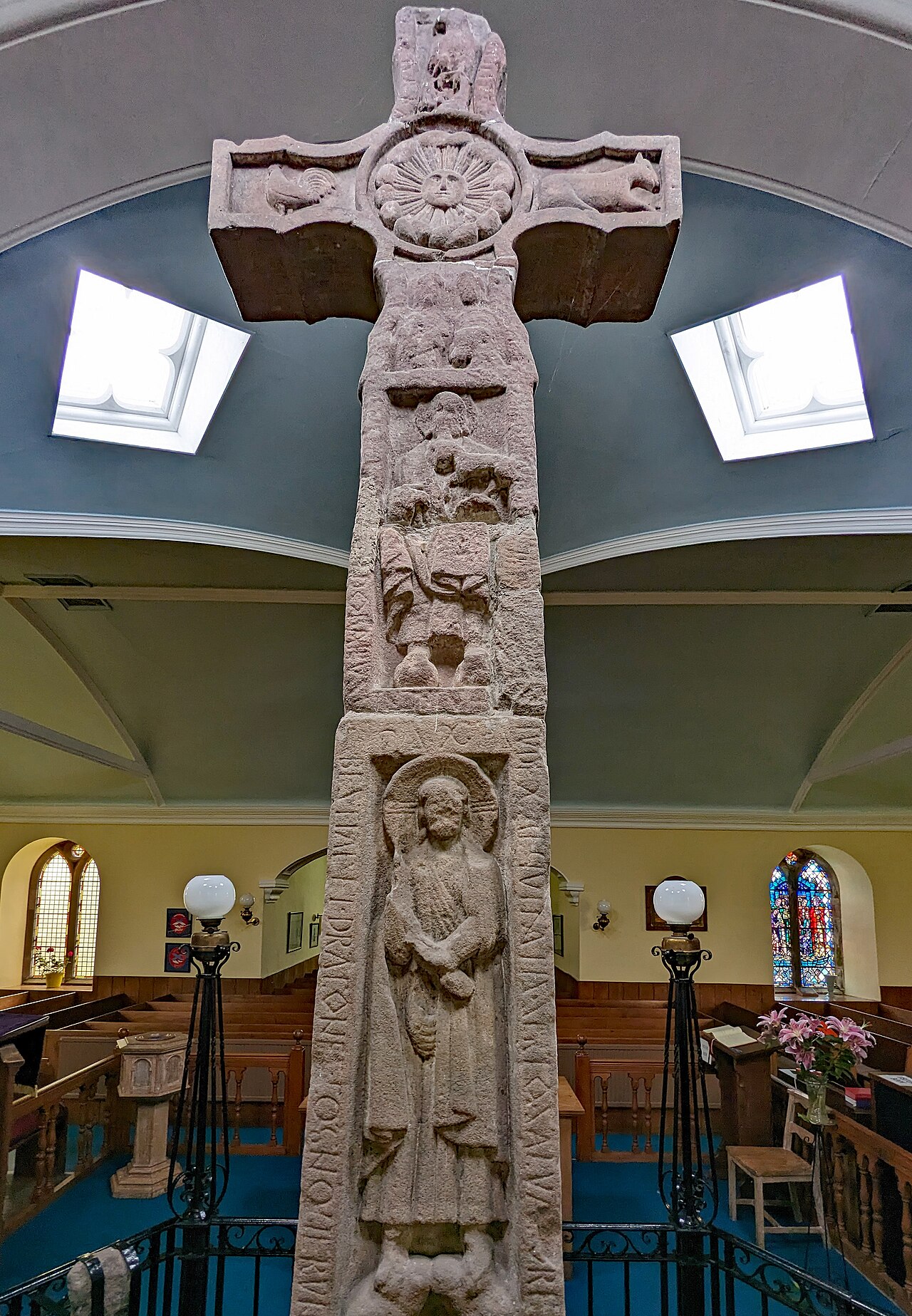
The Ruthwell Cross photograph used as the article image is therefore more than atmosphere. Britannica describes the monument as an early eighth-century Northumbrian work, more than 18 feet high, carved with Gospel scenes, vines, and runic verses from The Dream of the Rood.[4][7] A translator should feel that scale. The poem is intimate because a speaker confesses; it is monumental because the speaking thing also stands in public stone.
"Rood" keeps the wood in the cross
The Old English poem repeatedly reaches for words that keep the object vegetal: tree, beam, wood. The famous phrase "Rōd wæs ic ārǣred" can be rendered flatly as "I was raised as a cross," but that loses the strangeness of a thing becoming a structure while remembering its life as wood.[1] "Raised" helps, because it preserves both erection and exaltation. "Cross" clarifies doctrine. "Rood" keeps the foreignness.
That is why I would not translate every instance into one modern noun. A translation that says only "cross" risks making the object too familiar. A translation that says only "tree" risks hiding the execution. "Rood" is useful because it is half-known: archaic enough to slow the eye, clear enough through context to carry the Passion story. The poem asks the reader to dwell in that slow recognition.
The word "beam" also matters. The speaker commands the dreamer to disclose that this is the "wuldres bēam," the beam of glory.[1] "Beam" in modern English can mean timber, ray of light, or structural support. That range is a gift. It lets the translator keep wood and radiance in one word. The Rood is not only decorated by glory; it bears it.
The cross speaks like a warrior who cannot move
The second translation problem is tone. The Rood speaks with heroic energy, but its heroism is restraint. When Christ approaches, the speaker could destroy the enemies but must stand fast.[1] That scene is easy to flatten into passive suffering. The poem is sharper than that. It imagines obedience as a kind of force under command.
This is where Old English heroic diction does real theological work. Christ is not a fragile victim in the poem's central movement. He mounts the gallows with purpose. The Rood trembles, but it does not collapse. The drama comes from two kinds of strength meeting: Christ's chosen ascent and the cross's forbidden resistance. Translating the scene well means avoiding both sentimental softness and modern action-movie hardness. The poem's violence is public, bodily, and controlled.
The Cambridge Old English Reader summary is useful here because it frames the poem as an intense, original treatment of the cult of the cross and identifies its best-known version as the 156-line Vercelli Book text.[3] That framing changes the grammar of witness. The cross is not scenery. It is a participant that must remember without claiming mastery.
The short line "Crīst wæs on rōde" looks simple, but its simplicity is loaded.[1] "Christ was on the cross" is accurate. "Christ was on the rood" keeps the poem's older pressure. The preposition matters too. Christ is not merely attached to an object; he is borne by a speaker that has just narrated its own cutting, carrying, fixing, wounding, and waiting.
Wounds become legible before doctrine
The poem's most unsettling movement is visual before it is theological. The dreamer sees gold, jewels, blood, and changing color. The Rood is at once splendid and injured. A modern translation can accidentally tidy this by making the glory symbolic and the wounds explanatory. The poem does the reverse: it makes the reader look first, then interpret.
That is why words for surface should stay concrete. Blood should not become "sacrifice" too quickly. Nails should not become "redemption" too quickly. The Rood's wounds are signs, but they are also marks in wood. The poem lets a damaged object speak before it lets doctrine complete the scene.
Cambridge's abstract for Rosemary Woolf's classic article is a reminder of the interpretive caution needed: the relationship between the Ruthwell runes and the Vercelli poem is a matter of conjecture and dispute.[5] Oxford's teaching page makes a similar distinction, warning that the Ruthwell passages should not simply be treated as the whole Vercelli poem carved in advance.[6] Translation should keep that scholarly boundary. The manuscript poem and the monument illuminate one another, but they are not identical containers.
That boundary also improves the reading. The Vercelli poem has a dreamer, a speaking Rood, a command to tell, and a closing turn toward judgment and hope.[2][3] The Ruthwell Cross, by contrast, puts related crucifixion language into an image program of carved Gospel scenes and inscriptions.[4][6] One asks to be heard in a manuscript sequence; the other asks to be read by moving around stone. The shared material is not less powerful because it is not simple. It is more interesting because the poem's witness has already crossed media.
"Disclose in words" is the poem's own poetics
Near the end, the Rood tells the dreamer to "onwrēoh wordum" what he has seen.[1] That phrase can be translated as uncover, reveal, or disclose in words. It is one of the poem's best self-descriptions. Translation is not merely carrying meaning over; it is uncovering an image without pretending the cover was accidental.
"Reveal" has a devotional tone. "Uncover" has a physical one. "Disclose" has an almost legal precision. I prefer "disclose in words" because the poem is so concerned with testimony. The dreamer has seen something that is at once private vision and public command. He must not simply feel it. He must make it communicable.
That command gives the poem its afterlife. The Rood speaks to the dreamer; the dreamer speaks to listeners; scribes preserve the poem; carvers preserve related lines in runes; modern editors, teachers, and translators keep deciding how strange the poem should remain.[2][3][4][6] A too-smooth version makes the poem behave like familiar church language. A better version lets the object remain difficult: a tree that is a gallows, a gallows that is a throne, a wound that is a sign, and a sign that talks back.
The reason The Dream of the Rood still feels alive is not only its age. It survives because it solves a literary problem with startling confidence. How do you narrate an event everyone already knows? You give voice to the object that had to bear it. Then you make every translation choose what kind of object that voice is.
Sources
- Anonymous, The Dream of the Rood Old English text at Wikisource, including line-numbered text and public-domain status note.
- Old English Poetry Project, Rutgers University, "The Vercelli Book" and "Dream of the Rood" pages for manuscript placement and modern translation context.
- Cambridge Core, Richard Marsden, "The Dream of the Rood" in The Cambridge Old English Reader, for the 156-line Vercelli Book version, Ruthwell variant text, and Brussels Cross echo.
- Encyclopaedia Britannica, "Ruthwell Cross" for monument date, height, Northumbrian art context, Gospel carving, and runic inscription details.
- Cambridge Core, Rosemary Woolf, "'The Dream of the Rood' and Anglo-Saxon Monasticism," Traditio 22 (1966), abstract and publication details.
- Oxford Old English Coursepack, "Ruthwell Cross: Relationship to the Poem," for the boundary between the Ruthwell text and the Vercelli poem.
- Wikimedia Commons, "File:Ruthwell Cross 04.jpg" by PaulT (Gunther Tschuch), source page for the photographic cover image.