The speaker of Alice Meynell's “Renouncement” spends almost an entire sonnet keeping someone out of her thoughts. The beloved waits inside every pleasure: blue sky, music, whatever the mind would ordinarily turn toward for relief. Only at the end, asleep and released from vigilance, does she move freely: “I run, I run.” After so much holding back, four ordinary words feel like a door opening.[1]
That acceleration is a useful way into Meynell. Her poems repeatedly make composure something a person has to do. Thoughts need tending; wishes need checking; affection can surprise the person who has prepared herself to receive very little. Their measured surfaces register the effort of keeping a life in order, then let us feel what happens when the order changes.
Born Alice Thompson in 1847, Meynell published Preludes in 1875 and Poems in 1893. Between those books she married, raised a family, and worked in journalism. She coedited the Catholic magazine Merry England with her husband, Wilfrid, and became active in women's suffrage. The public life matters because it keeps the quietness of the writing from becoming an imaginary biography of withdrawal.[2]
The will comes off with the clothes
“Renouncement” opens with a prohibition: “I must not think of thee.” Its first eight lines show how difficult that instruction is to execute. Avoiding the beloved means interrupting experiences that would otherwise be innocent pleasures. The speaker must stop short even of her own most beautiful thoughts, because desire is waiting just beyond them.[1]
Meynell gives the effort a recognizable duration. This is work that fills a day, leaves the watcher tired, and has to begin again. The octave's enclosed rhymes keep returning us to the same small set of sounds. Reading the poem aloud, one can hear a voice repeatedly finding itself where it began.
At line nine, sleep arrives. Yet the sonnet does not immediately grant release. Its final six lines form a single sentence: clauses about sleep, night, loosened bonds, and a will removed like clothing delay the main action until the last line. The repeated obligation has changed direction. Earlier the speaker must refuse; now she must put refusal away.
The final movement is doubly intimate. She runs, actively, and is then gathered, passively, to the beloved's heart. Desire becomes both an action she performs and a welcome she receives. Dreaming does not settle the waking difficulty. The poem ends inside the brief freedom it has made audible.
The Academy of American Poets connects Meynell's early love poetry with her attachment to the Jesuit Augustus Dignam, who helped receive her into the Catholic Church. That context explains something of the stakes, but it cannot replace the poem's particular achievement. No biographical label conveys the sensation of waiting thirteen lines for that run.[2]
Keeping the flock in view
“The Shepherdess” offers a more settled picture of inward government. Its central metaphor is announced without disguise: “Her flocks are thoughts.” The woman guards, feeds, and brings those thoughts home for sleep. Her mind has a landscape and a daily occupation.[1]
The poem's three six-line stanzas use only two rhyme sounds throughout. A recurring pair of lines brings the shepherdess back before us, walking with her flock. That small musical enclosure suits the subject: the poem keeps its own sounds as carefully as she keeps her thoughts.
There is room for play inside it. The thoughts run and leap, while she holds them in sight. Attention allows movement. Reading this beside “Renouncement,” we can hear two different experiences of self-command: an exhausting refusal and a form of care that lets what it guards remain lively.
But “The Shepherdess” also asks for a little resistance from its reader. The woman is presented by an admiring speaker, and the language prizes her purity and correctness. This is a portrait of an ideal, with the limitations an ideal can impose. We should not simply turn it into Meynell's declaration of what every woman ought to be. Her other writing gives intimacy less predictable feelings.
A mother receives more than she expects
In “The Modern Mother,” a child's exuberant kiss arrives at a breast already troubled by misgiving. The mother's expectations diminish as she thinks them through: first tenderness, then gratitude, then forgiveness. Having given life does not, in her reckoning, establish an uncomplicated claim on the person who must live it.[1]
The alternation of line lengths helps enact this emotional revision. Short lines repeatedly open into longer ones, so an exclamation develops into a qualification or an uncomfortable thought. Affection catches the mother before she has finished explaining why she deserves so little of it.
The child therefore has something to give that her calculations could not produce. Its loving gaze becomes a guide for her. Read alongside the watchful shepherdess, this mother changes the direction of care: the adult who tends another life can also receive light from it. Meynell's restraint makes the excess of affection palpable.
Who gets to be alone?
Her essay “Solitude,” collected in the 1899 edition of The Spirit of Place, moves the question of inward freedom into streets, boarding houses, and households. Some people, she observes, never possess even an hour away from other people's casual scrutiny. Solitude depends partly on circumstances that an individual cannot create by exercising willpower.[3]
The essay is also willing to correct itself. Meynell first proposes measuring solitude in days, then decides that persons are the better measure. A place remains available for distinct experiences, however many people have been alone there before. The sentence revises its own accounting as her thought becomes more exact.
Her language has limits. She sometimes assumes that crowded people do not understand what they lack, and her confidence that a few steps into the countryside can secure privacy sits uneasily beside the deprivation she describes. Yet she makes a forceful distinction between owning extensive grounds and experiencing solitude. A large private park does not guarantee an inward life.
Most strikingly, she finds a shared solitude in a mother and newborn, once the bustle of attendants and visitors subsides. The woman's blood now moves beside her in a separate body, with another rhythm. Here closeness makes separateness perceptible. The image offers a way to understand the unexpected embrace in “The Modern Mother”: love reaches someone whose life cannot simply be counted as one's own.[3]
Walter de la Mare praised Meynell as a poet who could “think in verse,” a judgment preserved in the Academy's biography.[2] These poems make that praise concrete. A delayed main clause lets desire outrun discipline; a refrain holds moving thoughts in view; a mother's revised expectations leave room for a child's gift. Meynell asks us to attend to the small formal decisions through which a person gains, yields, or protects freedom. Her quiet has things happening inside it.
Sources
- Alice Meynell, The Poems of Alice Meynell: Complete Edition (McClelland & Stewart, 1923), Project Gutenberg transcription. “Renouncement,” lines 1–14; “The Shepherdess,” stanzas 1–3; and “The Modern Mother,” stanzas 1–4.
- Academy of American Poets, “About Alice Meynell.” Biography, publication chronology, editorial and suffrage work, the Dignam relationship, and Walter de la Mare's assessment.
- Alice Meynell, “Solitude,” in The Spirit of Place, and Other Essays, Project Gutenberg transcription of the 1899 John Lane edition. Social access to solitude, the essay's changing units of measurement, and mother-and-child intimacy.
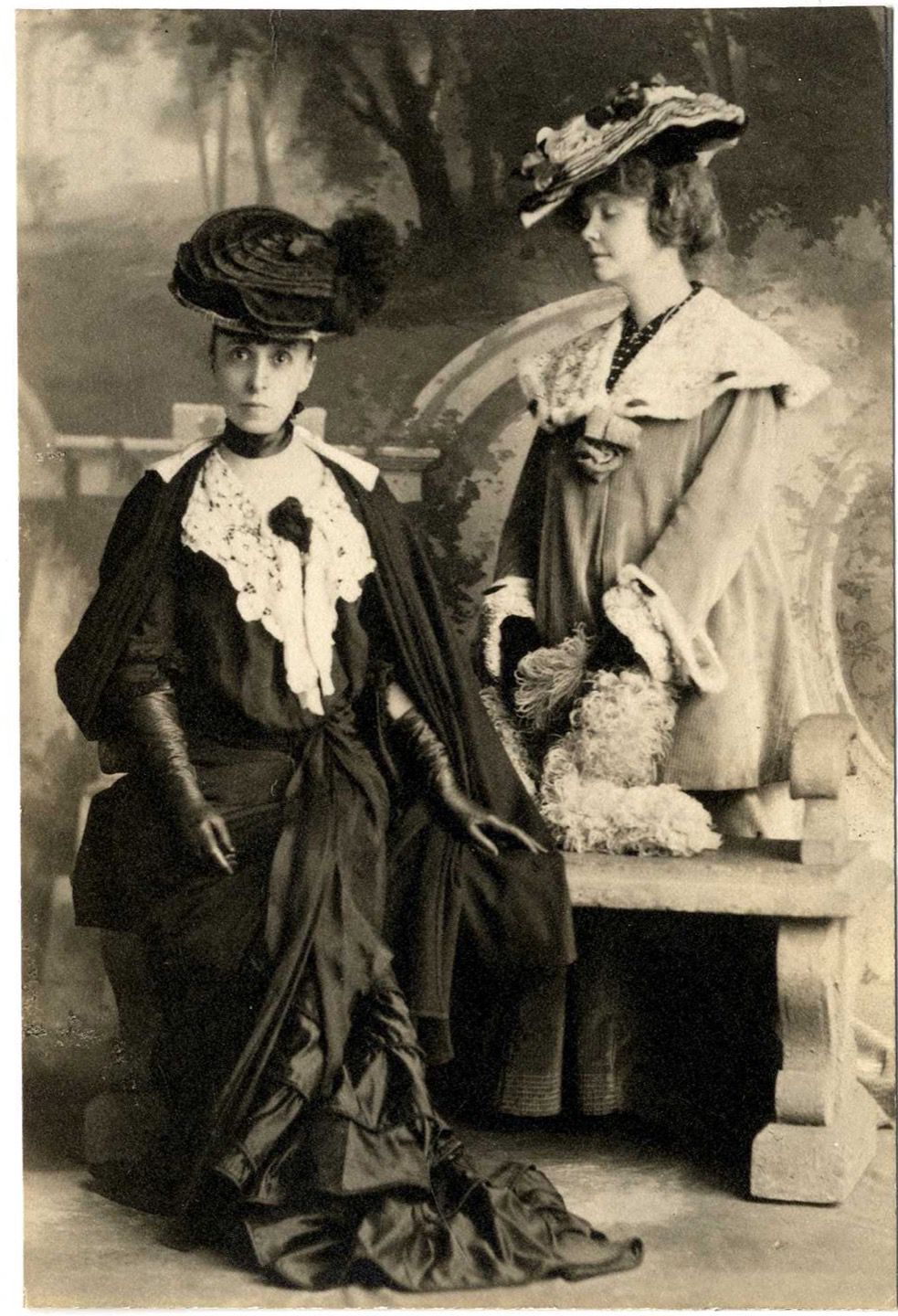
- Boston College Libraries, “Personal Objects,” The Object in the Archives. Undated photograph of Alice Meynell and Agnes Tobin, Boston College Collection of Alice Meynell, MS1986-061, box 2, folder 16.