In December 2023, a camera trap in Jiaozuo, Henan, recorded a female North China leopard with a cub about three months old. In the researchers’ catalogue the cub has a code, Jz10, and a row of its own. Three photographs, one video, one station. Under home range, the entry reads “N/A.” The team could say who had been there. Where else that cub went was an open question. [1]
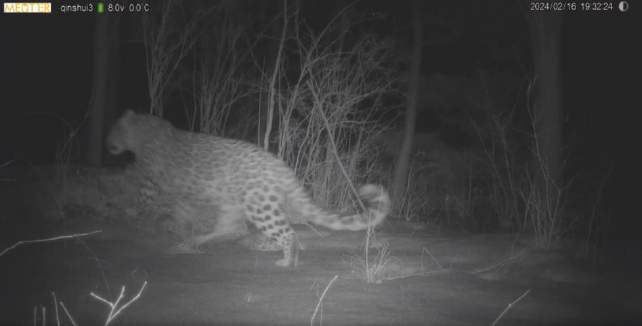
An earlier survey in northern China set two cameras facing each other on a trail. One took three pictures when triggered, the other recorded ten seconds of video. A leopard passing between them could leave a record of both flanks. That extra view is valuable months later, when another camera catches the animal coming the other way. In Tie Qiao Shan Nature Reserve, researchers used individual coat patterns to assemble repeat sightings for a population density estimate. If one animal acquires two identities in a catalogue, a return visit can look like the arrival of another cat. [3][4]
A place for an unfamiliar face
In a 2026 study, researchers working in Henan’s Taihang Mountains put a neural network called LeoNet to work on that filing problem. The reference collection took some building. Researchers first identified wild cats by hand and set aside blurred or obscured images. Only 20 wild adults had enough usable pictures across body regions for training. Photographs from Chinese zoos widened the collection to include captive leopards and jaguars. The team trained the model to recognize individuals from views that a camera might actually get, including a tail. [1]
A field catalogue has to admit newcomers. If the software always picks its closest familiar face, the first sighting of a cub could go straight into another animal’s file. LeoNet assigned each proposed match a confidence score. When even its strongest match fell below a threshold, it flagged the animal as unfamiliar. That flag still leaves a question for the researcher. Two poorly matched pictures could show the same newcomer, two newcomers, or a familiar leopard photographed awkwardly. [1]
The team tried the procedure on 696 field images collected from February 2023 through June 2024. When several body regions were visible, each could supply a vote on identity. Two specialists independently checked the results before the records went into the catalogue. Seven previously recorded cats turned up again, and three individuals, Jz10 among them, joined the list. Across eight years the team had documented 41 wild leopards. That total covers animals observed at different times across the survey. [1]
What a second station buys
Consider another Jiaozuo leopard, an adult male coded JZ01M. Thirteen stations recorded him. Each confirmed match gave the team a location and a time, enough to put his sightings in order and draw a polygon around the outermost stations. Its area, 9.43 square kilometres, is a minimum estimate based on where the cameras caught him. He could have ranged beyond its edges or taken a long detour between two neighboring cameras. [1]
For Jz10, even a perfect match across all three photographs would still yield a single point. A later sighting at a different station would do something another hundred frames from the first camera never could. It would put a second place in the cub’s history. [1]
Sources
- He and colleagues, “A Lightweight Deep Neural Network for Individual Leopard Identification,” Integrative Zoology (2026), methods, Table 2 and Figure 9.
- Sustainable Ecosystem Restoration and Biodiversity Conservation Project, environmental impact assessment, Lishan camera-trap photograph and field account.
- “Temporal activity patterns of North China leopards and their prey in response to moonlight and habitat factors,” Ecology and Evolution (2022), paired camera setup.
- “Population Density and Driving Factors of North China Leopards in Tie Qiao Shan Nature Reserve,” Animals (2021), individual identification and density estimation.