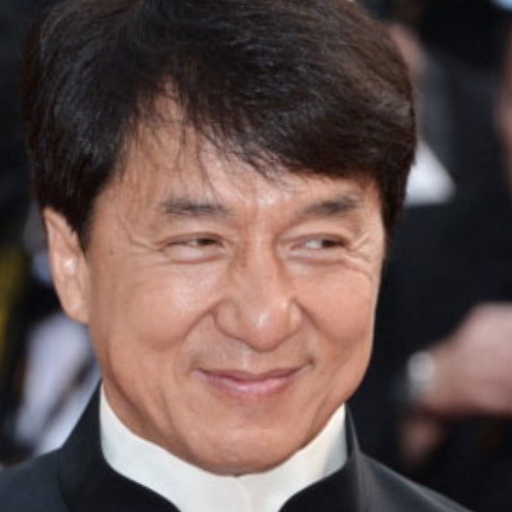
Tencent’s face-restoration project includes a small photographic puzzle. The team supplies a blurred photograph of Jackie Chan and three restorations of it, each made with a different release of GFPGAN. All three versions had the same evidence about his face. Which one got his eyes right? Recognition offers a tempting shortcut here. A viewer who knows Chan can recognize him in the input, too.[1]
A test with an answer in reserve
In 2021, Xintao Wang and colleagues at Tencent’s Applied Research Center built a test in which they could actually check the answer. They started with 3,000 held-out CelebA-HQ photographs. They blurred, downsampled, added noise and applied JPEG compression to produce damaged copies. The restoration system saw the copies. The researchers kept the clean portraits for scoring. In the blind-restoration experiment in Table 1, input and output had the same dimensions. The difficult part was deciding what belonged inside the pixels already there.[2]
Two columns in that table tell different stories about the very same faces. Measured by pixel error, leaving the damaged input alone earned 25.35 decibels of peak signal-to-noise ratio. Running GFPGAN brought that down to 25.08. Higher is better on this measure. Yet the average identity distance fell from 47.94 degrees to 34.60, an improvement. Those degrees describe an angle between two numerical representations made by the ArcFace recognition system. They have nothing to do with how far the sitter turned their head. A smaller angle means that ArcFace judged the reconstruction a closer likeness to the clean portrait.[2]
Imagine a blurred eyelid. Several positions for a thin dark lash could account for the same gray patch. Draw one lash a pixel too high and you introduce two errors against the original photograph. One row is now too dark and the next too light. Leaving the gray patch alone can cost less on a pixel score. A viewer, meanwhile, may find the eye with a distinct lid easier to read. This is a small example of a problem Yochai Blau and Tomer Michaeli formalized in their work on image restoration. Optimizing agreement with the original pixels and producing images that look like natural photographs can pull an algorithm in different directions.[3]
Where the lashes come from
GFPGAN has a source of detail beyond the damaged print. A generator trained on high-quality faces has learned patterns for rendering features such as eyes and mouths. Another part of the system reads the damaged face and guides the generator using features at several scales. During training, the researchers also used ArcFace to reward likeness to the original person. That last choice matters when reading the table. The identity score measures an ability the team explicitly taught the system, using the same recognition model to define likeness during training and evaluation.[2]
The release notes translate that distinction into terms a portrait owner might notice. Tencent describes version 1.2 as sharp, with a tendency to add a makeup effect. The team credits 1.3 with more natural-looking results on badly degraded inputs while acknowledging that it can slightly change the subject’s likeness. These are observations about particular releases. The numerical scores in the 2021 paper belong to the research model. Assigning them to every downloadable version would erase precisely the differences that the team’s examples let a viewer inspect.[1][4]
Return to Chan’s portrait and the comparison becomes more interesting if you already recognize him. Cover the reconstructions and pick a detail you could defend from the input alone, perhaps the outline of an eye. Then look across the three versions and see where they disagree inside that outline. On the synthetic test the researchers could open a clean file and settle a dispute about a lash. On the project’s comparison page, the first column holds the blurred photograph. Each additional column records another model’s reading of it.[1][2]
Sources
- Tencent ARC, GFPGAN version comparisons, including the Jackie Chan input portrait and three outputs
- Xintao Wang and colleagues, “Towards Real-World Blind Face Restoration With Generative Facial Prior,” CVPR 2021, sections 3–4 and Table 1
- Yochai Blau and Tomer Michaeli, “The Perception-Distortion Tradeoff,” CVPR 2018
- Tencent ARC, GFPGAN project documentation and model-version guide