After Brown v. Board of Education, school desegregation still had to pass a harder test than legal doctrine alone could answer: once a federal court had spoken, who would physically open the door?[1][2][3] Little Rock in 1957 and Ole Miss in 1962 asked that question under different pressure. Both crises forced Washington to decide whether federal authority would remain abstract or arrive as bodies, vehicles, and lines of protection around Black students trying to claim admission.[1][2][3][4][5]
The comparison matters because the two episodes are often flattened into one generic story of federal intervention in the civil rights era. They were related, but they were not operationally identical. In Little Rock, Governor Orval Faubus used the Arkansas National Guard itself as the barrier, so President Dwight Eisenhower's answer had to begin by taking that state force away from the governor and then adding the 101st Airborne Division to escort nine teenagers into a public high school day after day.[1][2] At the University of Mississippi, John F. Kennedy faced a different geometry. James Meredith was a single adult registrant, his route had been shaped by more than a year of litigation, and Washington first tried to enforce the court's order through U.S. marshals and Justice Department officials before riot conditions forced the addition of federalized Guard units and regular Army troops.[3][4][5]
That is the central claim of this comparative history: Little Rock and Ole Miss were both schoolhouse-door crises, but they required two different federal corridors. One corridor was broad, visible, and sustained around a high school under siege. The other began narrow and juridical around one man's registration, then widened violently when a mob turned procedure into open confrontation.[1][2][3][4][5]
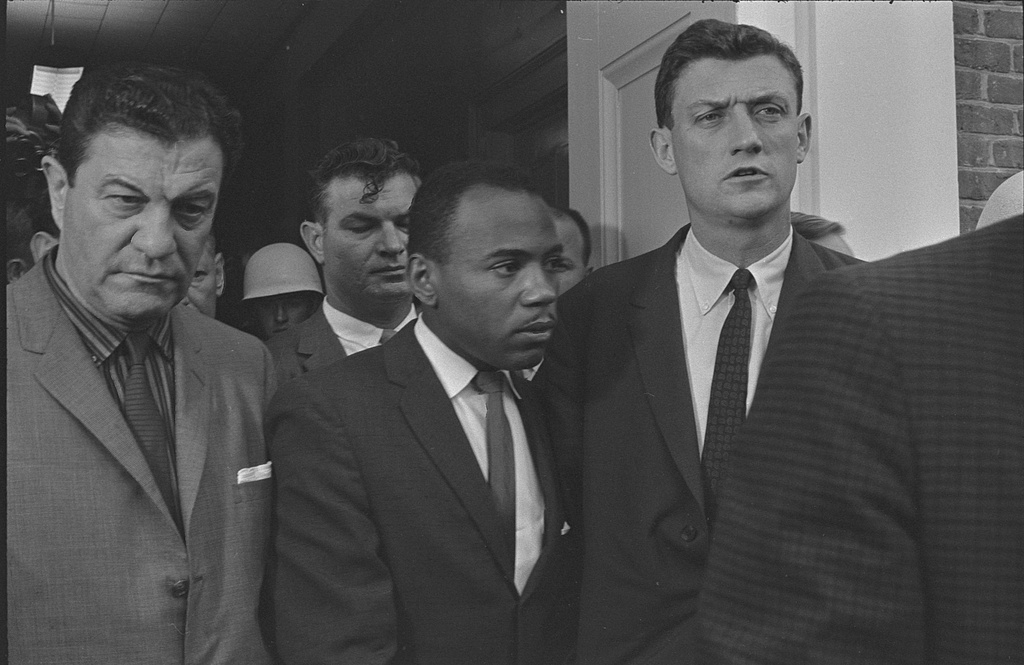
Image context: the cover uses a Library of Congress photograph made on October 1, 1962, showing James Meredith walking on the University of Mississippi campus beside U.S. marshals.[6] It fits this article because the picture compresses the Ole Miss model into one frame: law had to be translated into movement, and that movement had to be guarded all the way to class.
Timeline anchors
- September 2-4, 1957: Faubus orders the Arkansas National Guard into Little Rock, and the Little Rock Nine are turned away from Central High when the school year begins.[1]
- September 23-25, 1957: the students briefly enter under local protection, rioting erupts, Mayor Woodrow Mann asks Washington for help, Eisenhower federalizes the Guard, and the 101st Airborne escorts the students to their first full day of school.[1][2]
- January 1961-September 1962: James Meredith applies to Ole Miss, is rejected and delayed through a long legal fight, and makes repeated attempts to register under court order.[3][4]
- September 30-October 1, 1962: Kennedy federalizes the Mississippi National Guard, Army troops move into reserve and then onto the scene, and Meredith registers and attends class after a night of deadly campus violence.[3][4][5]
Little Rock: the state militia became the obstacle, so Eisenhower had to seize the corridor first
Little Rock's crisis was public from the beginning because the obstruction was public.[1][2] The National Park Service summary lays out the sequence with unusual clarity. On September 2, 1957, Faubus sent the Arkansas National Guard into Little Rock, claiming that tensions around integration threatened public order. Two days later, when the school year opened, the Guard stopped the nine Black students from entering Central High.[1] The key fact here is not simply that the governor opposed desegregation. It is that he used a state military instrument to convert opposition into a physical blockade.
That detail shaped the federal answer. Local and state authority had not merely failed to protect court-ordered integration; part of that authority had been repurposed to prevent it.[1][2] Even after Judge Ronald Davies ordered the obstruction lifted, the crisis did not settle. On September 23, the students managed to attend classes briefly under state and local police protection, but the day collapsed under rioting outside the school.[1] When the mayor urgently asked Eisenhower for help, the president could not simply add rhetorical support to a standing court order. He had to rebuild the chain of command around the school.
The Eisenhower Presidential Library's document guide makes that shift legible in administrative terms.[2] On September 23, Eisenhower issued Proclamation 3204 on obstruction of justice; on September 24, he followed with Executive Order 10730, the instrument that federalized the Arkansas National Guard and authorized the use of federal troops.[2] This mattered because it reversed the earlier logic of force. The same Guard that had been used to block the students was placed under federal control, and the 101st Airborne Division became the visible guarantor of entry.[1][2]
The result was a wide and unmistakable enforcement corridor.[1] On September 25, soldiers escorted the Little Rock Nine through the crowd and into school for their first full day. According to the NPS account, troops remained at the school for the rest of the academic year, protecting the students as they moved between classes.[1] That continuity is what made the Little Rock model distinctive. Washington was not protecting one legal appointment or one hour of registration. It was making daily attendance possible inside a building that had become a symbol of state defiance.
Ole Miss: the federal government tried a narrower legal corridor before the campus exploded
The University of Mississippi crisis began less theatrically and more procedurally, which is exactly why the later violence can be misunderstood.[3][4][5] James Meredith's challenge did not appear overnight at a school gate. The JFK Library's Ole Miss microsite traces it back to January 1961, when Meredith requested an application and submitted it to a university that remained whites only.[4] Rejection, litigation, contempt fights, and repeated maneuvering by Mississippi officials followed across 1961 and 1962.[4] By the time Meredith approached campus in late September 1962, the issue had already been worked through letters, filings, hearings, appeals, and federal orders.
That longer paper trail produced a different initial federal design. Kennedy did not begin with a school-year military escort of the kind Little Rock had required.[3][4] The route to compliance ran first through a narrower enforcement lane: marshals, Justice Department lawyers, and a single registrant whose right to enroll had already been established in court. The JFK Library's civil rights overview summarizes the hinge well. Meredith attempted to register four times without success, long telephone calls between the White House and Governor Ross Barnett failed, and federal marshals accompanied Meredith to campus in another effort to execute the law.[3]
The Ole Miss microsite then shows how quickly that limited corridor broke down under mass resistance.[4] Meredith made a first registration attempt on campus while Barnett personally blocked him. A second arrangement also collapsed. By September 30, Kennedy federalized the Mississippi National Guard and dispatched Army troops to Memphis in reserve.[4] The very need for those steps reveals the difference from Little Rock. Washington had tried to keep the enforcement footprint smaller and more juridical, but the political environment in Oxford turned registration into a campus-wide sovereignty fight.
The Library of Congress event summary names the scale of that escalation directly.[5] Meredith's admission triggered a riot driven by a mob of 3,000 whites from across the South, and Kennedy responded by sending 20,000 regular Army troops, in addition to federalized Mississippi National Guard soldiers, to restore order.[5] The next day, October 1, 1962, Justice Department attorney John Doar escorted Meredith to register, and Meredith then attended class under federal protection.[4][6] In other words, the Ole Miss corridor began as a law-enforcement path around one man and ended, temporarily, as a military stabilization operation around an entire campus.
What changed between the two crises
The most useful comparison is not that one president cared and the other cared differently. It is that the federal problem itself had changed.[1][2][3][4][5] In Little Rock, nine minors had to pass through a city-centered school crisis in which the governor had openly mobilized state troops against them. Federal intervention therefore had to be immediate, conspicuous, and durable enough to carry an entire school year.[1][2] In Oxford, the claimant was an adult Air Force veteran whose case had already traveled deep into the courts. The first federal task was to enforce a specific registration order through marshals and civil-rights lawyers, not to occupy a public high school indefinitely.[3][4]
Yet the comparison also shows a continuity that matters just as much. Both episodes proved that civil-rights victories after Brown depended on operational design, not only constitutional language.[1][2][3] Courts could define rights. Presidents still had to decide what kind of federal body would move those rights across hostile ground. In 1957, the corridor had to be taken from a governor and handed to soldiers. In 1962, it began with marshals and paper authority, then had to be widened because mass violence made a narrow corridor untenable.[2][3][4][5]
That contrast helps explain why the imagery of the two crises feels different even when the stakes were closely related. Little Rock is remembered in troop lines, bayonets, and a school entrance staged before a crowd.[1] Ole Miss is often remembered in photographs of Meredith walking between federal men, which suggest a thinner corridor of movement until you remember the riot, the deaths, and the massive troop presence that had to stand behind that walk.[5][6] The camera frames differ because the enforcement designs differed.
Why this comparison still matters
Read together, Little Rock and Ole Miss show that federal power in the civil-rights era was never only a matter of moral language or courtroom victory.[1][2][3] It was logistical. It involved command relationships, escort depth, reserve force, timing, and the decision about whether Washington was protecting a building, a route, a registrant, or an ongoing school day. The shape of the federal answer changed from one crisis to the next because the obstruction changed shape too.
That is why these two schoolhouse doors should be remembered side by side.[1][2][3][4][5] Little Rock demonstrated that a governor could turn state force into a segregation barrier and that the federal government would sometimes have to seize that force back. Ole Miss demonstrated that even a narrower court-ordered registration could trigger a campus insurrection large enough to require marshals, Guard units, and troops in layers. The common thread is not simple repetition. It is the repeated necessity of converting civil rights into protected motion.
The strongest lesson, then, is practical. Desegregation did not advance only because the law was right. It advanced because, at decisive moments in 1957 and 1962, Washington built corridors strong enough to move Black students through spaces that local power had tried to close.[1][2][3][4][5][6]
Sources
- National Park Service, "Arkansas: Little Rock Central High School National Historic Site" - summary of the September 1957 sequence from Faubus's Guard deployment to the 101st Airborne escort and continued protection of the Little Rock Nine.
- Eisenhower Presidential Library, "Civil Rights: The Little Rock School Integration Crisis" - document guide covering Faubus, Mayor Mann's request, Proclamation 3204, Executive Order 10730, and Eisenhower's Little Rock actions in September 1957.
- JFK Library, "The Modern Civil Rights Movement and the Kennedy Administration" - overview of civil-rights enforcement, including Little Rock, Meredith's repeated registration attempts, the Ole Miss riot, and Kennedy's use of Guard units and federal troops.
- JFK Library, "Ole Miss: James Meredith" - timeline of Meredith's application, rejection, court battle, Barnett's obstruction, Kennedy's federalization of the Mississippi National Guard, and Meredith's October 1, 1962 registration.
- Library of Congress, "James Meredith & the Ole Miss Riot" - event summary noting the 3,000-person mob and the dispatch of 20,000 regular Army troops alongside federalized Mississippi National Guard forces.
- Library of Congress, "Integration at Ole Miss(issippi) Univ(ersity)" - source page for the October 1, 1962 Marion S. Trikosko photograph used as the cover image.