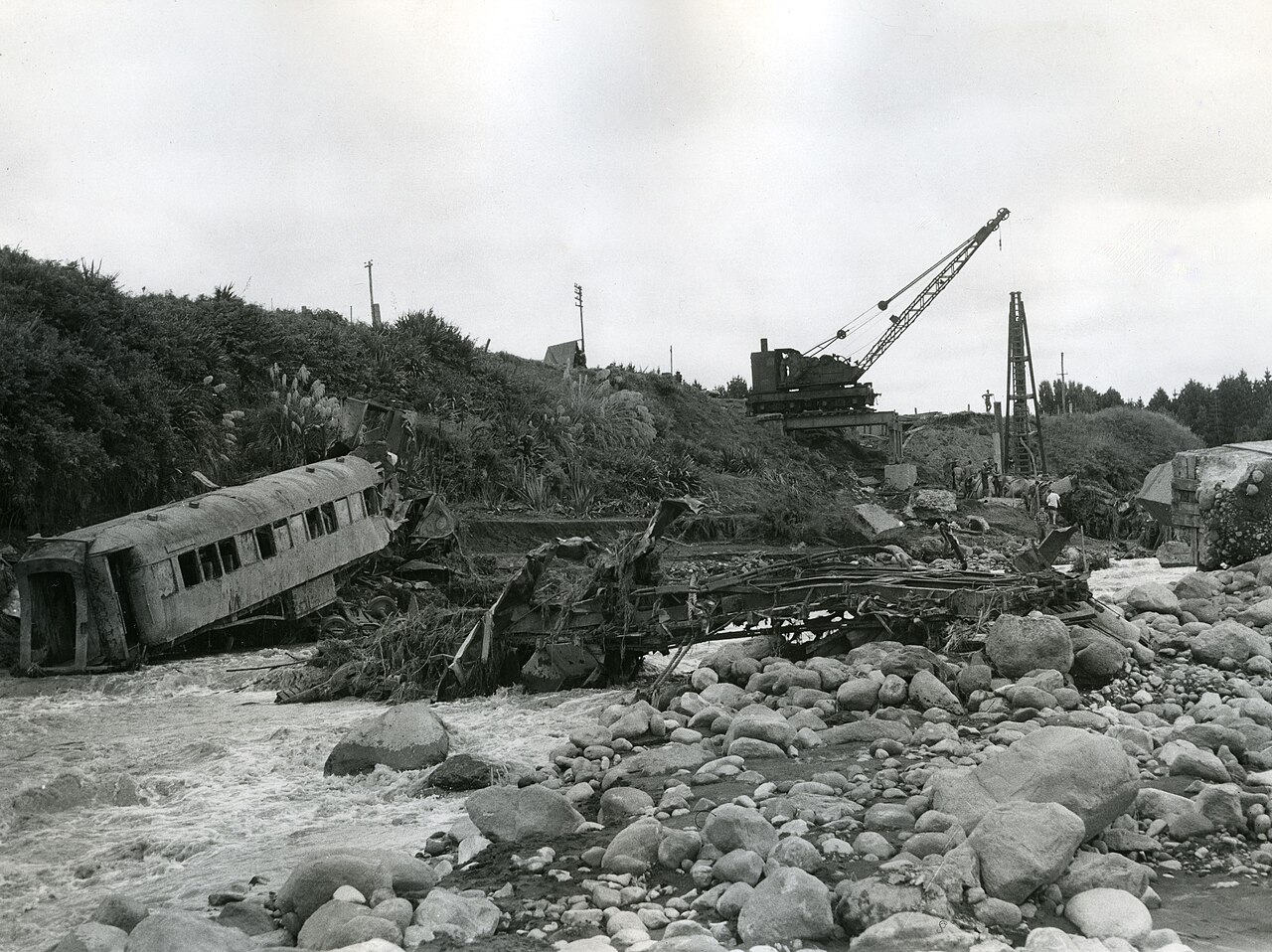
At 10:20 p.m. on December 24, 1953, the Wellington–Auckland night express passed Tangiwai station on time. One minute later, its locomotive reached a railway bridge that was no longer whole. The engine, its tender, and six of the train's nine passenger carriages went into the flooded Whangaehu River. Of the 285 people aboard, 151 died.[1][2]
The familiar summary—volcanic mudflow destroys bridge, train plunges into river—is accurate but too smooth. It makes the catastrophe sound simultaneous, as though mountain, bridge, and locomotive failed in one stroke. They did not. A lake barrier high on Mount Ruapehu broke more than two hours before the crash. The resulting lahar reached the bridge only minutes before the express. A motorist ran toward the approaching headlamp with a torch, and the crew braked. The inquiry could not determine whether the crew reacted to his signal or saw the damaged crossing in the headlight beam. What the evidence does establish is that braking helped keep the rear vehicles on the rails but began too late for the people travelling near the locomotive.[1][2][4]
Tangiwai is best reconstructed as two journeys converging on a single crossing. One began with a holiday train leaving Wellington at 3 p.m. The other began when water broke through volcanic debris at 8:02 p.m. Their paths joined at 10:21 p.m. The disaster lay in that timetable—and in the absence of any system able to turn an upstream rupture into a railway stop signal before the last desperate seconds.
3 p.m.: the night express goes north
Train No. 626 left Wellington for Auckland with five second-class carriages marshalled toward the front, followed by four first-class carriages and two service vans. It was Christmas Eve, and the passengers were travelling through a country absorbed by the first visit of a reigning monarch. Queen Elizabeth II and Prince Philip had arrived the day before. Many aboard hoped to see the royal tour farther north; others were simply going home with presents.[1][5][6]
The North Island Main Trunk was the country's central railway artery. Its engineering had made an overnight journey between Wellington and Auckland routine, and routine is important here: nothing about the train's departure suggested an expedition into a hazard zone. The weather was fine. A goods train crossed the Whangaehu bridge at about 7 p.m. and found the river apparently normal.[1]
Yet the railway entered a volcanic drainage system. The Whangaehu begins at Ruapehu's crater lake. An eruption in 1945 had emptied the lake and left volcanic rubble, ash, and ice across its outlet. Water slowly returned behind that unstable barrier. By 1953, Te Ara's geological account says, the lake stood about eight metres above its pre-eruption level.[2]
The risk therefore existed before Christmas Eve, but it was not visible from the train. This was not an erupting volcano announcing itself with fire and ash. Ruapehu seemed quiet. The stored water, rather than a new eruption, supplied the energy that mattered.
8:02 p.m.: the second journey begins
At 8:02 p.m., the debris barrier gave way. Water escaped into the head of the Whangaehu, gathered ash, sand, ice, and boulders, and became a lahar moving down the established river channel.[1][2][3] The distinction between a flood and a solid object began to break down: the flow was water carrying enough abrasive and heavy material to strike bridge piers as a moving load.
The train, meanwhile, continued north. It left Waiōuru at 10:09 p.m. The lahar reached bridge No. 136 at roughly 10:10–10:15 p.m., although the evidence does not support a more exact minute. It washed out pier 4 and left spans unsupported. The bridge had not been gradually closed by a rising rain-fed river; it changed from passable to broken inside the gap between scheduled trains.[1]
That gap is the event's hinge. At 7 p.m., a railway crossing offered no obvious warning. By 10:15, it had been struck. At 10:20, the express passed the last station before the river. There was no upstream detector connected to railway control and no automatic signal triggered by river height, so no inspection or stop order was initiated during the roughly five-to-eleven-minute interval between the bridge strike and the train's arrival. The hazard moved for more than two hours, but the railway only encountered it at the end.[1][4]
The torch and the final 200 metres
Motorist Cyril Ellis attempted an improvised warning at the bridge. He had stopped because the nearby road bridge was under water despite the clear night. Seeing the locomotive's light, he ran toward it along the track and waved a torch. As the train approached, driver Charles Parker and fireman Lance Redman shut off steam and fuel and made an emergency brake application about 200 metres before the railway bridge. The inquiry left the trigger explicitly open: Ellis's torch or the crew's own view of the river and damaged crossing.[1][4]
At the train's reported speed of roughly 65 kilometres per hour, that distance was not enough to stop a heavy express. But braking changed what followed. The locomotive and the five second-class carriages crossed onto the damaged structure and fell. The leading first-class carriage, known as Car Z, initially remained suspended at the broken edge. The final three passenger carriages and the vans stayed on the track.[1]
Parker and Redman died at their controls. It is tempting to treat the braking either as a failure, because the front of the train was lost, or as a complete rescue, because the rear remained. It was neither. It was a last intervention inside a sequence that had already narrowed to seconds. The brake application could shed speed and keep part of the consist behind the failure point; it could not repeal momentum.
The order of the carriages then became an order of survival. NZ History records that 148 of the 151 people killed had been travelling second class; just 28 of more than 170 second-class passengers survived. Only one first-class passenger died, along with Parker and Redman. The disparity was not produced by different tickets after the crash. It was built into where the cars stood before it: second class nearest the locomotive and the missing spans, first class largely behind them.[1]
10:21–10:35 p.m.: the train comes apart
The lahar did more than derail the express. It turned the river into a fast-moving field of wreckage. Four of the forward carriages were destroyed in the torrent; one was carried more than two kilometres downstream. Oil from the locomotive mixed with cold volcanic water, silt, timber, metal, and vegetation.[1][2][5]
Car Z shows how quickly the situation kept changing after the first impact. It balanced at the bridge for several minutes while Ellis and guard William Inglis tried to move its occupants rearward. At about 10:30 p.m., its coupling broke and the carriage fell. It rolled downstream before lodging on its side. Ellis, Inglis, and passenger John Holman broke windows and brought people out; 21 of the carriage's 22 passengers survived. As the water fell, survivors formed a human chain to reach the bank.[1]
Elsewhere, Arthur Bell helped people from a carriage thrown against the bank while his wife went to raise the alarm. Police, forestry workers, Ministry of Works staff, military personnel from Waiōuru, farmers, and other volunteers improvised most of the response on site. New Zealand had a rudimentary, aviation-focused search-and-rescue network in 1953, but not the functioning civil-defence structure it would have by 1968. The main lahar flow had substantially subsided by about 10:35 p.m., but darkness, debris, oil, and fast water kept the work dangerous.[1][9]
By midnight, survivors were reaching Waiōuru Camp Hospital. Recovered bodies began arriving around 4 a.m. The river made the accident site much larger than the bridge: bodies were found as far as 130 kilometres downstream, and twenty were never recovered.[1]
What the inquiry could—and could not—blame
The Board of Inquiry reported on April 23, 1954. Its central finding was that railway employees had exercised reasonable care and that unpredictable lahar forces caused a soundly constructed and maintained bridge to fail. No prosecution followed. The board recommended an upstream warning system.[1][4][6]
The “no blame” finding did not end the consequences of blame. Brett's later archival study treats Tangiwai's classification as an apparently natural tragedy as part of its long aftermath, shaping how compensation, trauma, behavioural change, and commemoration were discussed—or left undiscussed.[6]
That conclusion did not make the prior history disappear. A 1925 lahar had damaged the same bridge, and NZ History records that amateur geologists' concern about the crater barrier had received little official attention.[1] This supports a later negligence reading: the mountain and river had given warnings, so Tangiwai should not be filed as an unknowable “act of God.”
The strongest counterreading is narrower than saying nobody knew lahars existed. Brett notes that such flows were rare and poorly understood, that the 1925 event had not destroyed the bridge, and that disaster on the 1953 scale lay outside contemporary operational expectations.[5] The inquiry's claim and the warning evidence can therefore coexist. A general hazard was knowable; the time and magnitude of this breakout were not forecast in a form the railway could act upon.
The decisive missing link was detection. If evidence had shown an actionable structural defect ignored after inspection, or a reliable forecast left disconnected from railway operations, the balance of responsibility would shift. The record summarized by the inquiry and later historians instead shows scattered knowledge without an operating chain from crater lake to signal box. Tangiwai was not a place without warning signs. It was a place without a warning system.
After 1953: making the two journeys communicate
The practical answer was to connect the river's movement to transport decisions. A flood-detection warning system was installed in the river after the disaster, and later systems became more sophisticated.[1][8][10] When another crater-lake barrier failed on March 18, 2007, the Eastern Ruapehu Lahar Alarm and Warning System detected the event. Alerts and closures separated traffic from the flow; no one was killed, and damage was minor.[8]
That comparison should not be made into a simple victory story. The 2007 lahar differed from the 1953 event, and monitoring cannot eliminate volcanic risk. It does reveal what changed. In 1953, the lahar and the express travelled independently until the crew's braking—whether prompted by Ellis or by the view ahead—linked train operations to the danger in the final 200 metres. Later infrastructure moved that point of contact upstream and earlier in time.[4]
The archival photograph fixes the cost of the old arrangement: a carriage on a raw riverbank, its body twisted open, with workers and recovery equipment beside it.[5][7] It is not an image of a volcano overwhelming modernity from outside. Railway and river already occupied the same corridor. The catastrophe came when the schedule of one could not register the sudden schedule of the other.
Tangiwai was two journeys arriving at one bridge. The historical lesson is equally paired. Parker's brakes and the improvised rescue saved lives after the available time had almost vanished. The warning system built afterward addressed the harder problem: creating time before courage became the only safeguard left.
Sources
- Manatū Taonga — Ministry for Culture and Heritage, NZ History, Tangiwai disaster feature — official timeline, train and bridge sequence, rescue record, class distribution, inquiry findings, and warning-system legacy across “Wrong place at the wrong time,” “Search and rescue,” and “Death at Tangiwai: a class affair”
- Eileen McSaveney, Carol Stewart, and Graham Leonard, Te Ara — The Encyclopedia of New Zealand, “Ruapehu and the Tangiwai disaster” (2009) — crater-lake setting, lahar formation, derailment, and Car Z rescue.
- M. G. Webby, New Zealand Department of Conservation, Mt Ruapehu Crater Lake lahar hazard (1999) — hydraulic reconstruction of the 1953 flow, including travel time, peak-discharge modelling, observational uncertainty, and later warning implications.
- New Zealand Railways Board of Inquiry, Tangiwai Railway Disaster: Report of Board of Inquiry (Government Printer, 1954) — digitized primary report, including the Ellis-or-headlight uncertainty, bridge findings, reasonable-care decision, and recommendations.
- André Brett, “Lahar Meets Locomotive: New Zealand's Tangiwai Railway Disaster of Christmas Eve 1953,” Arcadia 2018, no. 31, Rachel Carson Center for Environment and Society — environmental-transport context, consist order, survival disparity, and historical interpretation.
- André Brett, “Fading into the Murky Past: Legacies of New Zealand's Hyde and Tangiwai Railway Disasters,” Journal of Disaster Studies 1, no. 2 (2024) — archival study of blame, trauma, behavioural change, and commemoration.
- Archives New Zealand via Wikimedia Commons, “In remembrance of the Tangiwai disaster (11440633043)” — source record for the December 27, 1953 New Zealand Railways Corporation photograph, archive reference AAVK W3493 D1812.
- U.S. Geological Survey, “Important lessons from a deadly lahar in New Zealand 60 years ago” (2013) — 1945–1953 crater-lake sequence and the warning-system response to the 2007 breakout lahar.
- Manatū Taonga — Ministry for Culture and Heritage, NZ History, “Police response to disaster” (updated 2025) — the rudimentary 1953 SAR network, improvised Tangiwai arrangements, and later civil-defence development.
- Eileen McSaveney and Simon Nathan, Te Ara — The Encyclopedia of New Zealand, “Lahar warning system” (2009) — record of the flood-detection system installed after Tangiwai.