The first Quebec Bridge collapse is often remembered as an engineering morality tale: a great cantilever span got too ambitious, failed during construction, and forced the profession to learn humility. That memory is useful, but it is too smooth. The bridge did not fall because ambition alone is dangerous. It fell because ambition was allowed to outrun the machinery that should have constrained it.
On August 29, 1907, the south arm and part of the unfinished structure dropped into the St. Lawrence River near Quebec City. Parks Canada, in its National Historic Site description, records the 1907 collapse as the loss of 76 lives before the later successful bridge was completed in 1917 with a 548.6-meter main span, still the longest cantilever span in the world.[2] The finished bridge became an engineering landmark, but its first failure was not an unfortunate prelude. It was the central lesson.
The causal chain was plain enough after the fact. The Royal Commission appointed after the disaster found that the collapse resulted from failure of the lower chords in the anchor arm near the main pier; those chords failed because of defective design, not abnormal weather or an accidental event.[1] It also found that a grave error had been made in assuming the bridge's dead load too low and then not revising that assumption when the actual design weight grew.[1] In other words, the bridge was asking its own compression members to carry a structure heavier than the calculations had honestly admitted.
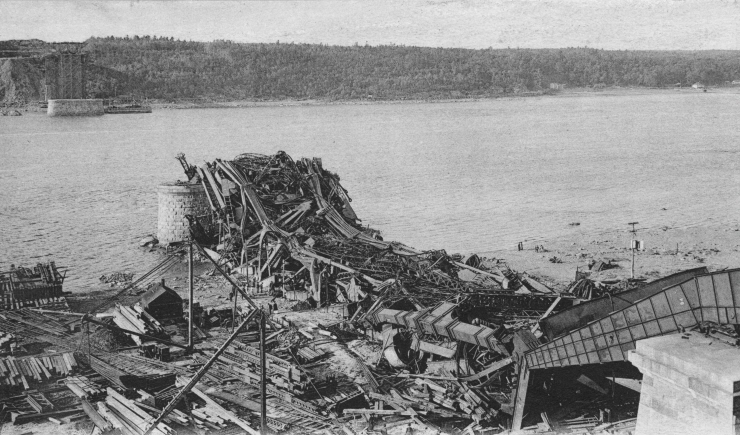
Image context: the cover uses a real 1907 archival photographic print from the McCord Stewart Museum record, reproduced on Wikimedia Commons. It is not a diagram or generated reconstruction. The value of the image is physical: the twisted steel keeps the article's argument grounded in an actual load path that failed, not in an abstract warning about overconfidence.[6]
A crossing problem became a scale problem
Quebec's desire for a bridge was understandable. The St. Lawrence was the city's commercial artery and barrier at once. A fixed rail crossing would connect lines, reduce seasonal dependence on ferries and ice, and let Quebec compete more directly with Montreal's rail-linked port economy.[4] The engineering problem, however, was severe: deep water, ice, strong current, tides, and the need for a long navigation span pushed designers toward a cantilever bridge of unusual size.[4]
That scale mattered from the beginning. The bridge was not simply another truss made longer. A cantilever span works by balancing projecting arms, anchor arms, suspended span, piers, and anchorage forces. Every pound of steel added to the arms is also a demand on members already carrying the growing dead weight of construction. The project therefore depended on a disciplined loop: estimate dead load, design members, update estimates as drawings became real, and stop when the numbers no longer matched the structure.
The loop broke. The UNC Charlotte ASCE failure-case study notes that Theodore Cooper increased the clear span from 1,600 feet to 1,800 feet in 1900, a decision with engineering reasons, including avoiding deep-water piers and ice exposure, but one that also made the project the longest cantilever bridge in the world.[4] A longer span raised the stakes of every assumption. The bridge needed not only bold design, but a checking culture equal to a first-of-its-kind structure.
The Royal Commission did not reduce the disaster to cheap steel. It found that the steel was of good quality and that fabrication and erection work were generally good; the serious defects were fundamental errors in design.[1] That is the uncomfortable part. A disaster can happen even when many visible craft processes are competent, if the governing assumptions beneath them are wrong.
The dead load error was not a bookkeeping detail
"Dead load" sounds static, almost harmless. In a bridge under construction, it is the weight that keeps arriving before the bridge is complete: steel members, connections, traveler equipment, and partial spans hanging before the final structural system can share load as intended. If the dead load is underestimated, the error is not cosmetic. It means the bridge is literally heavier than the stress sheets believe.
The Royal Commission stated the error bluntly: the assumed dead load was too low and was not afterwards revised.[1] The UNC Charlotte case study, summarizing the commission's comparisons, gives the practical scale of the mismatch: the actual dead load exceeded assumptions by roughly 17.6 percent for the half suspended span, 19.7 percent for the cantilever arm, and 30 percent for the anchor arm.[4] Those percentages are the hinge of the story. The bridge was not merely close to a limit in an elegant theoretical sense. Some of its most important members were being asked to work in a heavier bridge than the one that had been approved.
The lower chords were especially unforgiving because they were compression members in the anchor arm. Compression failure rarely gives the romantic warning people imagine from a slow tear in tension. A long built-up compression member can deform, bow, redistribute force badly, and then lose capacity suddenly once local weakness and global load converge. The Royal Commission found that the lower chords near the main pier failed because their design was defective, and that the stresses came in the regular course of erection.[1]
That phrase, "regular course of erection," is essential. It means the collapse did not require a freak storm, sabotage, or an extraordinary construction mishap. The bridge was failing under the work it was supposed to survive on the way to becoming a bridge. The event's historical force lies there: the ordinary sequence had become unsafe.
The warning signs were real, but weak in authority
There were warnings before the fall. The case study describes noticeable deflections in chords, misaligned rivet holes, and increasing bends in heavily loaded compression members as erection progressed.[4] Those symptoms were not decorative irregularities. They were the structure expressing a disagreement with the design sheets.
The deepest problem was not that nobody saw anything. It was that seeing did not translate quickly enough into command. The Royal Commission criticized the Quebec Bridge and Railway Company for failing to appoint an experienced bridge engineer as chief engineer, which produced loose and inefficient supervision by the owner.[1] Theodore Cooper, the prominent consulting engineer, had great professional standing, but he exercised authority from a distance.[1][4] The project's approval system concentrated trust in one remote expert while the structure itself was changing daily over the river.
This is where the story becomes an authority failure, not only a calculation failure. Cooper's reputation made his selection understandable; the commission explicitly said confidence in his judgment had been deserved by his record.[1] But a first-of-its-kind bridge did not need deserved confidence alone. It needed independent checking, owner-side competence, and a procedure that made field warnings more powerful than schedule momentum.
The commission's most humane finding is also its hardest: after August 27, 1907, it did not believe the fall could have been prevented safely by bracing or taking down the structure, but it said the loss of life on August 29 might have been prevented by better judgment from those in responsible charge.[1] That distinction matters. The bridge may have been beyond rescue by then. The workers did not have to be.
The disaster landed hardest in Kahnawake
The collapse was not only a professional failure in steel. It was a community wound. Canada's History records that 33 Kahnawake Mohawk men died in the Quebec Bridge collapse, leaving 25 widows and 53 children without fathers.[5] The Mohawk name preserved in that article, Shontoskwenne, means "when the bridge fell."[5]
That memory changes the scale of the disaster. Engineering histories often move quickly from failure to reform, from wreckage to improved standards. The Kahnawake record insists on another timeline: households, children, widows, and a community whose high-steel tradition carried both pride and loss. The bridge's dead load was steel; the historical load after the collapse was social.
This point should not be used sentimentally. It belongs inside the mechanism. A technical hierarchy made decisions about risk; workers occupied the risk physically. When lower chords bent, when rivet holes failed to line up, when telegrams and judgments moved through the management chain, the people most exposed were not the officials most empowered to stop the job.
The second bridge shows what the first one failed to build
The final Quebec Bridge is a remarkable achievement precisely because it did not simply repeat the first plan with more confidence. Parks Canada notes that Canadian engineers overcame the technical problems that caused the earlier collapse by using nickel steel and an innovative K-truss design.[2] ASCE summarizes the larger afterlife: design flaws and management errors caused the first collapse; the disaster led to new research and testing methods and better designer-contractor coordination.[3]
The story still had another tragedy. In 1916, during construction of the redesigned bridge, a 5,000-ton center span fell into the river while being raised, killing 13 workers.[3] The completed bridge opened afterward and became an International Historic Civil Engineering Landmark.[3] That sequence matters because it resists simple redemption. Learning from one failure does not make a project immune to another. It only changes where the next weak link may hide.
The successful bridge also clarifies the first failure. The problem was not that a long cantilever over the St. Lawrence could not be built. It could. The problem was that the first project treated unprecedented scale as if reputation, informal confidence, and insufficiently revised calculations could carry what only rigorous verification should carry.
What the Quebec Bridge still teaches
The Quebec Bridge collapse is strongest as a causal mechanism because every link is legible. The site demanded a long span. The long span magnified weight assumptions. Dead load estimates were too low. Lower-chord design did not carry the actual compression demands. Deflections appeared. Authority remained too distant and too concentrated. Owner-side supervision was too weak. By the time stopping the structure itself became obvious, safely undoing the danger was no longer practical.[1][4]
That is a more useful lesson than "engineers were arrogant." Arrogance may have been present, but systems do not fail only when personalities are bad. They fail when a project has no reliable way to force assumptions back into contact with evidence. The Quebec Bridge did not need less ambition. It needed a stronger discipline for revising ambition when the steel began to tell a different story.
The wreckage photograph holds the lesson in one frame.[6] It shows the aftermath of calculations that did not keep up with mass, warnings that did not outrank hierarchy, and a structure that was treated as nearly buildable until it was no longer standing. The bridge failed when authority outran weight. The history still matters because modern infrastructure can repeat that pattern in quieter forms: models that become untouchable, field observations treated as inconvenience, and responsibility diffused until the people at risk have the least power to stop the work.
Sources
- Royal Commission, Quebec Bridge Inquiry Report (1908) - official inquiry findings on lower-chord failure, defective design, dead-load underestimation, supervision, and preventability of worker loss.
- Parks Canada, "Quebec Bridge National Historic Site of Canada" - heritage description of the completed bridge, 548.6-meter cantilever span, 1907 loss of life, nickel steel, and K-truss redesign.
- American Society of Civil Engineers, "Quebec Bridge" - landmark summary of the 1907 design and management failures, 1916 center-span collapse, completion, and civil-engineering legacy.
- UNC Charlotte William States Lee College of Engineering, "The Collapse of the Quebec Bridge, 1907" - ASCE failure-case study on site constraints, span lengthening, Cooper, dead-load mismatch, deflections, and project organization.
- Canada's History, "A Community's Loss" - account of the 33 Kahnawake Mohawk workers killed in the 1907 collapse and the community memory of Shontoskwenne.
- Wikimedia Commons, "File:Pont de Quebec 1907.jpg" - source page for the 1907 McCord Stewart Museum archival photographic print used as this article image.