The Port Chicago disaster is easiest to remember as a single night: July 17, 1944, when ammunition exploded on Suisun Bay and killed 320 people at the Navy's West Coast loading site.[1][3] That memory is accurate, but it is incomplete. The more revealing historical question is why a blast at a wartime ammunition pier turned, within weeks, into the largest mass mutiny trial in U.S. naval history.[1][2]
The answer was not simply fear, disobedience, or one bad command decision. Port Chicago became a mutiny case because three systems that had been kept administratively separate were, in practice, one system: dangerous high-speed ammunition work, racially segregated labor under white command, and a wartime disciplinary structure that read refusal through obedience before it read refusal through safety.[1][2][3][4][5] Once the pier vanished, that separation could not hold. The men who survived knew what the work had cost. The Navy still needed ammunition loaded for the Pacific. Command treated the crisis as a labor-discipline problem, and the legal machinery followed.
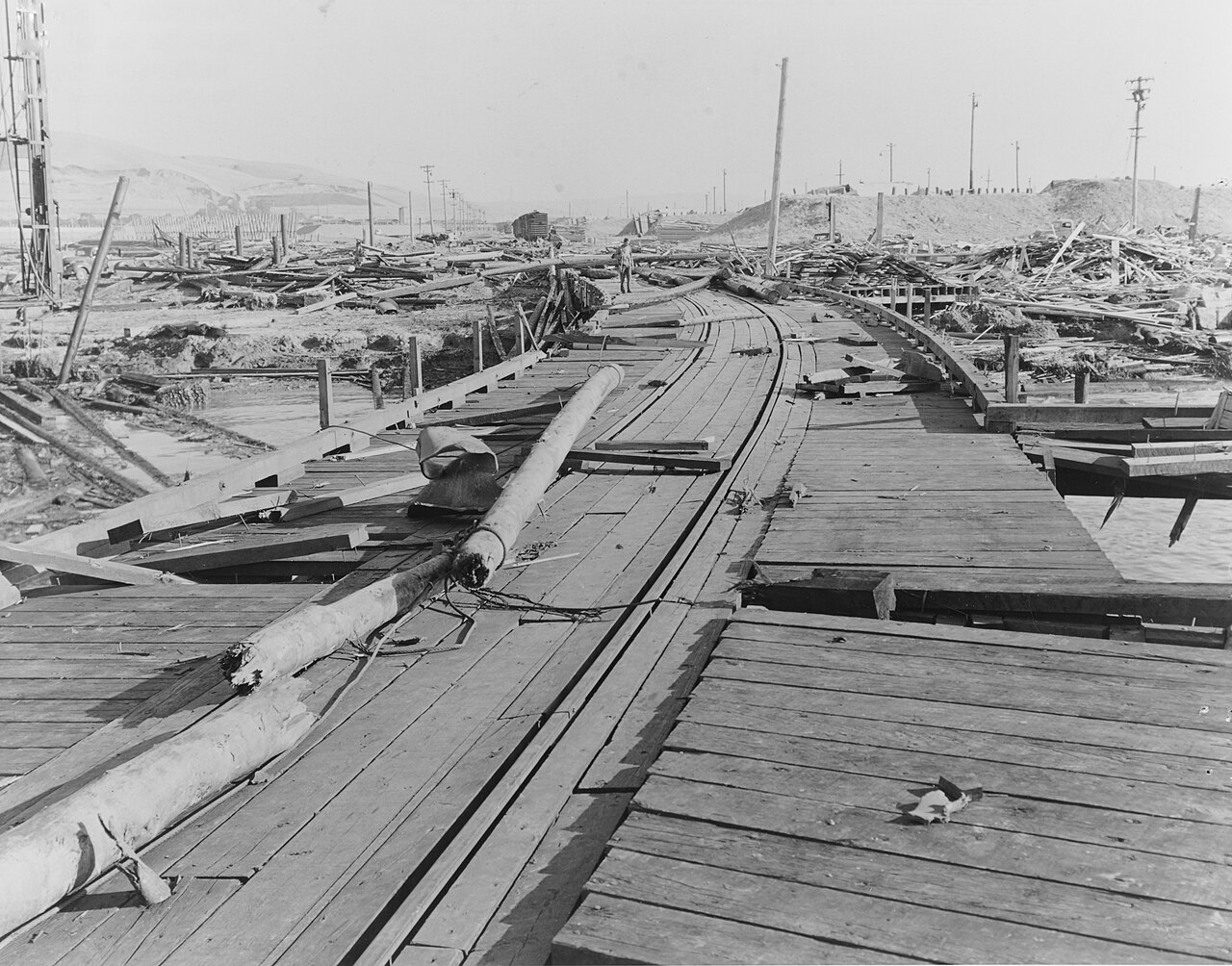
Image context: the cover photograph is an archival U.S. Navy view of the damaged Port Chicago site shortly after the explosion.[6] It is not a generic disaster image. The broken rail lines and wreckage show the workplace that survivors were being ordered back into, which is the central pressure point of the article.
Timeline anchors
- June 27, 1942: the Secretary of the Navy orders the establishment of the U.S. Naval Magazine at Port Chicago; it is commissioned on November 30, 1942.[5]
- July 17, 1944: explosions destroy ships, pier infrastructure, and nearby facilities, killing 320 and injuring roughly 390-400 people.[1][3][5]
- August 9, 1944: many surviving African American sailors refuse to resume ammunition loading without meaningful safety changes.[2]
- September 14-October 24, 1944: the Port Chicago 50 are tried by court-martial at Treasure Island.[2]
- January 1946: nearly all convicted sailors are released and allowed to finish their enlistments, after sentence reductions and reviews.[3]
- July 17, 2024: the Secretary of the Navy fully exonerates the remaining 256 defendants from the 1944 general and summary courts-martial.[3]
The loading system made speed visible and danger ordinary
Port Chicago was not a minor wharf that happened to have bad luck. The National Park Service describes it as the Navy's largest ammunition shipment facility on the West Coast, built after Pearl Harbor to feed the Pacific war.[1] The Court of Inquiry record gives the infrastructure logic in colder language: Mare Island's ammunition facilities had reached saturation, the Port Chicago site had deep tidewater, rail connections, room for expansion, and distance from dense industry.[5] The site made sense on a map.
The danger was in how that map became daily labor. Ammunition had to move from railcars to ships, quickly and repeatedly. The court record found 429 tons of munitions on the pier and 4,606 tons aboard the S.S. E.A. Bryan at the time of the explosion, with large quantities of high explosives and powder in both places.[5] Those numbers matter because they shift the story away from abstraction. The men were not handling symbolic "war materiel." They were moving an industrial mass of explosives through a pier, ship holds, winches, railcars, and cargo plans under wartime pressure.[1][5]
NPS and later Navy accounts both emphasize the training and safety imbalance. Many of the sailors assigned to the loading work were African American enlisted men in segregated units, while supervisory authority remained white.[1][3] NPS states that many had not received training for the dangerous work of loading ammunition; the Navy's 2024 review likewise says that African American sailors had been barred from nearly all seagoing jobs and concentrated in ordnance battalions under white officers.[1][3] That arrangement converted segregation into a safety system. Who got assigned to danger, who gave orders, who could question method, and who would be believed afterward were not separate questions.
The explosion destroyed more than a pier
The immediate event was catastrophic. NPS says the explosion killed 320, injured approximately 400, obliterated the pier and the cargo ships S.S. Quinault Victory and S.S. E.A. Bryan, and heavily damaged the nearby town of Port Chicago.[1] The Navy's 2024 press release gives the same basic scale and adds that a train was destroyed.[3] The Court of Inquiry record describes the blast in material terms: vessels, cargo, buildings, rail infrastructure, and government property were destroyed or damaged, while many bodies could not be recovered in recognizable form.[5]
This is the first causal turn. The blast made the loading regime visible as a bodily fact. Before July 17, unsafe procedure could be buried under production language: throughput, deadlines, Pacific supply, ship loading, officer supervision. After the explosion, survivors were not debating an abstract risk profile. They had seen an ammunition workplace become a mass-death site.[1][2][5]
The Navy still had a war to supply, and operations had halted for weeks.[1] That created the second turn. If the Navy had treated the disaster first as a safety and labor-structure crisis, the refusal that followed might have entered the record differently. Instead, as the Navy later summarized, white supervising officers received hardship leave while surviving African American sailors were ordered back to work without clarity on the explosions or further safety training.[3] In that setting, refusal was not a sudden break in discipline. It was a protest formed inside a command system that had not made the work newly trustworthy.
Refusal became mutiny when command narrowed the question
On August 9, 1944, according to the NPS trial synopsis, 258 African American sailors refused to resume ammunition loading, citing unsafe conditions and lack of proper training.[2] The Navy's 2024 account says that after threats of disciplinary action, 208 returned to work but were still convicted at summary court-martial for disobeying orders.[3] The remaining 50 continued to refuse and were charged with mutiny.[2][3]
The important mechanism here is narrowing. The sailors' action could have been understood through at least three frames: trauma after mass death, objection to unsafe work, and resistance to racially unequal assignment and discipline.[1][2][3] The court-martial frame narrowed it to obedience. Once the issue became whether men had refused orders in wartime, command gained a legal vocabulary more powerful than the sailors' safety claim.
That legal vocabulary carried severe consequences. NPS states that the trial ran from September 14 to October 24, 1944 at Treasure Island.[2] The Navy says all 50 were convicted at a mass general court-martial; each was sentenced to dishonorable discharge, 15 years confinement at hard labor, reduction to E-1, and total forfeiture of pay, though later reviews reduced confinement and suspended dishonorable discharges.[3] The severity was not incidental. It announced that command viewed collective refusal by Black sailors as a threat to naval authority during war.
Robert L. Allen's later account in Naval History helps explain why the case outgrew the courtroom.[4] The disaster and trial placed the Navy's racial order under public scrutiny, with Thurgood Marshall and civil-rights advocates pressing the injustice of calling these men mutineers while the labor and safety system that preceded the explosion remained insufficiently accountable.[1][3][4] The trial did not simply punish refusal. It exposed the asymmetry of the entire chain: Black sailors bore the dangerous work, the death toll, and the mutiny label, while the command structure was slower to absorb responsibility for the conditions that made refusal politically intelligible.[1][3][4]
Desegregation was an institutional response, not a clean ending
Port Chicago did not by itself desegregate the U.S. military, and the article would overstate the case if it made one disaster the sole cause of reform. The stronger claim is narrower: Port Chicago made the Navy's segregated labor system harder to defend because it joined safety, discipline, race, and public legitimacy in one case.[1][3][4]
NPS says the convictions drew public protest and attention from Thurgood Marshall and Eleanor Roosevelt, and that the protest and outcry helped prompt historic steps toward racial integration in the Navy in 1946, followed by President Harry Truman's military-wide order in 1948.[1] Allen's USNI essay frames the sequence similarly, arguing that the shock waves of the explosion and courts-martial led the Navy to reevaluate race relations and that desegregation in ships and shore facilities was underway by 1946.[4] This was not moral clarity arriving all at once. It was institutional pressure after a system's contradictions had become too visible.
The 2024 exoneration sharpened that historical judgment. Secretary of the Navy Carlos Del Toro announced the full exoneration of the remaining 256 defendants on the 80th anniversary of the explosion.[3] The Navy's own review concluded that significant legal errors had affected the courts-martial: defendants were improperly tried together despite conflicting interests, denied a meaningful right to counsel, and tried before the Court of Inquiry report was finalized, even though that report contained 19 substantive recommendations to improve ammunition loading practices.[3]
That last point is crucial. It means the exoneration did more than express regret. It reconnected what the 1944 trial had separated. Safety investigation, legal defense, racial hierarchy, and command discipline belonged in the same frame all along.[3][5]
The mechanism Port Chicago reveals
Port Chicago's historical lesson is not that military orders are easy, or that wartime logistics can wait for perfect safety. The sharper lesson is that systems become most dangerous when they split one problem into administrative compartments. Before the blast, ammunition loading could be treated as production. Segregated labor could be treated as personnel policy. Refusal could be treated as discipline. The disaster showed that all three were parts of the same machine.[1][2][3][5]
That is why the Port Chicago 50 should not be remembered only as defendants in a famous trial. They were survivors of a workplace catastrophe asked to re-enter a system that had not earned back trust. Their refusal forced the Navy and the public to confront a question command discipline could not answer by itself: what does obedience mean when the order returns men to danger through a racially unequal chain of labor and authority?[1][2][3][4]
The answer took far too long. The Navy began changing its racial order in the mid-1940s; Truman extended desegregation to the armed forces in 1948; one sailor, Freddie Meeks, received a presidential pardon in 1999; the broader group was exonerated only on July 17, 2024.[1][2][3][4] That sequence is the afterlife of the mechanism. A system that was quick to convict was slow to admit that the case had never been only about refusal.
Sources
- National Park Service, "California: Port Chicago Naval Magazine National Memorial" - site history, disaster scale, segregated labor context, memorial landscape, and desegregation significance.
- National Park Service, "The Mutiny Trial" - synopsis of the refusal, Port Chicago 50 court-martial, trial dates, and later pardon/exoneration context.
- U.S. Navy, "The Secretary of the Navy Exonerates 256 Defendants from 1944 Port Chicago General and Summary Courts-martial" (July 17, 2024).
- Robert L. Allen, "From Disaster to Desegregation," Naval History 29, no. 1 (February 2015), U.S. Naval Institute.
- HyperWar Foundation, "Port Chicago Naval Magazine: Court of Inquiry - Findings of Facts, Opinion, and Recommendations" - transcription of the 1944 Court of Inquiry record.
- Wikimedia Commons, "File:Portchicago.jpg" - source page for the U.S. Navy/Mare Island Navy Yard aftermath photograph used as the article image.