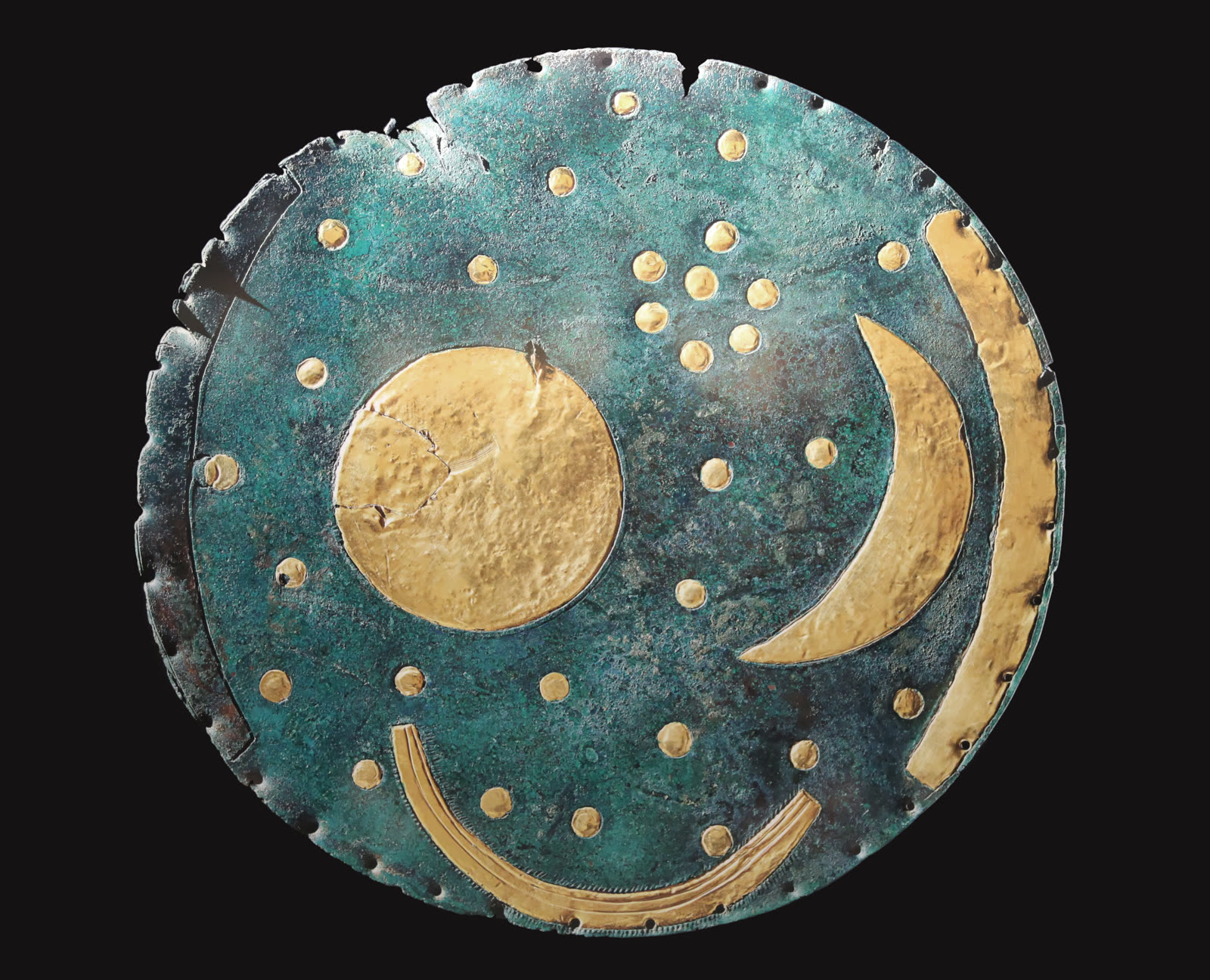
The Nebra Sky Disc is easy to overstate and hard to over-explain. It is a green-patinated bronze disc with gold inlays that appear to show a sun or full moon, a crescent moon, stars, horizon arcs, and a boat-like lower band. The State Museum of Prehistory in Halle presents it as the oldest known concrete depiction of astronomical phenomena, tied to knowledge and religious interpretation about 3,600 years ago.[1] UNESCO's Memory of the World entry similarly treats it as an exceptional Bronze Age document, ritually buried near the Mittelberg with swords, axes, spiral arm-rings, and a chisel.[2]
The cover photograph is useful because it keeps the argument attached to the object itself: a real disc, not a diagram, with gold forms fixed into a bronze surface whose meaning has to be argued from context as well as appearance.[6]
The debate begins because the object did not enter scholarship through a clean excavation. It was illegally unearthed in the summer of 1999, sold through the antiquities underworld, and recovered only in February 2002 in Basel.[1] That origin story makes the disc fascinating and methodologically dangerous at the same time. Archaeology depends on context: where an object lay, what lay with it, how soil, corrosion, associated objects, and stratigraphy fit together. Looting attacks exactly that chain.
This historiography map asks a narrow question: after looting damaged the first-order context, what kind of evidence is strong enough to keep the Nebra Sky Disc in the Early Bronze Age? The current consensus answer is not simply "the disc looks old." It is a cumulative argument. The case rests on the reported hoard, the Mittelberg findspot, court testimony, soil adhesions, metal and trace-element work, radiocarbon evidence from associated organic remains, typology of the accompanying objects, and more recent metallographic study of the disc itself.[3][4][5]
Position One: The Disc Is A Bronze Age Hoard Object
The dominant interpretation treats the Nebra Sky Disc as part of an Early Bronze Age hoard deposited around 1600 BCE, while allowing that the disc itself may have been made and reworked earlier.[3][5] The point is not only chronological. If the disc belongs with the swords, axes, arm spirals, and chisel, then it is not a free-floating image. It is an elite ritual or ceremonial object that ended its use-life in a specific deposition package.
The State Museum's public account gives the basic sequence: the disc was part of a bronze treasure illegally dug up near the summit of Mittelberg in 1999, secured by police in 2002, and placed on permanent exhibition in Halle from May 23, 2008.[1] UNESCO's register entry adds the commemorative weight: the disc was entered into Memory of the World in 2013, with its burial placed about 3,600 years before the present.[2] These institutional summaries matter because they show how the object has been stabilized for public history: Bronze Age object, Mittelberg hoard, oldest concrete cosmic depiction, world-document status.
The scholarly version is more technical. A 2024 Scientific Reports archaeometallurgical study describes the disc as one of the best investigated archaeological objects and places the associated finds at the end of the central European Early Bronze Age, around 1600 BC.[5] The same study emphasizes that the disc likely developed through multiple phases: an original celestial image, later additions and changes, and a final state that had accumulated both technical work and changing meaning.[5] That sequence is important. It prevents a too-simple story in which one artisan made one finished astronomical chart in a single moment. The object can be Bronze Age and still be historically layered.
In this reading, the disc's meaning depends on context plus alteration. The hoard ties it to a deposition moment. The metalwork ties it to sophisticated bronze treatment. The image history suggests that knowledge, ritual, and visual convention shifted while the object remained in use. That is a stronger claim than the popular shorthand "oldest star map," because it treats the disc as a worked artifact with a biography rather than as a prehistoric poster.
Position Two: The Context Is Too Damaged To Carry The Date
The serious challenge comes from the weakness everyone has to admit: the object was looted. Rupert Gebhard and Rudiger Krause's 2020 critique argued that the find complex should not be treated as a closed find, questioned whether the disc securely came from the determined Mittelberg location, and proposed that without secure context the disc should be dated typologically to the Iron Age rather than the Early Bronze Age.[4] A Goethe University summary of their position puts the methodological issue clearly: the disc itself could not be dated securely by ordinary comparison if separated from the hoard context.[4]
This challenge is not silly. It is the debate's necessary pressure test. If the disc were a single unprovenanced market object, and if the associated objects were merely an assembled story from looters and dealers, then the Bronze Age date would be much weaker. The gold symbols alone cannot do all the work. Iconography can suggest analogies, but a unique object is dangerous to date by appearance alone.
The Iron Age argument therefore shifts the burden of proof. It asks whether archaeologists have independently rebuilt enough of the context after the fact. Did the soil on the disc and accompanying objects really match the Mittelberg site? Do the metal signatures support unity among the finds? Are the accompanying swords and other objects genuinely part of the same deposition? Did court statements and field traces merely confirm a looter's story, or did they create a robust evidentiary chain?
That is why the dispute is useful even if one rejects the later date. It clarifies what kind of claim the Nebra Sky Disc can support. The strongest Bronze Age case is not a claim of untouched excavation. It is a reconstruction of context after damage. The weaker popular claim is that the object's beauty speaks for itself. It does not. The surface attracts attention; the provenance argument does the historical work.
Position Three: The Bronze Age Case Survives Because The Evidence Is Cumulative
The 2020 response paper argues that the Bronze Age attribution remains secure because several independent lines of evidence converge.[3] It says the Mittelberg site was verified through judicial statements, follow-up investigations, terrain markings, a discarded water bottle, pickaxe traces, and increased gold and copper concentrations in sediment; it also notes correspondence between soil samples from the findspot and sediment adhering to the disc, a sword, and an axe.[3] No single item in that list is magic. Together, they make the reported findspot harder to dismiss.
The same response treats the associated finds as central. Copper trace elements and lead isotope ratios link the disc and accompanying objects to the same broad ore source in the Salzburg region, while the gold is connected to Cornwall; radiocarbon dates from organic remains in one sword point to around 1600 BC; and the hoard composition is described as fitting Early Bronze Age patterns rather than Iron Age ones.[3] This is the key historiographical move: because a copper-alloy disc cannot be precisely dated by the metal alone, dating depends on a network of associated evidence.
The 2024 metallographic study adds a different kind of support. It is less about where the disc was found and more about how it was made. The authors compared a sampled area of the disc with experimental replicas and concluded that the object was not simply cast into its final thin form; it required a cast preform followed by repeated heating and forging, with gold inlays added by local deformation.[5] Their conclusion does not by itself prove the exact deposition date. But it strengthens the picture of the disc as a technically demanding ancient bronze object, not a casual anomaly.
This is where the debate narrows. The Bronze Age position does not need every interpretive flourish to be correct. The disc may be a calendar aid, a ritual image, a prestige object, a cosmological object, or some combination of those things. The dating and provenance question is prior. If the hoard context stands, the disc belongs to the Early Bronze Age world of central Europe. If the hoard context fails, much of the confident historical scaffolding has to be rebuilt.
What The Debate Should Change In The Story
The best public version of the Nebra Sky Disc story should keep two truths in view. First, the current evidentiary balance supports the Early Bronze Age interpretation. The strongest published response to the 2020 challenge argues that the alleged weaknesses are answered by site evidence, soil correspondence, metal provenance, associated-find typology, radiocarbon data, and hoard patterning.[3] The recent metallurgical work further shows that the disc's manufacture involved complex hot forging and finishing knowledge.[5]
Second, the looting never becomes a harmless footnote. It shapes every responsible interpretation. We do not have the original archaeological context as it should have been recorded. We have a recovered context, reconstructed through criminal investigation, later excavation, material analysis, and comparison. That does not make the object useless. It makes the evidentiary chain visible.
The phrase "oldest star map" is therefore too tidy. The disc is more interesting as a damaged-context problem that scholarship has had to repair. Its historical value lies in the bronze and gold, but also in the legal files, sediment samples, associated swords, metallographic sections, and arguments over what counts as enough proof after the first evidence was disturbed.
That is the lesson the debate leaves behind. Spectacular objects tempt readers to trust the image first. The Nebra Sky Disc asks for a stricter habit. Look at the surface, then ask how the surface was anchored: by hill, hoard, soil, metal, testimony, laboratory work, and disagreement. The disc survives as a cosmic image, but its modern history is a case study in provenance. What we know depends on what looting failed to destroy, and on how carefully later investigators stitched the remaining evidence back together.
Sources
- State Museum of Prehistory Halle, "Nebra Sky Disc" - official object page covering significance, 1999 illegal discovery, 2002 recovery, and permanent exhibition history.
- UNESCO Memory of the World, "Nebra Sky Disc" - register entry describing the object, burial context, associated finds, and 2013 registration.
- Pernicka et al., "Why the Nebra Sky Disc Dates to the Early Bronze Age. An Overview of the Interdisciplinary Results," Archaeologia Austriaca 104, 2020 - response to the Iron Age challenge, including site, soil, metal, radiocarbon, and hoard evidence.
- Goethe University Frankfurt, "New dating of Nebra sky disk" - summary of Gebhard and Krause's 2020 critique, including the argument that the disc may not belong to a closed Bronze Age find complex.
- Wunderlich et al., "Archaeometallurgical investigation of the Nebra Sky Disc," Scientific Reports 14, 2024 - metallographic study of the disc's manufacturing process and Early Bronze Age framing.
- Wikimedia Commons, "File:Nebra disc 1.jpg" - source page for the real photograph of the Nebra Sky Disc used as the article image.