The Morrill Act of 1862 is easy to remember as a generous origin story: Abraham Lincoln signs a law, states receive land, and practical public colleges appear across the United States.[1][2] That memory points toward something real. The act did help make higher education less exclusively classical, clerical, and elite. But the text itself is sharper and more complicated than the celebration. Read closely, it is not simply a college-founding law. It is a conversion machine.
The law converts land into scrip, scrip into sale proceeds, proceeds into invested principal, and interest into a recurring educational mission.[1][2] It also converts a political claim about the "industrial classes" into a curriculum built around agriculture, the mechanic arts, scientific studies, classical studies, and military tactics.[1] The most important historical question, then, is not whether the act mattered. It plainly did. The better question is how its words made a public university system possible while hiding the territorial violence underneath the funding model.
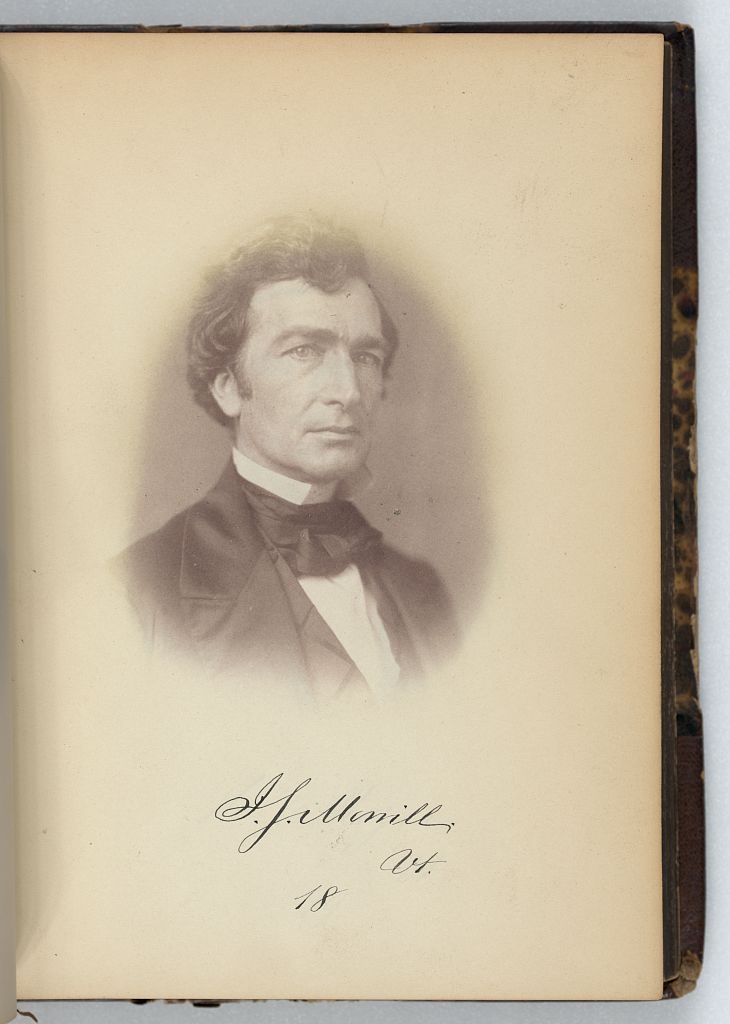
The cover image is an archival photograph of Justin S. Morrill, taken in 1859 while he was still a Vermont representative.[6] It belongs here because the act reads like the work of a legislator thinking in institutional channels. It does not merely announce uplift. It specifies apportionment, investment, annual reporting, eligibility, and timing. The photograph reminds us that this was a human-authored design, not an inevitable stage of national progress.
Timeline anchors
- 1857: Congress passed an earlier land-grant college bill, but President James Buchanan vetoed it.[2]
- 1859: Julian Vannerson photographed Justin S. Morrill for a congressional portrait volume.[6]
- 1862-07-02: Lincoln signed the Morrill Act during the Civil War.[1][2]
- 1863-01-01: land scrip issued under the act could begin to be located.[1]
- 1890: Morrill sponsored a second land-grant act, adding regular appropriations and reshaping the system's racial architecture.[3][5]
Those dates matter because they keep the act out of a simple progress fable. The proposal had a prewar history, became law only after secession altered congressional politics, began operating through delayed land-scrip mechanics, and later required a second statute to extend and racially manage the model.
1. The act did not give every state a campus; it gave states a financial instrument
The most revealing phrase in the statute is not the familiar curricular language about agriculture and the mechanic arts. It is the funding sequence.[1] States were to receive land or land scrip tied to their congressional representation, and the money from sales was to be invested so that the capital would remain "forever undiminished."[1] The college did not sit directly on the land in any simple sense. In many cases, especially for states without available federal public land inside their borders, the operative asset was scrip: a claim that could be sold or located elsewhere.[1][4]
That design matters because it made public higher education portable. A state in the East could benefit from Western land. A college could be funded by acres its students would never see. The act therefore nationalized a local institution-building problem. It did not ask each state to find a patron, a church, or a classical endowment. It used the federal public domain as a financing layer and told states to build an enduring fund from it.[1][2]
This is why the word "land-grant" can mislead if it is taken too literally. The deeper grant was an income stream. The land was the asset base, but the act cared about what the asset could be made to yield. Britannica summarizes the basic arithmetic: each state received 30,000 acres for each congressional seat, with sale proceeds used to establish or support colleges specializing in agriculture and mechanic arts.[5] The law's genius, and its moral problem, sit in the same conversion.
2. The curriculum was practical, but not anti-intellectual
The act's famous curricular sentence is more balanced than the usual shorthand. Its "leading object" was to teach branches related to agriculture and the mechanic arts, but it explicitly did this "without excluding other scientific and classical studies" and with military tactics included.[1] That wording matters. Morrill's law did not say that working people needed a cheaper, narrower education. It said practical subjects should become central without expelling older forms of knowledge.
The point was a new hierarchy, not a purge. Agriculture and mechanical knowledge moved from the margins toward the institutional center. Classical and scientific studies remained inside the frame, but they no longer defined the college's prestige by themselves.[1] Military tactics also made sense in 1862, not as a decorative add-on but as a Civil War-era recognition that the state now wanted colleges to produce disciplined technical citizens as well as gentlemen.
This is the act's most durable educational idea. It treated the farm, shop, machine, laboratory, and drill ground as legitimate sites of public knowledge. That is different from saying the land-grant college was merely vocational. The statute's phrase "liberal and practical education" holds the two terms together.[1] Liberal education would not be abandoned; practical education would no longer be treated as beneath it.
3. Reporting turned colleges into a network, not isolated state experiments
Another under-read clause required annual reports on each college's progress, improvements, experiments, costs, results, and useful industrial and economic statistics.[1] One copy was to go to every other college endowed under the act and another to the Secretary of the Interior.[1] That is a small administrative requirement with large implications.
The law was not only building campuses. It was building a comparison system. States would not simply spend proceeds and disappear into local discretion. They would produce records, exchange information, and make experiments visible to peer institutions and the federal government.[1] In that sense, the land-grant college was imagined from the start as a national learning infrastructure.
The reporting clause also clarifies the act's theory of applied knowledge. Experiment was not a metaphor. Improvements, costs, and results were supposed to circulate. A useful agricultural or mechanical lesson in one state might matter elsewhere. The act therefore linked public higher education to the habit of institutional measurement.
4. The hidden foundation was Indigenous land
A close reading of the statute also has to say what the statute does not say. The act treats land as public domain, an asset that Congress can apportion and states can monetize.[1] That legal frame excludes the prior history by which much of that land entered federal control.
The National Archives now states the issue directly: more than 10 million acres associated with the grants were expropriated from Native communities.[2] High Country News and its Land-Grab Universities data project reconstructed approximately 10.7 million acres taken from nearly 250 tribes, bands, and communities through more than 160 violence-backed land cessions.[4] Those figures do not sit outside the Morrill Act story. They describe the ground on which the financing system stood.
This does not mean the educational gains were imaginary. It means the gains were financed through a public-land system that had already transformed Indigenous homelands into federal assets. The act's language of perpetual endowment is especially important here.[1][4] If principal was meant to remain intact and support colleges indefinitely, then the benefits of dispossession were not a one-time start-up subsidy. They were designed to persist.
5. Two readings compete, and both catch part of the truth
The celebratory reading says the Morrill Act democratized higher education. It opened a path for farmers, mechanics, women, working-class students, and students far from older eastern colleges to enter institutions built around practical knowledge.[2][5] The Senate's institutional history credits Morrill's act with producing 68 new colleges and identifies it as the foundation for state agricultural and mechanical colleges.[3] This reading is real. A history that ignores access misses why the act became so beloved.
The critical reading says the act democratized one sphere by liquidating another people's land base. The law made education broader for many citizens while leaving Native dispossession outside its operative language.[2][4] This reading is also real. A history that praises public universities without following the land and scrip trail treats the funding mechanism as if it were morally weightless.
The stronger interpretation holds both together. The Morrill Act changed American higher education because it connected public land, permanent endowment, applied curriculum, and institutional reporting in one durable structure.[1][2][3] It also changed American higher education because that structure depended on a public-domain fiction that made Indigenous land appear available for national improvement.[2][4]
The bounded conclusion
Read as a primary source, the Morrill Act is less a sentimental birth certificate for state universities than a precise institutional bargain. It says: give states land-backed value, preserve the principal, spend the income on colleges, center agriculture and the mechanic arts without excluding broader studies, include military tactics, and report results into a national network.[1]
That bargain had extraordinary consequences. It helped make practical public higher education a national project. But the document's power came from conversion, and conversion always raises the question of what was converted from whom. The act turned land into curriculum. To read it honestly in 2026, we have to keep both halves of that sentence visible.
Sources
- National Archives, "Morrill Act (1862)" - milestone document page and transcript covering the funding, curriculum, annual-report, eligibility, and land-scrip clauses.
- Library of Congress Research Guides, "Morrill Act: Primary Documents in American History - Introduction" - summary of enactment, land-grant financing, Lincoln's signature, and Native-land context.
- U.S. Senate, "Justin Morrill" - Senate art and history page identifying Morrill's career, authorship of the 1862 act, the 1890 act, and the creation of agricultural and mechanical colleges.
- High Country News, "Land-Grab Universities" - investigative reconstruction of Morrill Act acres, Indigenous land cessions, sale proceeds, and continuing endowment benefits.
- Encyclopaedia Britannica, "Land-Grant College Act of 1862" - concise overview of the 30,000-acre formula, agriculture and mechanic-arts mission, ROTC link, and later 1890 act.
- Library of Congress Prints and Photographs Division, "Justin S. Morrill, Representative from Vermont, Thirty-fifth Congress, half-length portrait" - 1859 salted-paper photographic print used as the cover image.