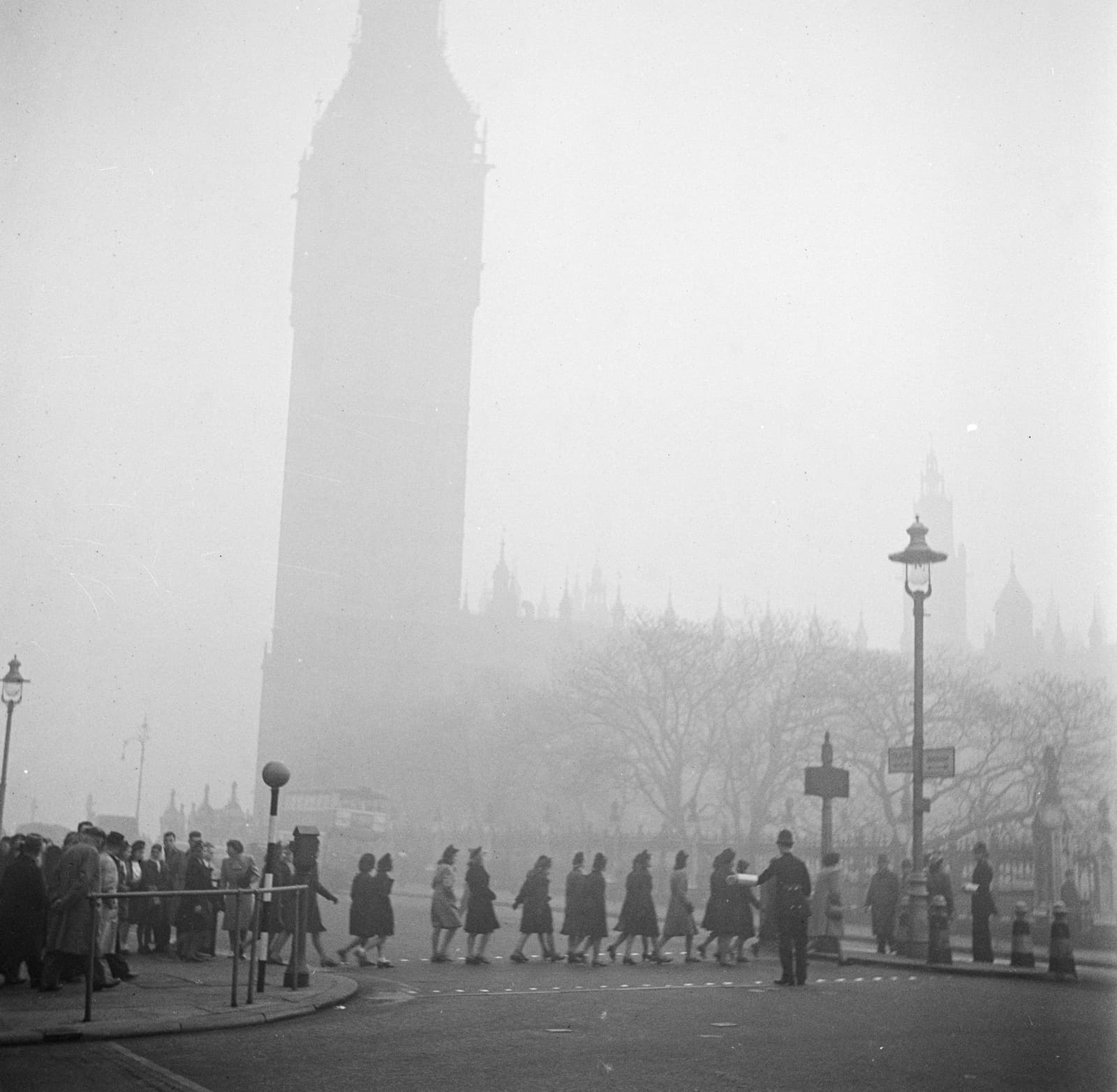
The Great Smog is often remembered as an atmospheric accident. It was not. It was a system failure with a traceable chain: fuel structure -> weather trapping -> chemical transformation -> health overload -> legal redesign.
If we ask one historical question sharply — why did London’s fog in December 1952 become far deadlier than ordinary winter fog? — the answer is causal sequencing, not one isolated trigger.
Timeline anchors: when the mechanism locked in
- 5–9 December 1952: metropolitan London remained under dense smoke-laden fog for five days.[1][2]
- 19 December 1952: Ministry of Health statement recorded a sharp mortality spike during the fog week and launched formal investigations.[1]
- 16 November 1954: minister confirmed receipt of the Beaver Committee’s final report on air pollution and moved to publication.[4]
- 5 July 1956: the UK Clean Air Act received Royal Assent, creating enforceable smoke-control architecture.[3]
These dates matter because they show the full loop from exposure event to institutional response.
Step 1: fuel load was already primed before the fog formed
Met Office case analysis notes very cold weather in late November and early December 1952, with households burning large quantities of coal for heating.[2]
That meant London entered early December with unusually high local emissions from domestic chimneys layered on top of industrial sources. In causal terms, the city had a high pollution baseline before meteorology turned hostile.
Step 2: anticyclone + inversion turned emissions into a ground-level trap
Under ordinary winter conditions, much chimney smoke rises and disperses. In early December 1952, an anticyclone created descending warm air aloft and cooler air near the surface — a temperature inversion that blocked vertical mixing.[2]
Met Office describes the trapped fog layer at roughly 100–200 metres depth under very light winds.[2] That depth is crucial: it converted a city-scale emission stream into a shallow, stagnant breathing zone.
Step 3: chemistry amplified toxicity, not just opacity
This was not only “low visibility.” During the fog period, Met Office reports substantial pollutant releases, including daily smoke particles and sulphur dioxide, with an estimated 370 tonnes of SO2 converted into 800 tonnes of sulphuric acid.[2]
That conversion helps explain why symptom burden and mortality were concentrated in respiratory and cardiac pathways rather than only transport disruption.
Step 4: health-system signals showed a shock, not routine winter noise
The Ministry of Health statement (19 December 1952) reported 4,703 deaths registered in Greater London for the week ended 13 December, versus 1,902 and 2,062 in the two preceding weeks.[1] It also recorded:
- influenza/pneumonia deaths rising from 89 to 380,
- marked increases in coroner-referred respiratory/cardiac deaths,
- 501 Emergency Bed Service applications for respiratory disease (majority age 45+).[1]
Those administrative signals are important as near-real-time primary evidence: they show acute pressure before later retrospective modeling.
Dispute line: influenza-only explanation vs pollution-shock explanation
A long-running interpretation split followed.
Interpretation A: mainly an acute fog event plus influenza confounding
This view emphasizes winter seasonality and respiratory infection overlap, treating the event as severe but temporally narrow.
Interpretation B: pollution shock with persisting mortality effects
Later reassessment using mortality, admissions, claims, influenza reports, temperature, and pollutant data estimated around 12,000 excess deaths from December 1952 through February 1953, rejecting influenza as a sufficient explanation for most excess mortality.[5]
Given current evidence, Interpretation B has stronger support, but the boundary should remain explicit: exact decomposition between direct exposure, infection interaction, and pre-existing vulnerability is model-dependent.
Step 5: policy translation changed the legal default
By November 1954, Parliament was already processing the Beaver Committee’s findings.[4] The 1956 Clean Air Act then shifted control from voluntary adaptation to enforceable standards, including prohibition of dark smoke from chimneys and statutory mechanisms around smoke-control and furnace compliance.[3]
The mechanism lesson is institutional: catastrophe produced law only after evidence became legible in both epidemiological and administrative registers.
What this causal history changes for how we read 1952
The Great Smog was not “weather that killed.” Weather was the trapping condition. The deeper driver was a high-emission urban heating/industry system interacting with inversion physics and sulfur chemistry, then colliding with a health system forced to reveal stress in real time.
That is why the episode remains historically useful: it is a clean example of how environmental risk becomes governable only when causal chains are made specific enough to legislate.
Sources
- UK National Archives, Ministry of Health statement transcript (MH 58/398, 19 Dec 1952)
- UK Met Office case study, The Great Smog of 1952
- UK legislation, Clean Air Act 1956 (5 July 1956)
- UK Parliament historic Hansard, Air Pollution Committee (Report), 16 Nov 1954
- Bell ML, Davis DL. “Reassessment of the lethal London fog of 1952…” Environmental Health Perspectives (PMC)