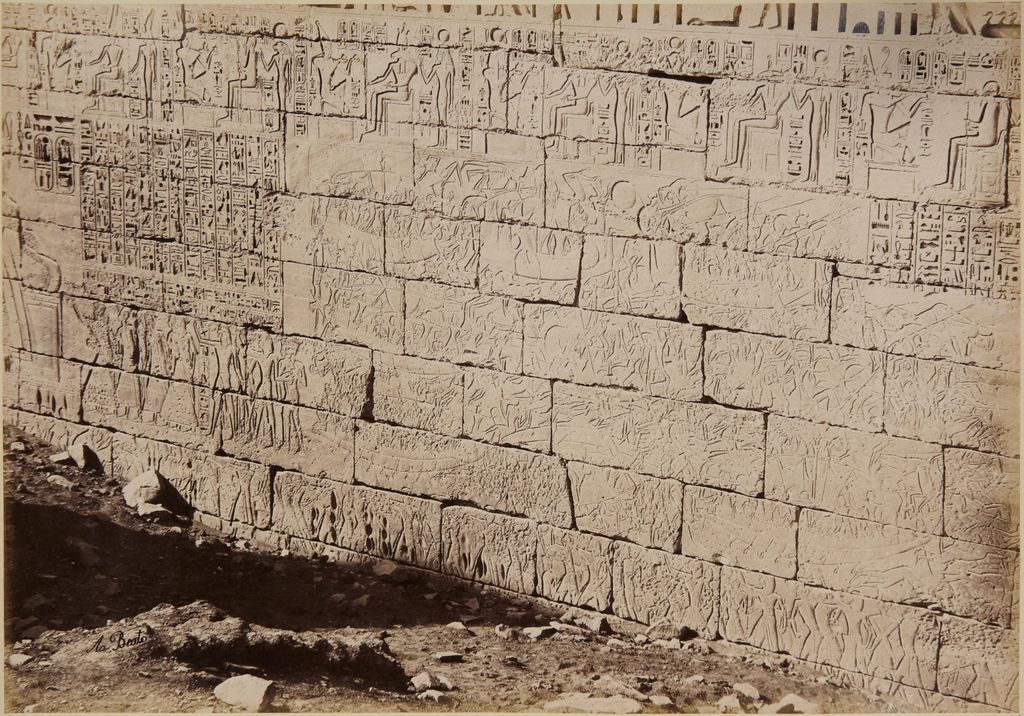
The Late Bronze Age collapse is easy to misremember as an ancient catastrophe with one name and one cause. Around 1200 BCE, palace systems, long-distance exchange, writing practices, and political orders changed sharply across the eastern Mediterranean and Near East. Hittite imperial power broke apart. Several Mycenaean palace centers burned or lost administrative continuity. Ugarit was destroyed. Egypt survived, but its New Kingdom power narrowed. Later memory has often compressed all of this into a single phrase: the Bronze Age ended because the Sea Peoples came.
That sentence is too neat. The hard historiographic question is not whether raiders, migrants, war, drought, earthquakes, trade rupture, palace weakness, and internal conflict mattered. The question is how much explanatory weight each should carry, and whether "collapse" describes a total civilizational death or a violent reorganization of particular institutions.[1][4] The best current reading is layered: Egyptian inscriptions and reliefs preserve one state-facing account of external threat; climate proxies show serious drought pressure in key zones; network and trade models show how interdependence could transmit shocks; and archaeology keeps reminding us that some regions transformed rather than simply vanished.[2][3][4][5]
The cover image is deliberately not a map, chart, or modern reconstruction. It is a nineteenth-century photograph of the naval battle reliefs at Medinet Habu, the mortuary temple of Ramesses III.[6] The reliefs matter because they helped make the Sea Peoples visually durable: boats, prisoners, weapons, royal victory. But the image is also a warning. A relief commissioned by a victorious king is not a neutral system diagram. It shows how Egypt wanted conflict remembered, not a complete explanation for why a whole regional order became unstable.
Timeline anchors
- Late thirteenth century BCE: the eastern Mediterranean remains deeply connected through diplomacy, tribute, copper and tin exchange, elite gift circulation, palace accounting, and maritime routes.[1][4][5]
- ca. 1200 BCE: the broad crisis horizon becomes visible in destructions, abandonments, shifts in settlement, and the weakening or disappearance of several palace-centered systems.[3][4]
- 1198-1196 BCE, plus or minus dating uncertainty: tree-ring evidence from central Anatolia points to a severe three-year dry interval coincident with the Hittite collapse window.[2]
- 1177 BCE: Cline uses the eighth year of Ramesses III, when Egyptian records place a major Sea Peoples attack, as a memorable hinge date rather than a claim that every collapse happened in one year.[1][6]
- Twelfth century BCE: the aftermath varies by region: some centers are destroyed, some networks shrink, some communities persist, and new Iron Age political and cultural patterns begin forming.[3][4][5]
Those markers keep the debate from sliding into either instant apocalypse or vague long decline. The crisis was not one day. It was also not so gradual that the violence and institutional rupture disappear.
Position one: invasion did the decisive damage
The older, vivid interpretation gives pride of place to attackers, especially the groups conventionally called the Sea Peoples. It has obvious evidence on its side. Egyptian sources from Ramesses III's reign present sea and land enemies as a major threat, and the Medinet Habu reliefs turn that threat into monumental state memory.[6] Written sources from places such as Ugarit and the larger Levantine world also point to anxiety over hostile movements at sea and on land.[3][4]
The strength of this position is concreteness. Cities did burn. People did move. Fortifications, weapons, and destruction layers are not metaphors. A crisis explanation that ignores violence becomes too smooth and administrative. The Late Bronze Age world was not only an economic network; it was also a military and political field in which displaced groups, raiders, mercenaries, and rival states could turn stress into direct attack.[1][3][4]
The weakness is that invasion alone explains too much by naming too little. "Sea Peoples" is not a single well-understood ethnic actor with a documented command structure. It is a label produced largely through Egyptian records, then expanded by modern scholarship and popular history into a regional cause. Even the PLOS ONE synthesis notes that scholars disagree over whether the Sea Peoples should be treated as a cause of decline or as one symptom of a crisis already underway.[3] Once that uncertainty is admitted, the invasion model cannot stand by itself. It identifies a visible pressure, not the whole mechanism.
Position two: climate stress pushed systems past adaptation
The climate argument has become harder to dismiss because the evidence has become more precise. Kaniewski and colleagues used pollen and environmental evidence around Cyprus and the Syrian coast to argue for environmental roots in the Late Bronze Age crisis, tying the 3.2 ka event to drought, agricultural stress, population movement, and conflict pressures across a connected region.[3] More recently, Manning and colleagues analyzed juniper samples from central Anatolia and identified an unusually dry three-year interval around 1198-1196 BCE, with additional dry years clustered nearby.[2]
This does not mean "drought caused the collapse" in a simple deterministic sense. The Nature article is careful on that point: ordinary one-year droughts were expected in semi-arid central Anatolia, and societies built storage, diversification, and social strategies around such risk.[2] The historically dangerous scenario is different: repeated or consecutive harvest stress arriving when a large political system is already rigid, expensive, and dependent on coordinated extraction and redistribution.[2]
Climate evidence therefore works best as a pressure layer. It helps explain why food security, labor supply, tribute expectations, migration, and military readiness could all become more fragile at once. It does not, by itself, explain why one city was destroyed, another survived, or why post-collapse cultural patterns differed across Greece, Anatolia, Cyprus, the Levant, and Egypt.[4][5] The climate position is strongest when it refuses to become a new monocause.
Position three: the palace-trade system became brittle
The systems interpretation starts from the Late Bronze Age world's success. This was not a set of isolated kingdoms accidentally falling in the same century. It was a connected political economy. Cline's account emphasizes a world of diplomatic contact, trade routes, elite exchange, and interdependence, then argues that breakdown came from multiple connected failures rather than one trigger.[1] Knapp and Manning's AJA survey similarly treats the crisis as a problem of context: climate, trade, migration, violence, chronology, and regional variation have to be read together.[4]
Recent network modeling sharpens that idea. The 2024 Global Environmental Change study models Late Bronze Age trade and sociopolitical networks and argues that single-node failure was not enough to bring down the whole system, while some paired disruptions could produce cascading effects.[5] That is a useful corrective. It means interdependence was not automatically weakness. A network can be robust against small failures and still vulnerable when several critical links or centers fail close together.
This position explains why the crisis could feel regional without being identical everywhere. If copper, tin, grain, prestige goods, envoys, scribes, ships, palace accounting, and military obligations were linked, then failure in one zone could raise costs elsewhere. The system did not need every city to fall for the order to stop working as before. It needed enough synchronized stress to make the old operating model unreliable.[1][4][5]
Position four: collapse is too blunt a word
The fourth position does not deny destruction. It asks what exactly collapsed. Palace bureaucracy? Royal dynasties? Trade routes? Writing systems? Urban life? Population? Cultural identity? These did not all fail in the same way or at the same speed.[4][5]
This matters because the word "collapse" can smuggle in a total ending that the evidence does not always support. Manning and colleagues describe the Hittite case as a harsh transformation, with continuity in many underlying aspects of life even as the imperial political system ended.[2] Knapp and Manning also stress that trade decline, climate pressure, and regional change require context rather than a single dramatic slogan.[4] The post-1200 world was damaged and changed, but it was not an empty stage.
The continuity argument is not a soft version of the story. In some ways it is more demanding. It requires historians to distinguish destruction layers from administrative endings, elite loss from household survival, palace disappearance from local adaptation, and regional crisis from universal ruin. It also makes the Sea Peoples question more interesting. Migrants and raiders may have been destroyers in one context, refugees in another, and participants in new post-palatial arrangements elsewhere.[3][4]
Where the debate now sits
The useful disagreement is no longer "invasion or drought." It is about sequencing, scale, and interaction.
If raiders are placed first, climate and trade become background stressors that made attacks more damaging.[3][6] If drought is placed first, migration and violence become downstream effects of harvest failure and social pressure.[2][3] If network fragility is placed first, drought and raiding become shocks that mattered because they hit a tightly connected palace economy.[1][5] If transformation is placed first, the central question shifts from "why did civilization die?" to "which institutions failed, which people moved, and which practices continued?"[2][4]
The strongest synthesis keeps all four in view. The Late Bronze Age crisis was probably not one falling domino line. It was closer to a stressed operating system losing redundancy. Drought could weaken food and storage margins. Military pressure could destroy ports, palaces, and confidence. Trade disruption could make bronze, grain, and elite exchange harder to sustain. Palace systems could fail faster because they had concentrated administration, labor obligations, and status goods in forms that worked well in stable conditions but poorly under repeated shocks.[1][2][3][5]
That reading also explains why Medinet Habu remains powerful but insufficient. The reliefs show a battle Egypt wanted to memorialize. They do not show the Anatolian dry years, the palace accounting systems, the trade dependencies, the destroyed and undestroyed sites, or the communities that adjusted after royal centers failed.[2][4][5][6] The image preserves one historical voice inside the crisis. Historiography is the work of not mistaking that voice for the whole chorus.
So the safest conclusion is precise rather than dramatic: the Late Bronze Age collapse was a regional institutional breakdown caused by interacting pressures, not a single invasion, a single drought, or a clean civilizational extinction. Its lesson is not that complex societies always fall. It is that systems built from interdependence, hierarchy, storage, and prestige can look strongest just before several different stresses start reinforcing one another.[1][2][5]
Sources
- Eric H. Cline, 1177 B.C.: The Year Civilization Collapsed, De Gruyter/Princeton University Press edition page - synthesis of the multi-factor and interdependence interpretation.
- Sturt W. Manning et al., "Severe multi-year drought coincident with Hittite collapse around 1198-1196 bc," Nature 614 (2023) - annually resolved tree-ring and isotope evidence from central Anatolia.
- David Kaniewski et al., "Environmental Roots of the Late Bronze Age Crisis," PLOS ONE 8, no. 8 (2013) - pollen, climate, Cyprus-Syria, and Sea Peoples context.
- A. Bernard Knapp and Sturt W. Manning, "Crisis in Context: The End of the Late Bronze Age in the Eastern Mediterranean," American Journal of Archaeology 120, no. 1 (2016) - historiographic survey of climate, trade, chronology, and regional variation.
- Igor Linkov et al., "Are civilizations destined to collapse? Lessons from the Mediterranean Bronze Age," Global Environmental Change 84 (2024), TU Delft Research Portal record - network-modeling approach to cascading failure and interdependence.
- Princeton University Art Museum, Felice Beato, "Medinet Habu: Temple of Rameses III, reliefs of naval battle," ca. 1855 - source page for the article image and Medinet Habu relief photograph.