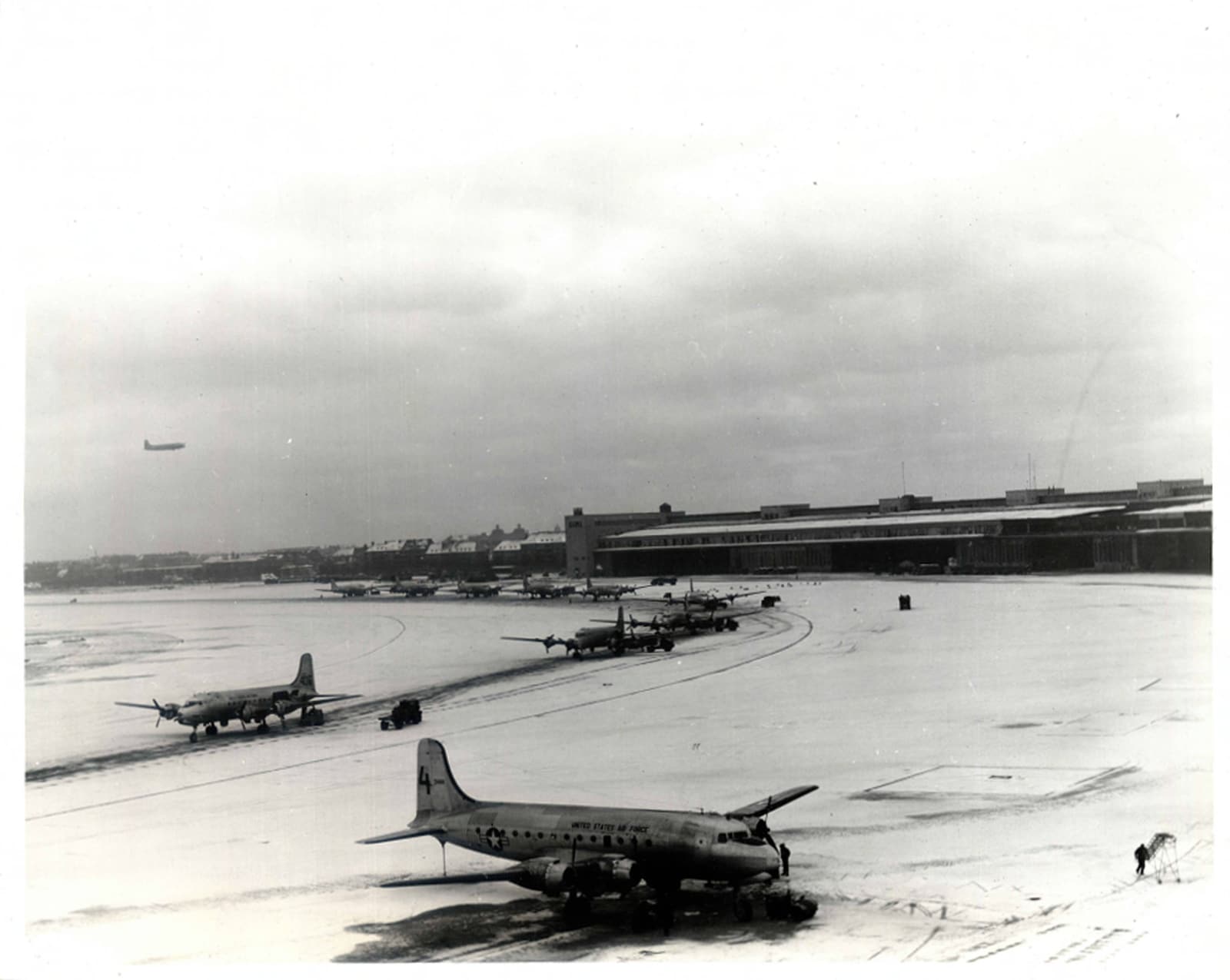
Berlin in 1948–49 and Cuba in October 1962 are often grouped as Cold War flashpoints where war did not happen. That is true but shallow. The more useful comparison is structural: these crises were run on different clocks, with different coercive instruments, and different political off-ramps.
The question is precise: why did Berlin become an 11-month logistics contest, while Cuba compressed into a 13-day escalation sprint?
Shared baseline, different machines
Both episodes began with coercive signaling around access and strategic position:
- Berlin (24 June 1948): the Soviet Union blocked road, rail, and water access to West Berlin, forcing the Western powers to choose between withdrawal, military confrontation, or sustained air supply.[1][2]
- Cuba (14–28 October 1962): U.S. reconnaissance confirmed Soviet missile deployments; Washington imposed a naval quarantine and entered direct crisis bargaining with Moscow under nuclear shadow.[3][4]
But from that shared baseline, the mechanism diverged.
Timeline anchors that show the divergence
Berlin crisis tempo (endurance model)
- 24 Jun 1948: land/water blockade starts.[1]
- 26 Jun 1948: U.S. starts Operation Vittles airlift.[1]
- 28 Jun 1948: UK joins with Operation Plainfare.[1]
- 11/12 May 1949: blockade lifted (Moscow / local timing conventions differ by source citation date line).[1][2]
- 30 Sep 1949: airlift formally ends after continuity operations.[2]
Cuba crisis tempo (compression model)
- 14 Oct 1962: U-2 imagery captures missile-site construction.[3]
- 22 Oct 1962: Kennedy announces quarantine.[3]
- 24 Oct 1962: first direct quarantine-line confrontation window.[3]
- 27 Oct 1962: hardest day: U-2 shootdown over Cuba, competing messages, accelerated invasion planning.[3][5]
- 28 Oct 1962: Khrushchev publicly accepts missile withdrawal framework.[3]
The key contrast is not only duration (~11 months vs 13 days). It is decision frequency under risk: Berlin allowed iterative logistics learning; Cuba forced near-real-time political-military synchronization.
Why outcomes diverged: three mechanism differences
1) Coercive instrument: strangulation vs placement
In Berlin, coercion targeted city sustainment. That created a technical substitute path: if tonnage could be flown, coercive leverage decayed over time. By spring 1949, aircraft throughput had become dense enough that one plane was landing roughly every 45 seconds at peak operation windows, signaling that the West could hold position indefinitely.[1]
In Cuba, coercion targeted nuclear strike geometry. Once missile operational readiness approached, delay raised existential downside. There was no equivalent “slow substitute” that could neutralize risk without immediate bargaining.
2) Political objective: expulsion pressure vs deterrence bargaining
Berlin’s central dispute was whether Western powers could be forced out of West Berlin. That objective tolerated prolonged pressure cycles.
Cuba’s dispute fused deterrence credibility, alliance commitments, and homeland vulnerability into one decision loop. That made public signaling, private concession channels, and military restraint interdependent inside days, not months.[3][5]
3) Information tempo: iterative correction vs knife-edge miscalculation
Berlin’s operations allowed repeated adjustment of sortie rates, fuel mix, and air-corridor discipline over months.[1][2]
Cuba’s 27 October sequence featured near-simultaneous incidents across theaters and command chains. National Security Archive reconstruction and declassified notes emphasize how quickly local military action could outrun top-level intent on that day.[5]
The strongest competing interpretations
Interpretation A: Berlin succeeded because logistics beat coercion; Cuba succeeded because leaders accepted reciprocal restraint in time
Evidence:
- Berlin: sustained airlift removed the blockade’s strategic payoff.[1][2]
- Cuba: public-private channel split (quarantine + message management + backchannel terms) created a fast political landing zone.[3][5]
Interpretation B: structure mattered less than opponent preference ceilings
Evidence:
- Stalin did not escalate to direct air-corridor war despite airlift persistence; this ceiling shaped Berlin’s feasible equilibrium.[1]
- Khrushchev and Kennedy both confronted command-and-control slippage risk by 27 October; withdrawal deal logic may have reflected shared fear thresholds more than elegant bargaining design.[3][5]
What would change the balance of judgment?
If additional Soviet archival material demonstrated that Moscow had already fixed a near-term Berlin climbdown independent of airlift sustainability metrics, Interpretation B would gain weight. If additional command-level records in Cuba showed robust operational control even after the U-2 shootdown, Interpretation A’s emphasis on deliberate channel design would strengthen.
Portable historical lesson
These were not interchangeable “Cold War standoffs.” Berlin shows how an adversary’s coercive tool can be degraded by operational substitution over time. Cuba shows that when coercion compresses into strategic-warning minutes, crisis stability depends less on endurance and more on synchronization between political signaling and military restraint.
That distinction is the practical value of comparing them together.
Sources
- U.S. Office of the Historian — The Berlin Airlift, 1948–1949 (Milestones)
- The UK National Archives — Berlin Airlift (timeline + operational totals)
- U.S. Office of the Historian — The Cuban Missile Crisis, October 1962 (Milestones)
- JFK Library — Cuban Missile Crisis (document portal and timeline framing)
- National Security Archive — The Cuban Missile Crisis @ 60: The Most Dangerous Day
- U.S. Office of the Historian — FRUS 1948, Vol. II, Chapter 20: The establishment of the Berlin blockade