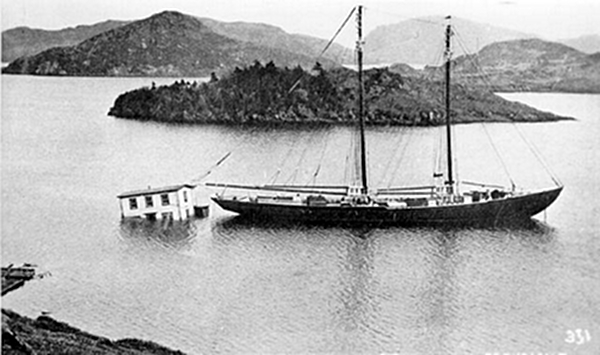
In the photograph, a house floats behind a schooner. Its roof and upper windows remain above the water; the place where a family lived has become something to secure in a harbour. Natural Resources Canada identifies it as Steven Henry Isaacs's home, swept from Port au Bras during Newfoundland's tsunami of 18 November 1929.[1]
The scene offers a tempting ending: a house survived and someone brought it back. For the fishing communities along the Burin Peninsula, however, recovery required much more than returning buildings to land. The sea had carried away the means of getting through winter and earning the following season's living.
The interval after the shaking
At 5:02 p.m. Newfoundland time, a magnitude 7.2 earthquake struck offshore, roughly 250 kilometres south of the island. Its vibrations were felt as far away as Montreal and New York. Beneath the Atlantic, the shaking triggered a huge submarine landslide, breaking transatlantic cables and generating a tsunami.[2]
The distinction between shaking and flooding matters to the sequence. The danger approaching the coast was already developing underwater while people ashore assessed a tremor that had left Newfoundland's buildings largely intact. About two and a half hours separated the earthquake from the tsunami's arrival.[2]
Three principal pulses struck the southern Burin Peninsula. Natural Resources Canada's account describes local sea-level rises of two to seven metres, with water reaching higher at the heads of some narrow bays.[2] The familiar shoreline ceased to be a reliable boundary. Houses, stores, boats, and landing places occupied the strip through which the water now moved.
That strip joined domestic life to work. A house close to a fishing store could belong to a practical arrangement built over years. In a few minutes, proximity became shared exposure.
The harbour moved indoors
A report in the St. John's Free Press of 26 November, reproduced by UNESCO's Tsunami Programme, describes a witness named Bartlett hurrying onto the wharf beside the steamer Daisy. He saw the sea withdraw and return. At his own premises, a shop had been lifted and deposited far from its original position.[4]
The same newspaper carried Magistrate Hollett's description of Port au Bras. Winter provisions, fuel, and fishing equipment had been stored beside the water. His report brought the scale of loss down to a household measure: “There are not 5 barrels flour in the place and no coal.”[4]
A missing store therefore meant several emergencies at once. People needed something to eat immediately, fuel for the approaching cold, and equipment for work still months away. A building counted as damaged property could contain the entire bridge between one fishing season and the next.
Nor did a surviving shell guarantee that its contents remained useful. Looking at an upright building in the water, a distant reader might see good fortune. Its owners still had to recover it, inspect it, and find somewhere to live.
A temporary berth for a home
The account accompanying the Isaacs photograph rests on Alan Ruffman's 1986 interviews with two men who had been schoolboys in Port au Bras. According to that reconstruction, Isaacs and his father recovered the house offshore and brought it into Little Burin Harbour. They secured it behind the anchored schooner; the schooner was not towing it in the photograph. The house was eventually returned to its original site.[1]
This is a reconstruction from later testimony, rather than a complete sequence recorded by the camera. The photograph preserves an intermediate condition: the house has been found, but it is still afloat.
That interval deserves attention. Salvage does not have the clean finality of a rescue headline. It is work done with whatever vessels, ropes, labour, and sheltered water remain available. Here, a home briefly depended on the sort of berth normally occupied by a boat.
The morning brought winter
On 19 November, a storm brought sleet and snow into the damaged communities. NOAA's historical account places that weather after the tsunami, an important distinction: survivors now faced a second source of cold and exposure while trying to recover from the first disaster.[3]
Communication had failed in stages. Ruffman and Violet Hann's archival study explains that a storm before the earthquake had broken the peninsula's connection to St. John's. The tsunami then damaged local telegraph facilities. At Burin, Daisy possessed a wireless set, but the study cites a contemporary letter reporting that nobody aboard knew how to operate it.[5]
The arrival of Portia on 21 November finally allowed a wireless message to carry news of the devastation to St. John's.[4] The relief steamer Meigle reached Burin the next afternoon with medical personnel and supplies.[3]
The dates measure a period in which people already on the coast had to do the work. Outside assistance began with finding out what had happened; those inside the disaster were already sharing shelter and searching the wreckage.
Rebuilding the next season
Historian Maura Hanrahan's report for Newfoundland and Labrador's commemoration programme follows the losses beyond the waterfront. Families had lost flour, preserved meat, root crops, fuel, and household possessions. Suppliers had also lost premises and goods. Replacing an individual fisher's boat could not, by itself, restore the commercial arrangements that made a season possible.[6]
The rebuilding inventory gives this problem physical form. Hanrahan records a requirement for 305 dories, alongside other boats and hundreds of oars. Demand required purchases beyond Newfoundland. Some replacement dories were stronger and more expensive yet less suited to local needs: obtaining a boat and obtaining the right boat were separate achievements.[6]
Even in 1931, the relief committee was authorizing purchases of lumber for reconstruction.[6] The emergency had become a succession of practical jobs: securing shelter, replacing equipment, restoring supply, and trying to earn again. Each depended partly on the others.
The disaster coincided with the onset of the Great Depression.[3] That timing made the prospect harder. A repaired waterfront could offer access to the sea without guaranteeing a viable income. The chronology cannot finish at the moment the relief ship appears; that is where a different kind of uncertainty begins.
What the photograph leaves outside its frame
The human losses also resist a single closing date. Ruffman and Hann distinguish the 27 deaths recorded at the time or soon afterward from their total of 28. They include Amelia Alice Bonnell, who died in March 1933, on the strength of family testimony linking her continuing illness to tsunami injuries. They acknowledge the lack of detailed contemporary medical evidence.[5]
That qualification keeps the familiar number honest. The toll describes people and evidence, not merely a figure repeated from one account to another.
The floating house offers something more bounded: a visible piece of property that could be retrieved. Its upper windows are still there. The harbour is calm enough for a photograph. What remains beyond the frame is the work of making a household possible again—food, warmth, tools, earnings, and people who cannot be brought back. A house at its old address would be one achievement within that longer recovery.
Sources
- Natural Resources Canada, notes on the Isaacs house photograph (PANL A 2-149), based on Alan Ruffman's 1986 interviews.
- Natural Resources Canada, “The 1929 Magnitude 7.2 ‘Grand Banks’ earthquake and tsunami”: earthquake timing, submarine landslide, and inundation.
- NOAA National Centers for Environmental Information, “On This Day: 1929 Grand Banks Tsunami” (18 November 2024): subsequent storm and relief arrival.
- UNESCO Intergovernmental Oceanographic Commission, “18 November 1929, Mw 7.2, Newfoundland, Canada”: reproductions of contemporary reports in the St. John's Free Press, 26 November 1929.
- Alan Ruffman and Violet Hann, “The Newfoundland Tsunami of November 18, 1929,” Newfoundland and Labrador Studies 21(1), 2006; communications and death-toll evidence.
- Maura Hanrahan, Report on the Newfoundland Tsunami of 1929, Provincial Historic Commemoration Program, September 2009, printed pp. 4–7.