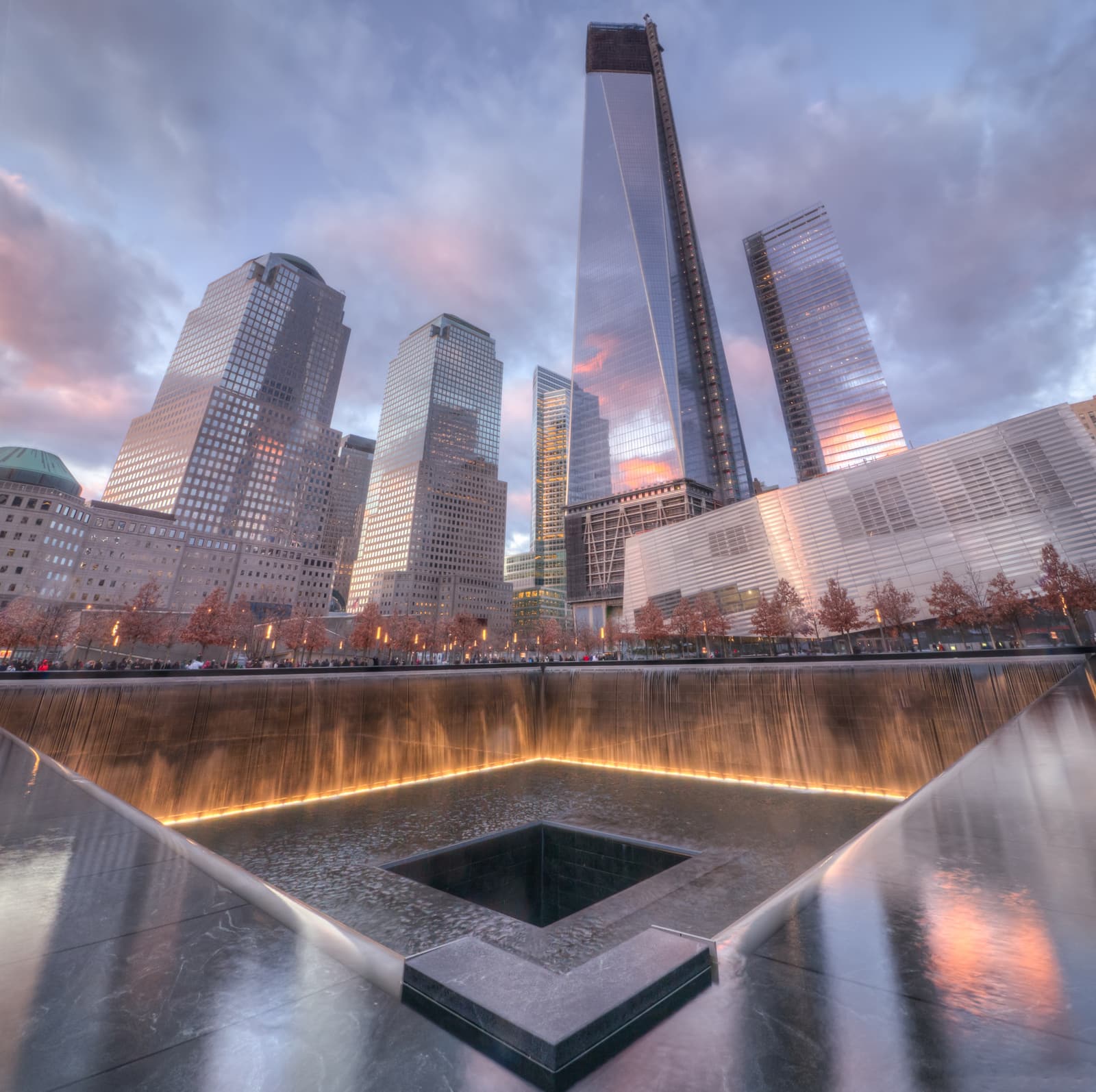
At Ground Zero, the hardest institutional problem was never just “how to build a memorial.” It was how to hold multiple kinds of memory at once: family grief, national trauma, local daily life, and a city’s push to keep moving.
What emerged is not only a monument. It is a repeatable commemoration system that can absorb new generations without flattening the original loss. The system works because three layers lock together: spatial design, name-order governance, and annual ritual practice.
Image context: the South Pool photograph captures the core design logic in one frame—an active city skyline surrounding a deliberately unfillable void.
Timeline anchors: how remembrance became infrastructure
A few dates explain the transformation from disaster site to civic ritual machine:
- 2001-09-11: attacks destroy the Twin Towers; later commemorative practice has to integrate New York, Pentagon, and Pennsylvania loss into one national memory frame.[3][8]
- 2003-04: the Lower Manhattan Development Corporation opens an international memorial competition; 5,201 submissions from 63 countries arrive.[1]
- 2004-01: Michael Arad and Peter Walker’s Reflecting Absence is selected.[1][4]
- 2011-09-11: the Memorial opens on the 10th anniversary.[1]
- 2014-05-21: the Museum opens to the public after dedication on May 15.[2]
- 2019-05-30: the Memorial Glade opens, extending recognition to those sick or dead from post-attack toxic exposure.[1]
- 2024: the institution reports 11.6 million Memorial visitors and 2.4 million Museum visitors in that year alone, with cumulative totals above 83 million (Memorial) and 24 million (Museum).[7][8]
The sequence matters: remembrance moved from event response to durable civic operations.
Layer 1: design made “absence” visible without pretending to close it
The two memorial pools, set within the towers’ original footprints, and the descending water are often described aesthetically, but their institutional effect is more important. The pools create a stable rule for public behavior: approach, read, pause, circulate. They anchor commemoration in repeated embodied movement instead of one fixed message.
Arad’s “absence made visible” formulation is powerful precisely because it refuses narrative closure.[1] Water falls continuously, but the central void never fills; the form keeps loss present while making public visitation possible at scale.
The plaza’s roughly 400 swamp white oaks add a second signal: continuity in living time around irreversible absence.[1] That visual pairing—void and regrowth—lets the site carry mourning and civic persistence simultaneously, which is why the memorial can function both on anniversaries and on ordinary weekdays.
Layer 2: the names are not decorative text—they are governance
Most memorials settle names by alphabet, rank, or chronology. The 9/11 Memorial chose a different rule set: “meaningful adjacencies.”[1][5]
That decision turned inscription into a governance problem with moral consequences. Families and close networks submitted adjacency requests so names that belonged together in life would remain together in death. The resulting constraints were too dense for manual layout; computational methods were used to satisfy large numbers of overlapping relationships while preserving larger incident-based group boundaries.[5][6]
This is the underappreciated mechanism: the memorial did not just list victims; it encoded social bonds into bronze.
Three concrete outcomes follow:
- Institutional categories stay legible (tower location, flights, responder units, 1993 victims).
- Relational memory survives (friends, coworkers, relatives positioned together when requested).
- Visitors can locate specific names reliably through panel logic and lookup tools, making return visits practical rather than overwhelming.[1][5]
In commemoration terms, that is the difference between symbolic inclusion and operational inclusion.
Layer 3: annual ritual converted architecture into civic time
Architecture alone does not preserve memory across generations. Repeated public practice does.
Each anniversary ceremony reads the names aloud, with six moments of silence corresponding to strike and collapse times plus Pentagon and Flight 93 markers.[3] This rhythm does two jobs at once:
- it keeps temporal precision (the day’s sequence is not abstracted away), and
- it renews social participation (families, witnesses, and newer publics can re-enter the event through ritual form).
The institution also broadened commemoration scope over time. February 26 observances keep the 1993 bombing visible inside the same memorial frame, while May 30 ceremonies mark the formal end of recovery operations and acknowledge long-tail health harms among rescue/recovery populations.[4]
So the site’s memory is no longer single-date memory. It is a calendar of linked remembrance obligations.
Why this model held up under mass visitation
A memorial can fail by becoming either too private (inaccessible to wider publics) or too touristic (detached from grief structure). The 9/11 site avoided total drift toward either pole because the three layers reinforce one another:
- Design slows people down.
- Name-order logic individualizes loss without isolating it.
- Ritual calendar keeps institutional attention from collapsing into one annual headline.
That is likely why high visitor throughput did not erase commemorative seriousness. In 2024, millions passed through the Memorial and Museum, yet the institution still centered family participation, name-reading practice, and structured silence.[3][7][8]
Two interpretations, and where the evidence leans
Interpretation A: the memorial’s durability comes mostly from iconic design
This view argues that once the pools and voids were built, long-run legitimacy followed naturally. In this framing, architecture is the primary cause; ceremonies and data tools are secondary wrappers.
Interpretation B: durability comes from a three-part operating system
This view argues the opposite order: design was necessary but insufficient. Long-run legitimacy depended on continuous governance of names, ceremony protocols, and scope expansion (1993 dead, recovery workers, health afterlives).
Current evidence favors Interpretation B. The strongest indicators are procedural, not purely visual: family adjacency integration, annual scripted practices, and iterative commemorative additions such as the Memorial Glade.[1][3][5]
Boundary and falsifier
This analysis would weaken if internal records showed that family adjacency and annual ritual structures had minimal effect on return participation, trust, or perceived legitimacy—and that visitor meaning was overwhelmingly produced by visual form alone.
Conversely, if future commemoration rounds continue to scale while preserving name-centered ritual integrity, the operating-system interpretation becomes stronger.
Working conclusion
The long-run achievement at Ground Zero is not that a city built a beautiful monument after catastrophe. It is that the site learned to institutionalize memory without freezing it.
By combining unfillable spatial form, socially meaningful name arrangement, and annually renewed civic ritual, the 9/11 Memorial became a place where private grief and public time can coexist without one erasing the other.
Sources
- National September 11 Memorial & Museum, “About the Memorial” (competition data, design features, opening date, meaningful adjacencies, Memorial Glade)
- National September 11 Memorial & Museum, “About the Museum” (dedication/opening dates, site-remnant interpretation, Foundation Hall/Last Column context)
- National September 11 Memorial & Museum, “September 11, 2001 Commemoration” (annual name reading + six moments of silence protocol)
- National September 11 Memorial & Museum, “Commemoration” (1993, 9/11, and May 30 observance architecture)
- National September 11 Memorial & Museum Blog, “‘Meaningful Adjacencies’ Shape Design of 9/11 Memorial” (final names-arrangement release process)
- Scientific American, “Commemorative Calculus: How an Algorithm Helped Arrange the Names on the 9/11 Memorial” (algorithmic arrangement and constraint structure)
- National September 11 Memorial & Museum, “2024 Annual Report” (2024 annual visitor totals and institutional milestone framing)
- National September 11 Memorial & Museum, “Financial & Legal Information” (cumulative visitation totals and institutional continuity indicators)
- PBS NewsHour, “Reflecting Absence” (2004 jury rationale and design-brief framing)
- PBS NewsHour, “The Complexity of 2,982 Names on the September 11 Memorial” (implementation details of meaningful-adjacency layout)