Vitamin A has two reputations that keep colliding. In global child health, it is a cheap, targeted intervention for places where deficiency is common and young children face high infectious-disease risk. In wellness folklore, it can be miscast as a broad immune booster, a substitute for vaccines, or a high-dose home treatment. The evidence supports the first reputation. It does not support the second.[1][2][6]
The sharper way to read vitamin A is as a deficiency-sensitive public-health tool. WHO describes vitamin A deficiency as a leading cause of preventable childhood blindness and as a condition that raises the risk of severe illness or death from infections such as diarrhoeal disease and measles.[1] That is not a claim that every child everywhere needs large doses. It is a claim about a biological bottleneck in populations where diet, infection, poverty, and health-system access make deficiency common.
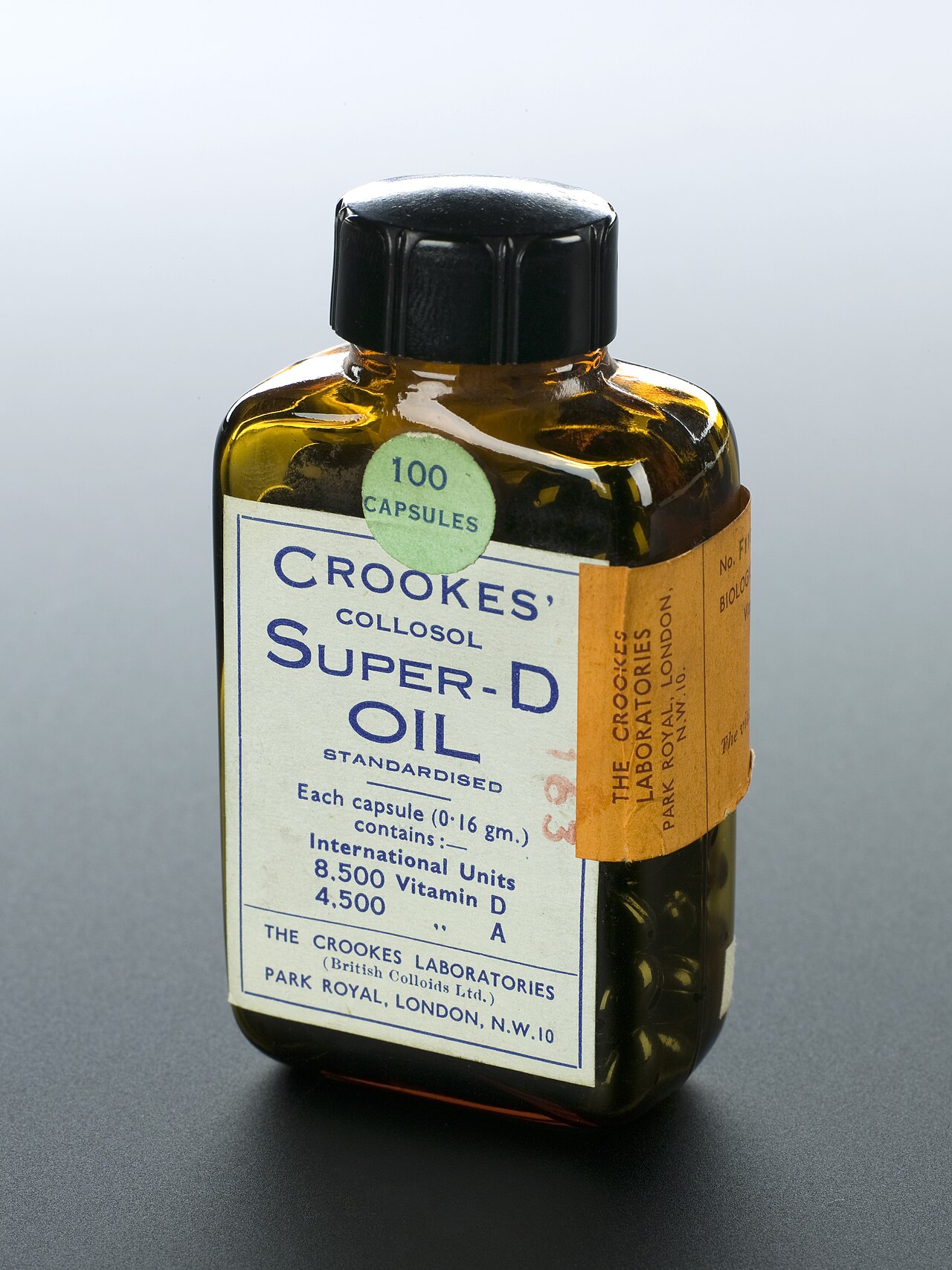
Image context: the cover uses a real 1940-1945 photograph of Super-D oil capsules containing vitamins A and D.[7] The object is useful precisely because it is ordinary. Vitamin A's power, when the evidence supports it, comes from getting a specific nutrient to the right population at the right interval. The capsule is not magic; the program around it is the intervention.
Myth: vitamin A is just about eyesight
The eye story is real, but it is too small. Vitamin A deficiency can produce xerophthalmia, a spectrum that runs from night blindness and Bitot's spots to corneal damage and blindness.[1] That clinical image is why vitamin A has long been associated with vision. But the child-survival case widened when researchers and health agencies recognized that deficiency also weakens resilience against severe infections.[1][5]
The modern evidence summary makes that wider claim visible. WHO's eLENA review summary says vitamin A supplementation in children aged 6 months to 5 years reduced all-cause mortality and diarrhoea-related mortality in comparison with placebo or no treatment, in data largely from low- and middle-income countries with high vitamin A deficiency prevalence.[3] Cochrane's updated public summary similarly concludes that, among children aged 6 to 59 months who are at risk of deficiency, supplementation can reduce illness and death.[4]
That is the central correction: vitamin A is not only an eye vitamin. In deficiency settings, it is part of the body's ability to preserve epithelial barriers, immune function, and recovery capacity when infections arrive.[1][3][4]
Evidence: the benefit is population-specific, not universal
The strongest mortality evidence comes from populations where deficiency risk was meaningful. WHO's review summary reports 43 randomized trials enrolling 215,633 children in the older review and a 24% reduction in all-cause mortality across 17 trials with 194,795 children.[3] The later Cochrane update, which includes 47 randomized trials and more than 1.2 million children, gives a more conservative combined estimate: vitamin A supplementation reduced overall mortality and diarrhoea-related mortality by 12%.[4]
Those two estimates belong in the same article because they show why evidence boundaries matter. The effect did not become imaginary because a very large later trial made the average smaller. Nor should the largest historical estimate be treated as a permanent global constant. Cochrane notes that one large study of about one million children did not show an effect, but that the combined evidence still supported benefit for children at risk of vitamin A deficiency.[4]
The practical conclusion is therefore neither "give megadoses to every child" nor "vitamins never matter." It is: identify settings where deficiency is a public-health problem, use tested dosing schedules, and monitor coverage as a child-survival intervention rather than as an individual wellness ritual.[2][3][4]
Myth: a vitamin A capsule can replace measles vaccination
This is the most dangerous confusion. Vitamin A can matter during measles management, especially where deficiency is present, but it does not prevent infection. The American Academy of Pediatrics states the boundary plainly: vitamin A does not prevent measles; only the MMR vaccine can prevent measles.[6] It also warns against using high-dose vitamin A to try to prevent measles because toxicity can occur.[6]
The distinction is not semantic. Vaccination trains immunity before exposure. Vitamin A, in this evidence lane, supports a deficient child's ability to withstand illness and reduces some complications. A child who receives vitamin A can still catch measles. A community that substitutes capsules for vaccination leaves transmission routes open.[6]
The older trial literature helps explain why the confusion is tempting. Vitamin A supplementation reduced measles incidence in pooled evidence summarized by WHO, while measles-specific mortality in preventive supplementation studies was not significantly reduced in that same analysis.[3] Cochrane's separate update reports that vitamin A can reduce new occurrences of measles and helps eye outcomes in at-risk children, but it does not turn the vitamin into a vaccine.[4] The proper phrase is supportive and preventive nutrition in deficient populations, not immunization replacement.
Evidence: the dose is a public-health schedule, not a home experiment
WHO's monitoring page describes the current international schedule for affected areas: high-dose vitamin A every 4 to 6 months for children aged 6 to 59 months, with 100,000 IU for children aged 6 to 11 months and 200,000 IU for children aged 12 to 59 months.[2] That looks simple on paper, but the simplicity is administrative. It is meant to be delivered through campaigns or routine health systems that know age, timing, eligibility, and prior dosing.
The same evidence base contains adverse-effect signals. WHO's review summary reports increased vomiting within 48 hours after supplementation, and the NCBI Bookshelf summary of the WHO guideline gives the same risk ratio for vomiting after 100,000-200,000 IU dosing.[3][5] AAP's measles FAQ adds the more serious misuse boundary: high-dose vitamin A used without proper indication or supervision can lead to toxicity, including liver damage and neurologic symptoms.[6]
That does not make vitamin A supplementation unsafe when used correctly in the right setting. It makes it a medical and public-health intervention rather than a casual household escalation. The dose is large because the schedule is intermittent and targeted. Copying the dose outside that context changes the risk-benefit equation.
Why the Aceh trial still matters
The historical hinge was not a laboratory discovery that vitamin A existed. It was the move from eye disease to survival. The 1986 Lancet trial led by Alfred Sommer and colleagues in northern Sumatra randomized 450 villages: 229 participated in a vitamin A supplementation scheme and 221 served as controls. The study followed 25,939 preschool children and was published on May 24, 1986.[5]
That design mattered because it treated child mortality as the endpoint, not only visible xerophthalmia. In global health terms, that changed the argument. If vitamin A deficiency made infections deadlier before eye signs appeared, then waiting for night blindness or corneal disease meant acting too late for many children. The capsule became a way to reach risk that was partly invisible.[1][3][5]
The strongest legacy of that trial is not that one place settled every future dosing question. It is that it forced public health to see mild or subclinical deficiency as a survival problem. Later systematic reviews, WHO guidance, and coverage indicators all grew from that wider frame: deficiency control had to be measured not only in eyes saved, but in lives not lost.[2][3][4]
What the myth-vs-evidence boundary leaves standing
Vitamin A supplementation deserves its global-health reputation when four conditions line up. The population has meaningful deficiency risk. The target group is young children in the recommended age range. The dose and interval follow a tested public-health schedule. The intervention complements, rather than replaces, vaccination, feeding support, infection treatment, sanitation, and primary care.[1][2][3][6]
It loses that reputation when the evidence is stretched into a universal supplement story. High-dose vitamin A is not a general immune upgrade, not a measles shield, not a substitute for MMR, and not something to improvise repeatedly at home.[6] The same capsule can be a life-saving delivery system in one setting and a toxicity risk in another.
That is the disciplined conclusion. Vitamin A is powerful because deficiency is powerful. It prevents blindness and can reduce deaths where the underlying shortage and infectious risks make the biology matter at population scale. The evidence asks us to keep the capsule in that lane: targeted, timed, supervised, and never confused with the vaccines and care systems it is meant to sit beside.[1][2][3][4][6]
Sources
- World Health Organization, "Micronutrients" - vitamin A deficiency as a preventable-blindness and severe-infection risk.
- World Health Organization Nutrition Landscape Information System, "Children 6-59 months receiving vitamin A supplements" - coverage definition, 4-6 month interval, and 100,000/200,000 IU schedule for affected areas.
- World Health Organization eLENA, "Vitamin A supplementation for preventing morbidity and mortality in children from 6 months to 5 years of age" - systematic-review summary and effect estimates.
- Cochrane, "Vitamin A supplementation for preventing disease and death in children aged six months to five years" - updated review summary including 47 randomized trials and 1,223,856 children.
- Johns Hopkins University research record for Sommer et al., "Impact of Vitamin A Supplementation on Childhood Mortality: A Randomised Controlled Community Trial," The Lancet, 1986.
- American Academy of Pediatrics, "Measles Infection Prevention and Control Frequently Asked Questions" - current vitamin A/measles boundary and toxicity warning.
- Wikimedia Commons, "Bottle of Super-D oil capsules, London, England, 1940-1945 Wellcome L0057855.jpg" - source page for the archival capsule photograph used as the article image.