
Emergency antiviral policy has a recurring problem: the first wave of certainty is usually about access, while the second wave is about whether the promised clinical effect survives contact with broader populations. Oseltamivir (Tamiflu) and nirmatrelvir-ritonavir (Paxlovid) are a useful comparative history because both were deployed under outbreak pressure, both were pushed as early treatment, and both eventually had to be reinterpreted after the initial launch narrative.
The central comparison is not “good drug vs bad drug.” It is about translation architecture: what outcome was promised, in which patients, under what timing constraints, and how fast those conditions changed in the real world.
Image context: the hero image shows an oseltamivir capsule, grounding the first half of the article in the influenza-era antiviral policy cycle that shaped later expectations for COVID-era oral antivirals.
Timeline: two emergency rollouts, two evidence afterlives
- 1999: U.S. approval of oseltamivir for influenza treatment and prevention pathways.[2]
- 2009 pandemic period: many countries rely on neuraminidase-inhibitor stockpiles as vaccine-mismatch or vaccine-delay protection.[1]
- 2014: Cochrane regulatory-data synthesis (46 trials; 20 oseltamivir trials; 9,623 participants in oseltamivir trials) reports modest symptom benefits and no significant hospitalization effect in treatment trials.[1]
- 2021-12-22: FDA issues Paxlovid EUA for high-risk non-hospitalized COVID-19 patients within 5 days of symptom onset.[3]
- 2022: CDC real-world analysis (699,848 eligible adults) finds Paxlovid prescription associated with lower 30-day hospitalization risk (aHR 0.49), with only 28.4% of eligible patients receiving prescriptions in the study window.[4]
- 2025: IDSA guidance continues to emphasize time-sensitive outpatient antiviral use in risk-stratified patients, with explicit uncertainty boundaries and conditional recommendations across scenarios.[5]
This sequence shows a recurring pattern: emergency deployment first, denominator broadening second, and credibility renegotiation third.
Episode 1: what Tamiflu changed about evidence standards
The Cochrane regulatory-information review became the turning point for oseltamivir’s policy reputation. Using clinical study reports and regulator files rather than only journal publications, the review estimated that in adults oseltamivir reduced time to first symptom alleviation by 16.8 hours (95% CI 8.4 to 25.1) and found no significant effect on hospitalization (risk difference 0.15%, 95% CI -0.78 to 0.91).[1]
Those are not trivial data points. They changed the implied contract between governments and antiviral manufacturers:
- Endpoint discipline hardened. “Feels better sooner” and “keeps people out of hospital” stopped being treated as interchangeable claims.
- Data-access politics became a clinical issue. The review depended on large-scale regulatory files (more than 160,000 pages), not only published papers.[1]
- Harms entered the same ledger as benefits. In adults, treatment-phase nausea risk difference was 3.66% and vomiting risk difference 4.56% in the Cochrane analysis.[1]
So Tamiflu’s historical legacy is larger than influenza management itself. It reset what many clinicians and policy teams expected before accepting broad emergency-use narratives for the next oral antiviral class.
Episode 2: why Paxlovid launched with stronger trial optics but harder implementation constraints
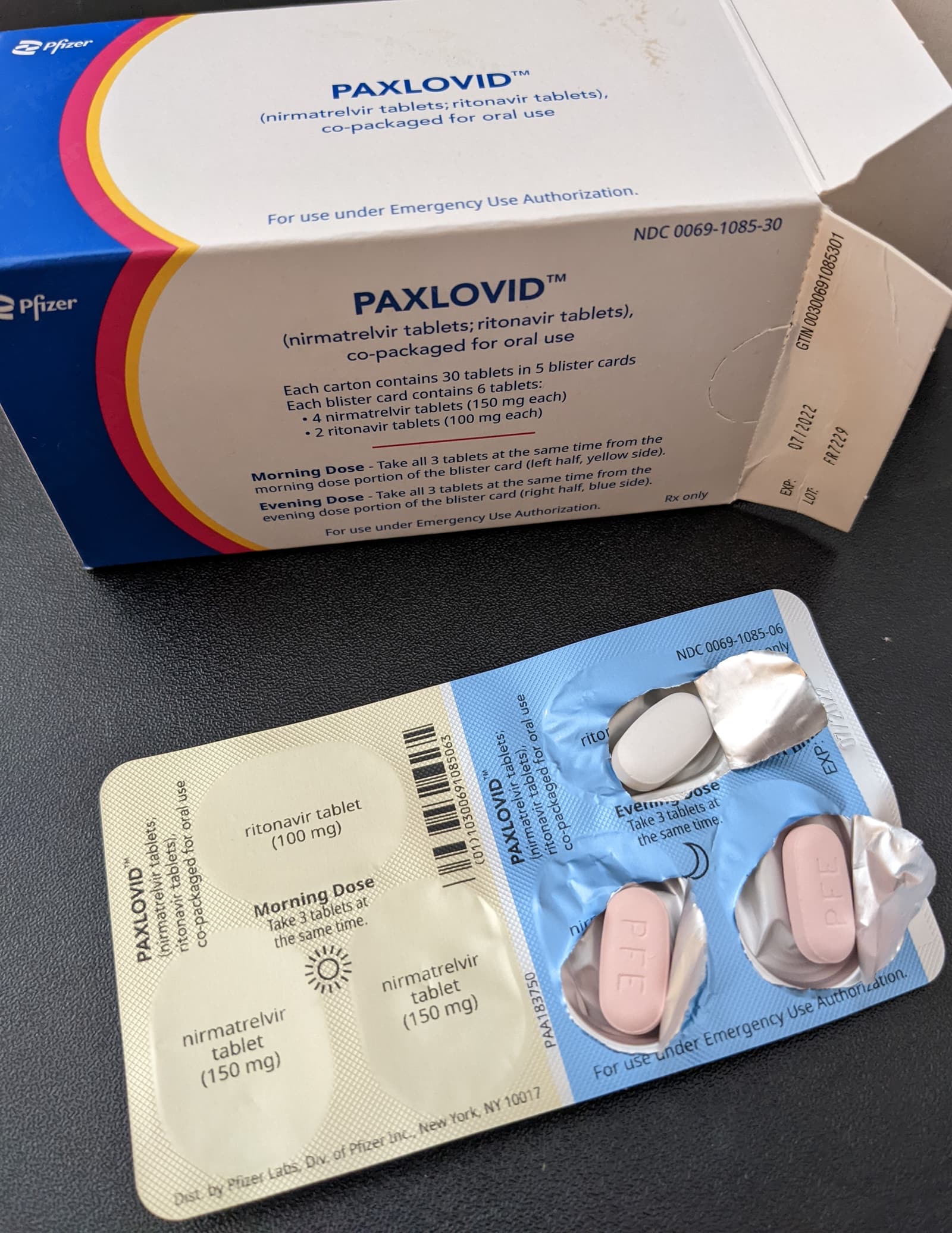
Paxlovid’s initial clinical narrative was much sharper than Tamiflu’s. In the FDA’s EUA summary based on EPIC-HR, among patients treated within 5 days, hospitalization or death occurred in about 0.8% of Paxlovid recipients versus about 6% in placebo, an 88% relative reduction (1,039 vs 1,046 participants in that analysis set).[3]
That is a high-signal efficacy headline. But translation friction appeared immediately in routine care:
- Treatment had to start quickly (within 5 days of symptom onset).[3][5]
- Drug-drug interaction checks were operationally nontrivial because of ritonavir’s interaction profile.[3]
- Real-world prescribing did not automatically saturate eligible populations: in CDC’s 2022 EHR analysis, only 28.4% of eligible adults were prescribed Paxlovid within 5 days.[4]
Even with that incomplete uptake, CDC still observed lower hospitalization rates in recipients (0.47% vs 0.86% among nonrecipients; adjusted hazard ratio 0.49).[4] So the issue was not efficacy disappearing. The issue was that benefit depended more explicitly on workflow quality than many early public narratives acknowledged.
Comparative mechanism: why trust curves diverged
1) The primary promise was different
- Tamiflu’s durable value proposition drifted toward symptom-duration reduction in many settings, while severe-outcome claims faced persistent challenge.[1]
- Paxlovid launched with severe-outcome reduction as the dominant headline in a clearly defined high-risk window.[3]
When the primary promise is severe-outcome prevention, clinicians tolerate process complexity if the endpoint remains visible. When the promise is mostly symptom-time reduction, tolerance for uncertainty is lower.
2) Denominator drift happened in opposite directions
Tamiflu credibility weakened as broad public-health expectations outran what controlled evidence could firmly support for major outcomes.[1]
Paxlovid began with a narrow high-risk denominator, then moved into populations with heterogeneous immunity histories (vaccination and prior infection). Real-world data still supported benefit, but effect interpretation required more context than a single RCT-era headline.[4]
3) Implementation burden became part of efficacy
For Paxlovid, “drug works” and “system can deliver treatment in time” are inseparable statements. IDSA’s timing language (early, risk-stratified antiviral initiation) reflects this operational dependence.[5]
That operational dependency existed for Tamiflu too (earlier treatment windows), but the post-2014 debate centered more on endpoint magnitude and evidence architecture than on interaction-heavy prescribing workflow.[1][2]
What this means for 2026 antiviral policy
A. Separate mechanism success from delivery success
A molecule can be pharmacologically effective while population impact remains suboptimal because diagnosis-to-prescription pathways are slow. CDC’s 28.4% uptake finding is a systems metric, not a molecule metric.[4]
B. Lock endpoint language before scale-up
Before large procurement or broad messaging, policy teams should pre-commit to which endpoint is being bought: symptom duration, hospitalization reduction, mortality reduction, or transmission impact. Tamiflu’s trust drawdown was amplified by endpoint ambiguity; Paxlovid’s early credibility came from endpoint clarity.[1][3]
C. Treat interaction screening as infrastructure, not clinician heroics
If oral antivirals depend on interaction review and renal/hepatic checks, that needs protocolized support, not ad-hoc physician memory. Otherwise the measured efficacy and delivered efficacy will systematically diverge.[3][5]
D. Plan for evidence renegotiation as a normal phase
Emergency authorization should be the beginning of the evidence contract, not the end. Comparative history suggests every antiviral will pass through three phases: efficacy claim, denominator expansion, and implementation recalibration.
Falsifier: what would change this comparative reading
This interpretation would weaken if future multi-system studies showed that antiviral deployment quality (timing, eligibility precision, interaction management) has minimal influence on severe-outcome benefit once a high-efficacy trial result exists. Current evidence points the other way: deployment architecture materially mediates realized benefit.[3][4][5]
Sources
- Cochrane Review (2014 update): Regulatory information on trials of oseltamivir (Tamiflu) and zanamivir (Relenza) for influenza in adults and children
- CDC: Influenza Antiviral Medications: Summary for Clinicians
- FDA Press Announcement (2021-12-22): FDA Authorizes First Oral Antiviral for Treatment of COVID-19
- CDC MMWR (2022): Paxlovid Associated with Decreased Hospitalization Rate Among Adults with COVID-19 — United States, April–September 2022
- IDSA: Guidelines on the Treatment and Management of Patients with COVID-19
- FDA Paxlovid EUA fact sheet and safety conditions