On October 3, 1910, the requests reaching Susan La Flesche Picotte in Walthill, Nebraska, included advice about building a house, a telephone call concerning a daughter's money, and a letter about inherited land. The Nebraska State Historical Society reconstructs this crowded day from her journal. The physician's door opened onto much more than a medical practice.[1]
Picotte is remembered as the first Native American woman in the United States to receive a medical degree, in 1889.[2] Following her work beyond graduation reveals another achievement: she assembled ways for people to obtain help when a prescription alone could not meet the need. By 1913, that work had acquired a purpose-built hospital.[5]
An education carried home
Born into the Omaha Nation, Susan was the daughter of Joseph La Flesche, known as Iron Eye. Her parents encouraged her education, which took her to Hampton Institute in Virginia and then to the Woman's Medical College of Pennsylvania. She graduated at the head of her medical class.[3]
The National Library of Medicine records her explanation for choosing medicine: as a child, she had witnessed a sick Omaha woman die after a white physician failed to provide care. This is a remembered experience, preserved in biography, rather than an independently reconstructed clinical case. Its significance lies in the obligation Picotte attached to becoming a doctor: she intended to return to the people who had needed one.[2]
That intention complicates a familiar story of professional advancement. The degree's value would be tested in the community she returned to, through patients' ability to reach her and her ability to reach them.
Help with conditions attached
The institutions supporting her education brought their own ambitions. Drexel's Legacy Center archivist Matt Herbison describes Hampton's Native American program as part of an educational system organized around Christianization and assimilation. Her father's support for adopting aspects of white society was itself contested among the Omaha.[3]
Those pressures belong inside the account of her success. Training offered skills and credentials that Picotte could use, while its sponsors also sought cultural change. Accepting assistance did not make their objectives identical to those of the people she treated. Herbison identifies this tension in both her schooling and the organizations that supported her practice.[3]
It would therefore flatten the history to cast her simply as a heroic graduate bringing medicine to a passive community. She worked through relationships shaped by unequal power. The important question is what she made possible through them, and what demands remained beyond her control.
The work that entered the house
Picotte married Henry Picotte in 1894, raised two sons, and continued practicing. The National Library of Medicine describes a career serving more than 1,300 people across 450 square miles, with financial advice and family mediation among her responsibilities.[2] Distance was one obstacle; the administrative problems arriving with patients were another.
In Walthill, the house she built for herself and her sons in 1907 became a recognizable place to seek assistance. The state historical society records that she kept a lamp lit in a window to welcome people at night, despite her own painful ill health.[4] The lamp is a small, practical detail: it tells a person approaching a dark house that the door may still open.
Her home also hosted political discussion. On March 2, 1911, three Nebraska legislators met there with about sixty Omaha people over a proposal concerning the inheritance of Native American women and children. The historical society's account, drawing on the Walthill Times, describes Picotte addressing the gathering in Omaha.[1]
These episodes suggest why the categories “doctor,” “interpreter,” and “advocate” fit poorly when kept apart. A letter concerning land or a call about money could be the immediate help someone sought from the same person trusted with illness. The surviving account does not establish that each administrative intervention improved health. It shows the range of problems people brought to her door.
Giving the work a building
The Walthill hospital made care less dependent on what could happen in a private home. The National Historic Landmark nomination distinguishes the 1912 groundbreaking from the 1913 opening. It describes an $8,000 project supported by church organizations and individual donors, with land given by Picotte's sister and equipment obtained through donations.[5]
The state historical marker names the Presbyterian Board of Home Missions among the financial supporters and records that the hospital served both Native American and white patients.[6] The donor list matters. Building the hospital required Picotte to turn a collection of relationships into rooms, equipment, and an institution that other people could use.
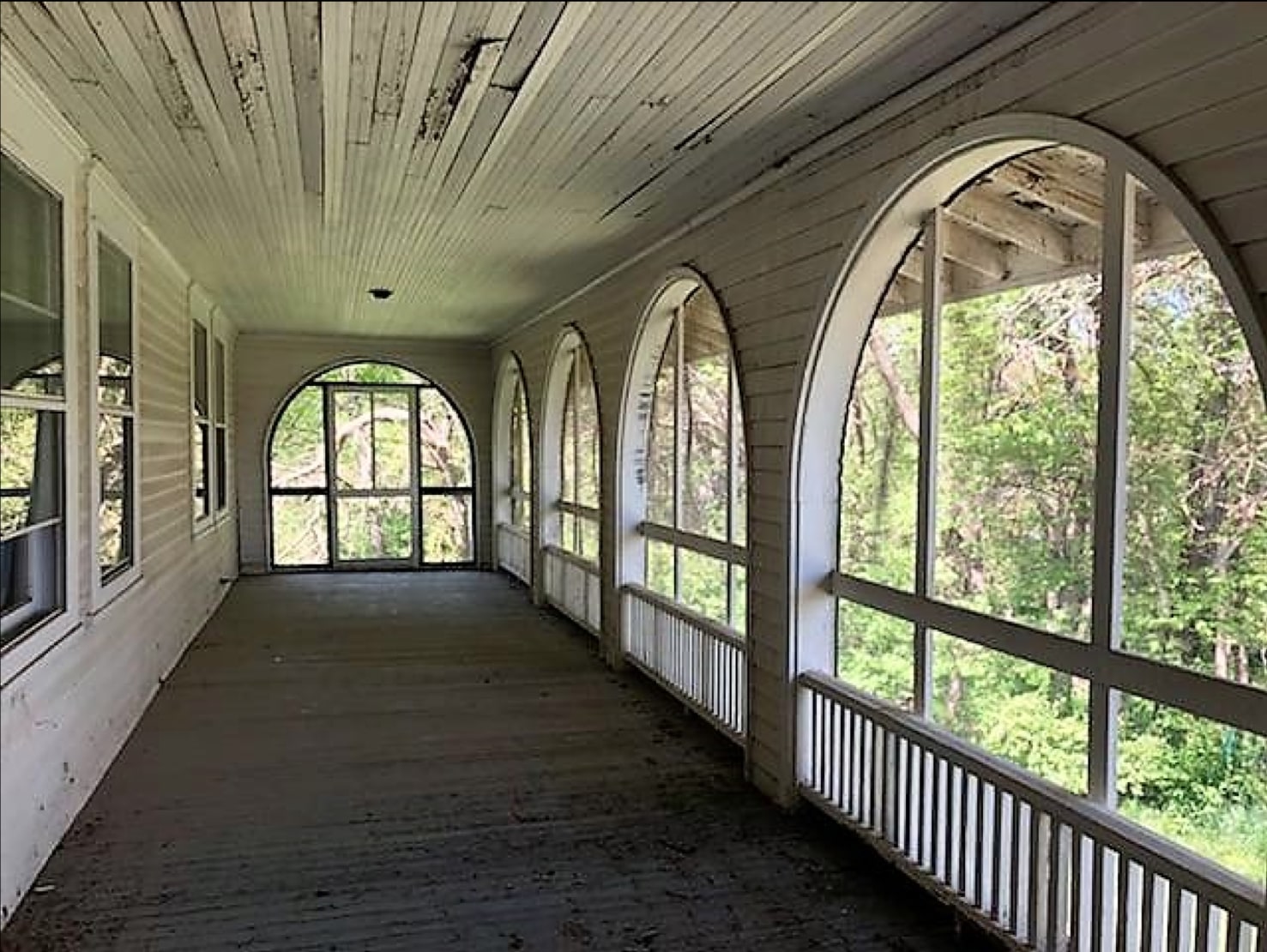
Designed by William Steele, the building included general and private wards, maternity and operating rooms, and quarters for nurses and the superintendent. Food preparation and other household functions had their own spaces. A broad screened porch extended along the front.[5] The arrangement placed treatment within the everyday work of feeding, housing, and attending to patients.
Reading the building this way is an interpretation of its plan, not evidence of a particular treatment's success. Its rooms show what the institution was equipped to accommodate. They cannot, by themselves, tell us how well each patient recovered or how consistently the hospital met demand.
What survives beyond the milestone
Picotte died on September 18, 1915, only a short time after the hospital opened. The building continued serving as a hospital into the late 1940s, according to the landmark nomination.[5] Her work had gained a physical continuity beyond her own availability.
The paper record offers a different kind of continuity. The LaFlesche family collection includes her correspondence, a diary covering September 1910 through January 1911, and a 1914 state health committee report. The archive lists a photocopy of the diary because the original is restricted for preservation.[7] These are distinct kinds of evidence: appointments and requests, formal advocacy, and institutional reporting. Together they invite a biography built from ordinary work as well as public recognition.
They also leave questions open. A record of a request is not necessarily a record of its resolution; an institutional tribute cannot replace a patient's account. Picotte's importance does not require every gap to be filled with a triumph. It is visible in the work that can be traced: obtaining training, answering requests, negotiating with officials, and bringing a hospital into being. In Walthill, a medical career became a place where care could continue.
Sources
- Nebraska State Historical Society, “Dr. Susan La Flesche Picotte, First Native American Woman Physician” — reconstruction of her October 1910 journal entries and the March 1911 meeting at her home.
- National Library of Medicine, “Biography: Dr. Susan La Flesche Picotte,” Changing the Face of Medicine — education, family, recalled motivation, and extent of practice.
- Matt Herbison, Drexel Legacy Center archivist, “Native American Heritage Month: Dr. Susan La Flesche Picotte and Dr. Lillie Rosa Minoka-Hill” (November 24, 2020) — professional opportunity and the assimilation agendas of supporting institutions.
- Nebraska State Historical Society, “Dr. Picotte's House” — the Walthill home, her sons, and the lamp welcoming patients at night.
- Jill S. Mesirow and Page Putnam Miller, Dr. Susan LaFlesche Picotte Memorial Hospital: National Historic Landmark Nomination (1992), pp. 4–5 and 12–13 — building layout, funding, opening chronology, and subsequent hospital use.
- Nebraska State Historical Society, “Marker Monday: Susan La Flesche Picotte Memorial Hospital” — historical marker identifying donors and the communities served.
- Nebraska State Historical Society, LaFlesche Family [RG2026.AM], subgroup 2, series 12 — finding aid for Picotte's diary, correspondence, and public-health papers.
- Dr. Susan La Flesche Picotte Center, “Picotte Gallery” — source of the undated hospital-porch photograph.