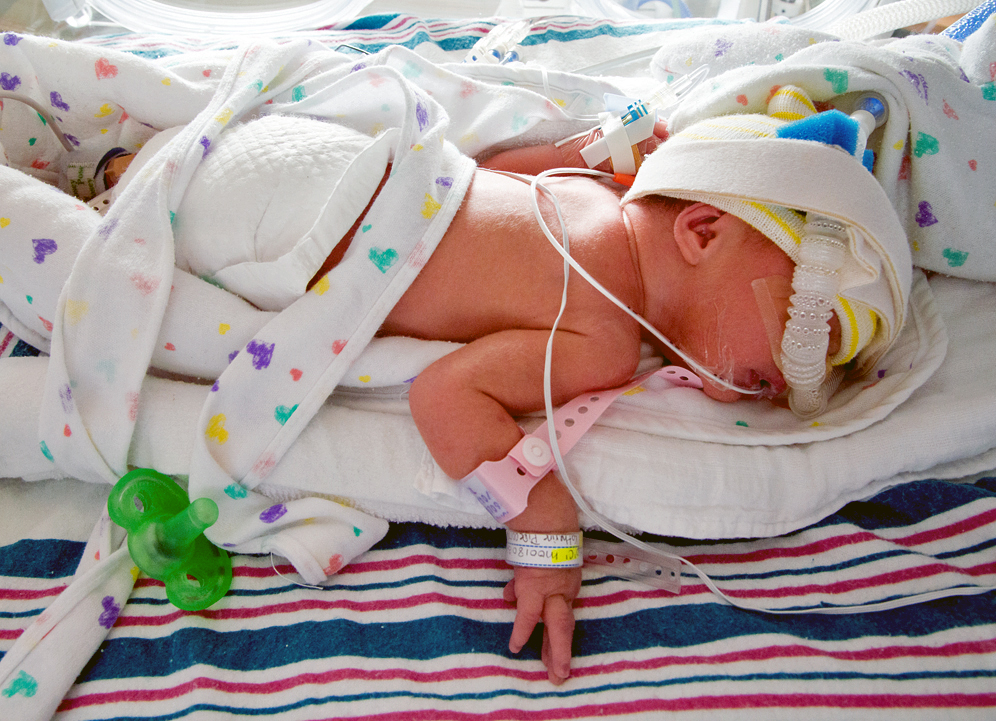
RSV prevention in infants is not mainly a "pick one product" question. It is a timing-and-handoff system: protection quality depends on whether antibodies are in place when an infant enters the first RSV season, and whether care pathways avoid gaps between prenatal care, delivery, and newborn follow-up.
Image context: the lead photo shows a premature infant in a NICU setting, which matches the article’s core point that early-life respiratory vulnerability is concentrated in the first months after birth, when prevention timing matters most.
Timeline anchors before interpretation
- August 2023: FDA approved nirsevimab for infant RSV prevention and approved maternal RSVpreF vaccine (Abrysvo) for use at 32-36 weeks gestation to protect infants from birth to 6 months.[1][2]
- September 2023: CDC/ACIP recommended maternal RSV vaccination at 32-36 weeks with seasonal use (generally September-January in most of the U.S.), and reiterated that most infants need either maternal vaccination or nirsevimab, not both.[3]
- 2023-2024 U.S. RSV season: early CDC effectiveness estimate found nirsevimab was 90% effective (95% CI: 75%-96%) against RSV-associated hospitalization in infants in their first season.[4]
The policy architecture is recent, but the mechanism is now clear enough to analyze.
Mechanism step 1: burden is front-loaded in very early infancy
RSV is not evenly distributed across childhood risk. WHO estimates RSV causes over 3.6 million hospitalizations and about 100,000 deaths annually in children under 5 globally, with about half of pediatric RSV deaths occurring in infants under 6 months.[5] CDC similarly notes RSV hospitalization risk peaks in early infancy in the U.S.[3][4]
That concentration creates a prevention design requirement: protection has to be present before or right at exposure season, not after first severe episodes appear.
Mechanism step 2: maternal vaccination protects through placental transfer, but only if prenatal timing is clean
Maternal RSV vaccination works by generating maternal antibodies during late pregnancy and transferring them through the placenta. In the phase 3 MATISSE trial, efficacy against medically attended severe RSV lower respiratory tract illness was 81.8% within 90 days after birth and 69.4% within 180 days.[6] FDA’s approval summary also reports strong severe-disease reduction signals in the 32-36 week subgroup while flagging safety monitoring obligations (including preterm-birth signal assessment).[2]
Operational implication: this pathway is strongest when prenatal care continuity is high and the vaccine window is actually reached. Missed late-pregnancy visits, uncertain gestational dating, or supply/administration delays can convert a high-efficacy product into low population coverage.
Mechanism step 3: nirsevimab protects through direct infant administration, shifting risk to postnatal logistics
Nirsevimab bypasses placental transfer and gives infants passive antibodies directly, usually as a single dose around season entry. In the MELODY trial, medically attended RSV LRTI was 1.2% in the nirsevimab arm versus 5.0% in placebo (efficacy 74.5% through 150 days).[7] In pooled prelicensure analysis cited by ACIP, efficacy against RSV hospitalization was about 80.6% through 150 days.[1] Early U.S. post-introduction data then suggested 90% effectiveness against RSV hospitalization in first-season infants, with a median 45 days from receipt to symptom onset among observed cases.[4]
Operational implication: this pathway reduces dependence on prenatal vaccine timing but increases dependence on delivery-hospital workflows, newborn record linkage, and outpatient follow-up capacity.
Mechanism step 4: the dominant failure mode is coverage fragmentation, not biologic weakness
Both pathways show substantial protective signal. The larger real-world risk is a handoff gap where:
- maternal vaccine is not given during 32-36 weeks,
- infant nirsevimab is not given before/at season entry,
- and no recovery workflow catches the miss in early pediatric visits.
This is why CDC’s framing is pathway-based: ensure every infant is covered by at least one route.[3][4] The core mechanism is therefore delivery architecture: one missed handoff can nullify two good products.
Strongest counterweight
A fair counterargument is that broad implementation can strain budgets and operations, especially when seasonal procurement, staffing, and clinic throughput are uneven. WHO also notes affordability constraints in many low- and middle-income settings.[5]
That counterweight is real. But it changes the implementation strategy, not the mechanism. If frontline systems cannot support universal deployment at once, the causal logic still supports explicit prioritization of infants entering first season at highest early-life risk while building reliable handoff tracking.
What would change this assessment
This mechanism-first view weakens if health systems show sustained low infant hospitalization rates with no improvement in prenatal-to-newborn prevention handoffs. If outcomes stay strong despite fragmented delivery, then biologic durability or background seasonality would be doing more of the work than currently assumed.
Today’s evidence points the other way: product efficacy is necessary, but handoff reliability is the higher-leverage policy variable.
Sources
- CDC MMWR (Aug 2023) — Use of Nirsevimab for the Prevention of RSV Disease Among Infants and Young Children
- FDA — ABRYSVO (Respiratory Syncytial Virus Vaccine) regulatory information page
- CDC MMWR Early Release (Oct 2023) — Use of the Pfizer RSV Vaccine During Pregnancy
- CDC MMWR (2024) — Early Estimate of Nirsevimab Effectiveness for Prevention of RSV-Associated Hospitalization Among Infants
- WHO Fact Sheet — Respiratory syncytial virus (RSV)
- Kampmann B, et al. Bivalent Prefusion F Vaccine in Pregnancy to Prevent RSV Illness in Infants (NEJM, 2023; PMID: 37018474)
- Hammitt LL, et al. Nirsevimab for Prevention of RSV in Healthy Late-Preterm and Term Infants (NEJM, 2022; PMID: 35235726)