Prone positioning looks, from outside the ICU, like an almost crude maneuver: turn a critically ill patient from the back onto the stomach and wait for the oxygen number to improve. That description is too small. In severe acute respiratory distress syndrome, proning is not mainly a posture hack. It is a way of changing how an injured lung receives air, blood flow, weight, and ventilator pressure at the same time.[1][2][4]
The distinction matters because ARDS is already a disease of unevenness. The lung is not uniformly wet, stiff, or open. Some regions are recruitable, some are overinflated, some are collapsed, and some still receive blood flow while receiving too little ventilation. A ventilator can keep a patient alive, but it can also concentrate damaging stress in the parts of the lung still open enough to take each breath.[2][3] Proning became important because it attacks that geometry before it asks the ventilator to do more.
The timeline that made the maneuver credible
- 2012: the Berlin Definition organized ARDS by oxygenation severity, including severe ARDS at a PaO2/FiO2 ratio of 100 mm Hg or less and moderate ARDS at 101-200 mm Hg, on appropriate positive-pressure support.[1]
- June 2013: the PROSEVA trial randomized 466 patients with severe ARDS to prolonged prone sessions or supine care and reported sharply lower mortality in the prone group.[2]
- 2017: the ATS/ESICM/SCCM mechanical-ventilation guideline strongly recommended lower tidal volumes of 4-8 ml/kg predicted body weight for ARDS and prone positioning for more than 12 hours per day in severe ARDS.[3]
- 2021: a multinational awake-proning meta-trial in COVID-19 showed that the idea could help selected non-intubated patients on high-flow nasal cannula, while also making the boundary clearer: awake proning is related to, but not identical with, ventilated severe-ARDS proning.[5]
- 2023: ESICM guidelines again treated prone positioning as a core respiratory-support strategy, recommending prolonged sessions of 16 consecutive hours or more for moderate-to-severe ARDS after stabilization when PaO2/FiO2 remains below 150 mm Hg.[4]
Those dates show why the maneuver should not be filed under pandemic improvisation. COVID-19 made proning visible to the public, but the adult severe-ARDS survival argument was already mature.
1. ARDS turns the lung into an uneven sponge
ARDS is often explained as fluid in the lungs, which is true but incomplete. The Berlin Definition described it as acute respiratory failure with bilateral opacities not fully explained by cardiac failure or fluid overload, then classified severity by the PaO2/FiO2 ratio.[1] That ratio is not just a number. It is a signal that oxygen transfer is failing despite supplied oxygen and ventilatory support.
The mechanical problem is that the injured lung becomes patchy. In a supine patient, dependent dorsal regions are vulnerable to collapse and compression, while ventral regions may receive a disproportionate share of tidal ventilation. Blood flow, however, remains substantial in dorsal lung regions. The result is a mismatch: blood keeps moving through areas that may be poorly ventilated, while the ventilator pushes more of each breath into the smaller "baby lung" that remains open.[7]
That is why simply raising pressure can be dangerous. More force may recruit some alveoli, but it can also overdistend regions that were already open. Modern ARDS care therefore became lung-protective care: smaller tidal volumes, lower plateau pressure, careful PEEP, and strategies that reduce stress concentration rather than merely chase a prettier oxygen saturation.[3]
2. Proning changes the pressure map
Turning the patient prone changes the gravitational and anatomical load on the lung. The heart no longer presses into the same dorsal lung regions in the same way. The abdomen and chest wall mechanics change. Dorsal lung units can reopen, and ventilation becomes more evenly distributed across the lung. Because perfusion often remains strong in those dorsal regions, reopening them can improve ventilation-perfusion matching rather than merely shifting air to a less useful compartment.[7]
This is the mechanism behind the monitor change. Oxygenation often improves after proning, but the oxygen number is the visible downstream result. The deeper benefit is more homogeneous lung inflation and less regional stress and strain.[7] In practical terms, proning helps the ventilator distribute a limited breath through a larger and better-matched surface.
That is also why proning belongs beside low tidal volume ventilation, not instead of it. The 2017 guideline's two strongest ARDS recommendations sit together: lower tidal volume ventilation for all ARDS, and prone positioning for severe ARDS.[3] The first limits the size and pressure of each breath. The second changes where that breath goes.
3. The survival signal appeared only when the dose and patient were right
Earlier proning trials often improved oxygenation without proving a clean survival benefit. PROSEVA changed the argument because it selected very sick patients, used early and prolonged sessions, and placed proning inside a lung-protective protocol.[2]
The trial's details are the whole lesson. Adults with severe ARDS were randomized to prone-positioning sessions of at least 16 hours or to remain supine. Severe ARDS in that trial meant PaO2/FiO2 below 150 mm Hg with FiO2 of at least 0.6, PEEP of at least 5 cm H2O, and tidal volume close to 6 ml/kg predicted body weight.[2] Mortality by day 28 was 16.0% in the prone group versus 32.8% in the supine group; unadjusted 90-day mortality was 23.6% versus 41.0%.[2]
Those numbers are impressive, but they are not permission to treat every hypoxic patient the same way. They say that in severe, ventilated ARDS, early long-session proning can be a survival intervention when the rest of the ventilation strategy is disciplined. They do not say that a brief turn, a poorly selected patient, or proning without lung-protective ventilation carries the same evidence.
4. Awake proning is the useful cousin, not the same intervention
COVID-19 revived public interest because clinicians began asking whether non-intubated patients could lie prone before they reached mechanical ventilation. The large 2021 meta-trial pooled randomized trials in adults with acute hypoxaemic respiratory failure due to COVID-19 who were receiving high-flow nasal cannula. It found that awake prone positioning reduced the primary composite outcome of intubation or death within 28 days.[5]
That finding matters, but it should not be merged casually with PROSEVA. An awake patient on high-flow oxygen can change position, report discomfort, and stop early. A deeply ill ventilated ARDS patient requires airway security, line protection, sedation planning, pressure-injury prevention, and a team that can turn the body without turning the tubes into hazards. The physiology overlaps, but the operational problem is different.[4][5]
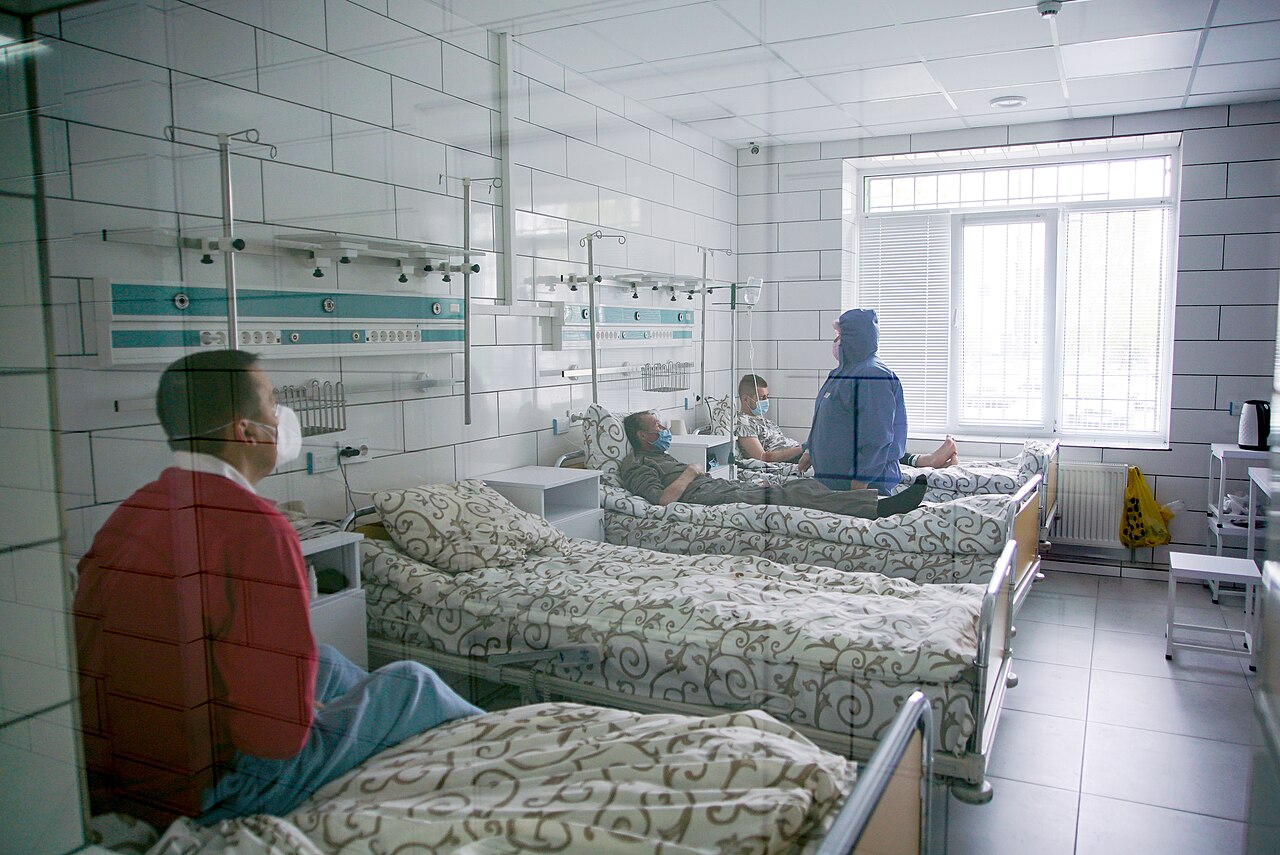
This boundary explains why the article's image is contextual rather than procedural.[6] During COVID-19, respiratory care moved into public view: ward oxygen, high-flow support, ICU escalation, and proning all became part of the same public vocabulary. But evidence still has to separate awake from ventilated, moderate from severe, and oxygen response from survival.
5. The maneuver is simple only after the system is built
Proning is sometimes described as low-tech because it does not require a new drug or machine. That is misleading. The act of turning a mechanically ventilated patient with severe ARDS is a systems procedure. The airway has to stay secure. Central lines, arterial lines, feeding tubes, drains, and monitoring cables have to move with the body. Pressure points need protection. The face, eyes, shoulders, abdomen, and knees need attention. The team needs a rescue plan if the patient destabilizes while face-down.
The 2023 ESICM recommendation reflects that operational reality by specifying prolonged sessions and timing after initial stabilization with low tidal volume ventilation and PEEP adjustment.[4] The maneuver works best when it is neither a last-second panic move nor a casual posture suggestion. It is a scheduled lung-protective intervention for a patient whose physiology fits the evidence.
That is the cleanest way to remember proning in severe ARDS. It does not save lives because stomach-down is inherently therapeutic. It saves lives when it changes the injured lung's stress map, recruits dorsal units that still receive blood flow, improves ventilation-perfusion matching, and lets a protective ventilator strategy operate through more of the usable lung. The monitor may show the first visible improvement. The deeper achievement is that the lung is no longer being asked to survive each breath in the same damaging shape.[2][3][4][7]
Sources
- ARDS Definition Task Force, "Acute Respiratory Distress Syndrome: The Berlin Definition" (JAMA, 2012) - diagnostic framework and mild, moderate, severe oxygenation categories.
- Claude Guérin and the PROSEVA Study Group, "Prone Positioning in Severe Acute Respiratory Distress Syndrome" (New England Journal of Medicine, 2013) - 466-patient randomized trial of early prolonged prone sessions in severe ARDS.
- Eddy Fan et al., "An Official ATS/ESICM/SCCM Clinical Practice Guideline: Mechanical Ventilation in Adult Patients with Acute Respiratory Distress Syndrome" (American Journal of Respiratory and Critical Care Medicine, 2017) - lower tidal volume and severe-ARDS prone-positioning recommendations.
- Giacomo Grasselli et al., "ESICM guidelines on acute respiratory distress syndrome: definition, phenotyping and respiratory support strategies" (Intensive Care Medicine, 2023) - updated ARDS respiratory-support guidance, including prolonged prone sessions.
- Stephan Ehrmann et al., "Awake prone positioning for COVID-19 acute hypoxaemic respiratory failure: a randomised, controlled, multinational, open-label meta-trial" (The Lancet Respiratory Medicine, 2021) - awake-proning evidence in high-flow oxygen COVID-19 respiratory failure.
- Wikimedia Commons, "File:COVID-19 patient medical examination performed in a ward. Bucha, Kyiv oblast.jpg" - documentary photograph by Mstyslav Chernov used as the article image.
- Christopher Lai, Xavier Monnet, and Jean-Louis Teboul, "Hemodynamic implications of prone positioning in patients with ARDS" (Critical Care, 2023) - open-access review summarizing dorsal recruitment, ventilation-perfusion matching, atelectrauma, and transpulmonary-pressure mechanisms.