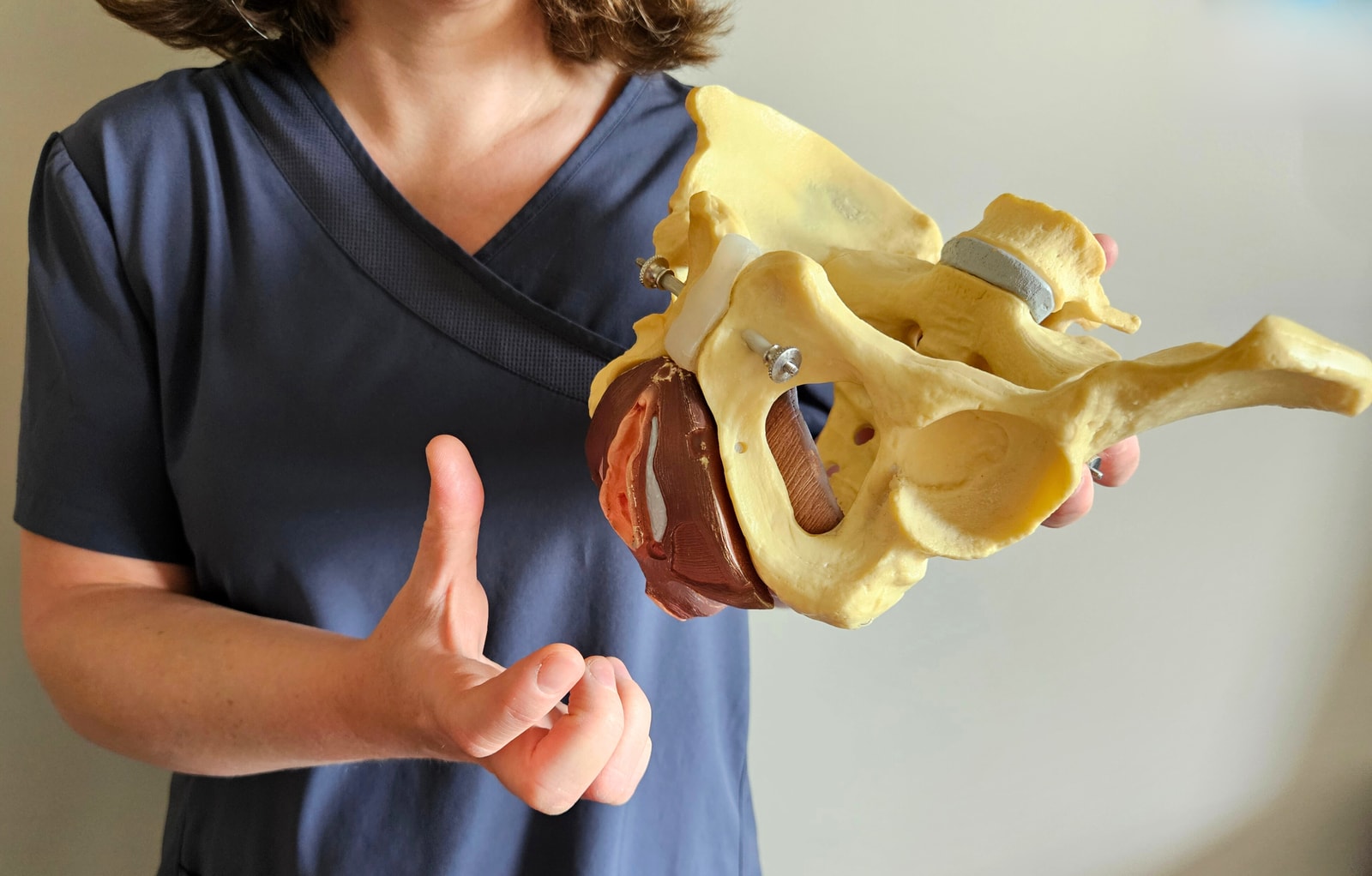

Pelvic-floor exercise has an unusual teaching problem: the important movement is internal. A learner cannot copy a visible elbow angle or watch a foot land. She has to distinguish a small lift from a general brace, keep breathing while it happens, and then notice whether the muscle truly lets go. That makes “do your Kegels” much less useful than it sounds. The first task is sensory: find the right movement without recruiting every nearby muscle.[2][5]
University College London Hospitals uploaded Pelvic Floor Exercises — Finding Your Pelvic Floor on December 22, 2021; its current patient-education page presents the clip first among eight pelvic-floor videos.[1][2] Its chapter markers reveal the logic: the clip moves from introduction to “Finding your Pelvic Floor” at 0:21, then to “Pelvic Floor Exercises” at 1:18. Watch for the modesty of the demonstration. A pelvic model supplies location; verbal cues supply movement; the learner has to supply attention.
That narrow lesson matters because pelvic-floor muscle training is not fringe wellness advice. It is an evidence-based first-line treatment for women with stress or mixed urinary incontinence, but the evidence is for a sustained, correctly performed programme—not for occasional hard squeezing.[3][4] The video is worth watching as the beginning of that programme: a lesson in recognition, coordination, and release before repetition takes over.
Watch the verbs: close, lift, release
Around 0:21, the anatomical model changes the question from “Where is my core?” to “Which layer am I trying to move?” The pelvis is not presented as a fitness prop. It gives a physical frame for a sheet of muscle that supports pelvic organs and helps control the bladder and bowel. The useful cues are directional: imagine closing around the back and front passages and drawing that action upward. Cambridge University Hospitals gives a similar instruction—feel a slight internal lift while avoiding a buttock squeeze or held breath.[5]
The word lift does important work. A maximum-effort clench can recruit the abdomen, thighs, or buttocks and still miss the intended movement. From the outside, that effort may look convincing. Internally, it may be poorly targeted. The UCLH presenter therefore has to teach through analogy, a pelvis model, and repeated attention rather than spectacle.[1] The video’s calm pace is part of its clinical value: it leaves room to sense a contraction instead of racing to count one.
At 1:18, the clip turns recognition into exercise. Short contractions train a quick response; longer holds ask for endurance. Yet every contraction has a second half. CUH’s written guidance explicitly tells learners to let go completely after a short contraction, to keep breathing during a longer one, and to rest because these muscles fatigue.[5] A repetition is not complete when the squeeze ends. It is complete when the muscle returns to rest.
That is also why breath is more than a relaxation flourish. Holding the breath can turn a precise internal action into a whole-torso brace. Easy breathing provides an informal quality check: if a learner cannot continue to breathe, soften the shoulders, and release between efforts, adding more repetitions may only rehearse compensation. The goal is controlled movement, not visible strain.
The evidence belongs to a programme
The strongest numbers are encouraging, but they need their frame. A 2018 Cochrane review included 31 trials and 1,817 women across 14 countries. Its headline stress-incontinence cure estimate came from 4 trials and 165 women: 56% assigned to pelvic-floor muscle training reported cure at the end of treatment, compared with 6% in inactive control groups, a risk ratio of 8.38 with a 95% confidence interval from 3.68 to 19.07. Across urinary-incontinence types, the corresponding cure figures were 35% versus 6%.[4]
Those results do not mean that one generic squeeze works for every symptom. The trials varied in programme content, duration, population, and outcome measurement; most were small to moderate in size, and follow-up was generally shorter than 12 months.[4] The useful conclusion is bounded but substantial: correctly delivered pelvic-floor muscle training can cure or improve urinary-incontinence symptoms for many women, while long-term effectiveness and the best programme design still deserve study.
NICE’s quality statement, first published in 2015 and updated in 2021, turns that evidence into a care standard: women with stress or mixed urinary incontinence should be offered at least three months of supervised pelvic-floor muscle training as first-line treatment.[3] “Supervised” is not decorative. NICE says the programme should assess both contraction and relaxation, then be tailored to ability, discomfort, needs, and goals. A leaflet or video can make the first attempt less mysterious; a trained professional can tell whether the intended muscle is actually doing the work.
Strength includes the ability to stop squeezing
The most valuable boundary sits just outside the video’s simple exercise sequence. Pelvic-floor symptoms are not always a story of weakness. Somerset NHS Foundation Trust notes that incontinence, constipation, and pelvic pain can sometimes be associated with a pelvic floor that does not relax fully; a healthy pelvic floor needs to contract well and relax fully.[6] That does not let a reader diagnose an “overactive” muscle from a webpage. It does explain why indiscriminate advice to squeeze harder can be incomplete.
Think of three separate capacities: finding the contraction, grading the effort, and releasing on purpose. A person may struggle with one while doing the others well. Someone who leaks during a cough may need better anticipatory timing; someone who cannot feel a lift may need hands-on assessment or another form of feedback; someone with pain or difficulty relaxing may need a programme that does not begin with more strengthening. The symptom alone does not reveal which capacity is missing.[3][6]
This is where the UCLH series design becomes more revealing than the single clip. Its other videos address breathing, bowel bracing, bladder calming, physical activity, common questions, and a real-time training session.[2] “Finding” comes first because exercise dosage is downstream of identification. The collection quietly rejects the idea that pelvic health is one muscle plus one command.
What this six-minute lesson cannot decide
The video cannot determine the type or cause of urinary leakage, evaluate prolapse, explain persistent pelvic pain, or tailor rehabilitation after childbirth or surgery. It also cannot confirm from a viewer’s effort that the correct contraction occurred. Those are reasons to seek assessment, especially when symptoms persist, the movement cannot be found, or squeezing is uncomfortable—not reasons to abandon a useful conservative treatment.[3][5][6]
What the clip can do is improve the first conversation between body and brain. It replaces a vague command with a sequence: locate, close, lift, breathe, and return fully to rest. The evidence then adds the missing clinical frame: repeat that sequence inside a programme long enough to learn from it, with supervision when symptoms or uncertainty make feedback valuable.
The movement remains invisible to everyone else. Good instruction makes it legible to the person doing it.
Sources
- University College London Hospitals NHS Foundation Trust, “Pelvic Floor Exercises — Finding Your Pelvic Floor” (YouTube, uploaded December 22, 2021) — the embedded institutional tutorial and chapter timings.
- University College London Hospitals NHS Foundation Trust, “Pelvic floor exercise videos” — the eight-part patient-education series surrounding the anchor video.
- National Institute for Health and Care Excellence, “Quality statement 4: Supervised pelvic floor muscle training” (published 2015; updated 2021) — duration, supervision, and individual-assessment standard.
- Dumoulin, Cacciari, and Hay-Smith, “Pelvic floor muscle training versus no treatment, or inactive control treatments, for urinary incontinence in women,” Cochrane Database of Systematic Reviews (2018; full text via PubMed Central) — 31-trial review, cure estimates, evidence quality, and limitations.
- Cambridge University Hospitals NHS Foundation Trust, “Female pelvic floor muscle exercises” (version 5, approved July 16, 2024) — contraction, breathing, release, fatigue, and physiotherapy guidance.
- Somerset NHS Foundation Trust, “Improve your pelvic health” — why coordinated contraction and full relaxation both matter, and when symptoms merit specialist support.
- MelConfidentiel, “Physiotherapist explaining pelvic floor function” (Wikimedia Commons; photographed June 5, 2024) — source page for the clinical-instruction cover photograph.