At an American hospital, the word EMERGENCY over a door is more than wayfinding. Since 1986, it has marked the entrance to a federal duty. When a person comes to a Medicare-participating hospital's emergency department and requests examination or treatment—or the circumstances amount to a request on that person's behalf—the hospital cannot let insurance status or ability to pay decide whether the clinical work begins. It must provide an appropriate medical screening examination; if that examination finds an emergency medical condition, it must provide stabilizing treatment or arrange an appropriate transfer.[1][2]
That sounds like a general right to hospital care. The statute is both narrower and more exact. The Emergency Medical Treatment and Labor Act, or EMTALA, does not create national health insurance, erase the eventual bill, or promise every treatment at every facility. It builds a sequence for the dangerous interval when delay, refusal, or a financially convenient transfer could turn illness or labor into irreversible harm. Read closely, its power sits in three linked verbs: screen, stabilize, transfer.[1][3]
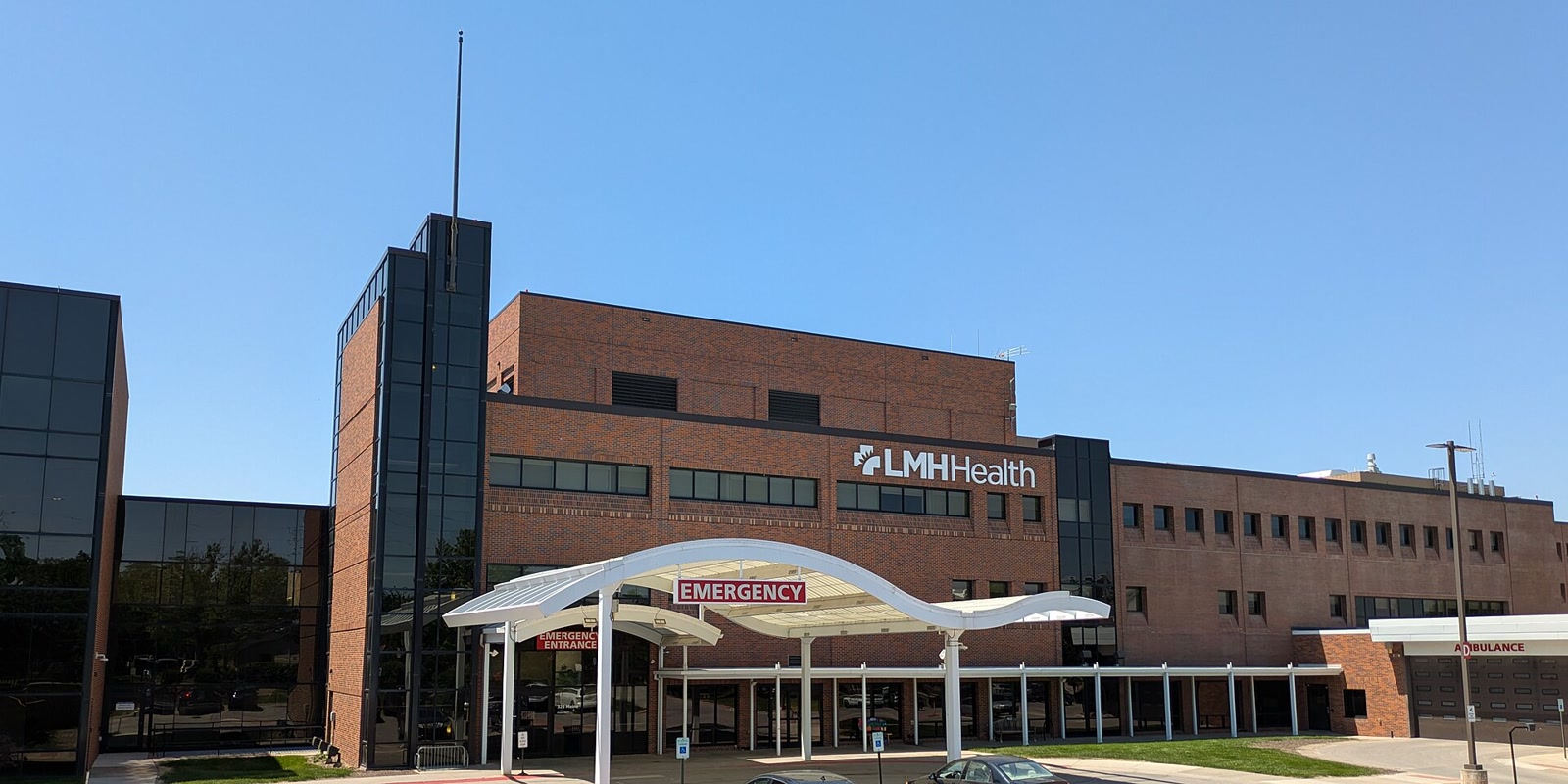
The photograph above shows the emergency entrance and ambulance bay at Lawrence Memorial Hospital in Lawrence, Kansas. It is a real, site-specific image rather than a symbolic medical graphic. The canopy, walk-in door, and vehicle bay make the law's operating threshold visible: EMTALA attaches when someone comes and requests—or is deemed to request—examination or treatment. Under CMS's regulation, a request can be made on the person's behalf or inferred when a prudent layperson would recognize from appearance or behavior that examination or treatment is needed. The door is visual shorthand rather than the law's full geography; certain presentations elsewhere on hospital property and in hospital-owned ambulances can also qualify.[1][2][7]
The problem before the sequence
Congress enacted EMTALA in 1986 after reports that hospitals were refusing uninsured or indigent patients or moving them to public hospitals before they were stable, a practice that became known as patient dumping. Contemporary accounts from Cook County Hospital in Chicago described economically motivated transfers that fell disproportionately on unemployed and minority patients. The injury was not transfer by itself. Hospitals transfer patients every day for specialist care. The injury was allowing finance to choose the timing and clinical condition of the transfer.[3][5]
The later record gives the law three useful time anchors. In 2001, the U.S. General Accounting Office—renamed the Government Accountability Office in 2004—reviewed EMTALA's effect and enforcement, restating the basic chain: screening when someone comes to the emergency department and requests examination or treatment, stabilization when an emergency condition exists, and an appropriate transfer when the first hospital is unable to stabilize.[3] In 2003, CMS issued a final rule clarifying what counts as a dedicated emergency department.[6] Today, CMS investigates compliance through the Medicare provider agreement, while the HHS Office of Inspector General can pursue civil monetary penalties for negligent violations.[4]
Those later layers matter, but the statutory architecture was already clear. EMTALA did not try to write a national emergency-medicine textbook. It changed who was allowed to reach the point where clinical judgment could operate.
First: screen before sorting by money
Section 1867 begins with the medical screening examination. When an individual comes to a covered hospital's emergency department and a request is made by or on behalf of that person—or is deemed made under the regulation—the hospital must provide an appropriate screening within the capability of that department, including routinely available ancillary services. The purpose is specific: determine whether an emergency medical condition exists.[1][2]
The phrase within the capability prevents a false uniformity. A small rural emergency department and a major trauma center do not have identical laboratories, imaging, consultants, or beds. EMTALA does not pretend otherwise. CMS instructs that the examination must match the presenting signs and symptoms, be reasonably calculated to identify an emergency medical condition, and follow the same screening process used for patients who present similarly. It cannot collapse into a token glance because registration shows no insurance or staff decide that a presentation is not worth the hospital's usual diagnostic process.[2]
This is also why triage and screening are not synonyms. Triage sets order under pressure: who needs immediate attention, who can safely wait, and which resources must move first. The EMTALA screening answers a different question: does this person have an emergency medical condition as federal law defines it? A waiting room may still run by clinical urgency. What it cannot do is make payment status a substitute for that determination.[1][2]
The statute draws the boundary directly. A hospital may follow reasonable registration practices and ask about insurance, but those practices may neither delay the required screening or stabilizing treatment nor unduly discourage the person from remaining for evaluation. The prohibition is about sequence, not paperwork abolition. Registration can occur; it cannot become a financial checkpoint placed ahead of emergency assessment.[1][2]
Second: stabilize the emergency condition, not the entire life
The screening is a gate, not the whole obligation. If no emergency medical condition is found, EMTALA's central stabilization duty is not triggered. If one is found, the hospital must provide further examination and treatment within the capabilities of the staff and facilities available at the hospital to stabilize the condition, or arrange an appropriate transfer.[1][2]
The statute defines an emergency medical condition by risk: acute symptoms, including severe pain, serious enough that the absence of immediate medical attention could reasonably be expected to place health in serious jeopardy, seriously impair bodily functions, or cause serious dysfunction of an organ or body part. It also speaks explicitly to a pregnant patient having contractions when inadequate time for safe transfer or a threat to the patient or unborn child makes labor an emergency.[1]
Stabilization is often misunderstood as cure. For emergency conditions outside the statute's pregnancy-and-contractions branch, the test is transport-focused: has treatment made it unlikely, within reasonable medical probability, that the condition will materially deteriorate during or because of transfer? That may require resuscitation, medication, blood, imaging, a procedure, monitoring, or specialist involvement. The labor branch is categorical: when the statutory conditions are met, stabilization means delivery of the child and placenta. Neither definition requires the first hospital to complete rehabilitation, long-term cancer care, or every downstream intervention before EMTALA can be satisfied.[1][2]
That boundary is not a retreat from care. It is what makes the duty enforceable at the moment of greatest leverage. The law asks a hospital to identify the emergency, use the capabilities it actually has, and prevent departure from becoming the dangerous act. Other laws, professional duties, coverage rules, and hospital conditions govern much of what comes before and after. EMTALA protects the hinge.
Third: make transfer a clinical handoff, not an exit
An unstable patient can still be transferred, but the transfer must earn the word appropriate. Before the move, the sending hospital must provide treatment within its capacity that minimizes the risks. The receiving facility must agree to accept the patient and have space and qualified personnel; all available records related to the emergency condition must travel with the patient; and the move must use qualified personnel and suitable transportation, including necessary life-support measures. A physician—or, when the physician is absent, a qualified medical person after consultation and with the required countersignature—must certify that expected medical benefits outweigh the increased risks. The alternative is a written transfer request by the patient or a legally responsible person acting on the patient's behalf after being informed of the hospital's obligations and the transfer risks. The writing must give the reasons for the request and acknowledge awareness of the transfer's risks and benefits. That request replaces the certification; it does not waive the rest of the appropriate-transfer safeguards.[1][2]
The law also closes the loop at the far end. A Medicare hospital with specialized capabilities or facilities may not refuse an appropriate transfer of an unstabilized, EMTALA-protected person who needs those capabilities when the referring hospital lacks the capability or capacity and the receiving hospital has capacity. CMS's regulation does not extend that receiving-hospital obligation to someone whom the referring hospital, after screening and finding an emergency condition, has admitted in good faith as an inpatient specifically to stabilize it. Within those boundaries, a tertiary center cannot enjoy the status of a referral hub while rejecting a patient whose needs match its available expertise.[1][2][4]
Capability and capacity therefore do different work. Capability asks what the hospital's staff and facilities can do; capacity asks whether the hospital can accommodate this person. CMS looks not only at occupied beds, qualified staff, and working equipment, but also at what the hospital customarily does when it exceeds its stated limits. A full intensive-care unit matters, but it is not automatically dispositive if the hospital ordinarily moves patients, calls in staff, or borrows equipment to create room. EMTALA requires a case-specific determination and action through the result, not a vague claim of inconvenience that disguises a refusal.[1][2]
What the statute does not promise
The strongest reading of EMTALA resists two opposite myths.
The first myth says it created free emergency care. It did not. The statute prevents payment questions from delaying the required screening and stabilization sequence; it does not create an insurance plan or cancel lawful billing afterward. Its clinical entitlement is immediate, bounded, and tied to emergency risk.[1][2]
The second myth says it merely requires hospitals to look at everyone. That is too weak. Screening is followed by stabilization or appropriate transfer when an emergency condition is found, and hospitals with needed specialized capability and available capacity have duties on the receiving side as well. The HHS Office of Inspector General still describes failures of screening, stabilization, transfer, and acceptance as enforceable forms of patient dumping.[4]
These limits do not make later neglect lawful. They mean EMTALA is one specific federal gatekeeping rule, not the complete law of hospital care. Other Medicare conditions, civil-rights laws, professional standards, coverage rules, and state tort law govern other parts of the encounter. Close reading preserves EMTALA's force by keeping it trained on emergency access, screening, stabilization, and hospital-directed transfer instead of asking one statute to stand in for the entire health system.[1][2]
The door is a sequence
EMTALA's achievement was not to make emergency departments equal, uncrowded, affordable, or universally capable. It was to make one kind of exclusion harder to hide. Before a hospital can direct an unstable patient's discharge or transfer, someone qualified must assess whether an emergency exists and the hospital must use its available capabilities or build a transfer that can carry the risk. The statute separately addresses informed refusal and excludes from its transfer definition a person who leaves without hospital permission. Before payment becomes the conversation that controls the encounter, clinical danger gets its turn.[1][2][3]
That is why the law is best understood as a sequence rather than a slogan. Screen converts a covered presentation and actual or deemed request into a clinical question. Stabilize converts danger into a duty within the hospital's means. Transfer converts a hospital-directed departure into a documented handoff rather than abandonment. The emergency-room door matters because EMTALA made what happens after crossing it answerable to an order.
Sources
- U.S. Government Publishing Office, 42 U.S.C. § 1395dd, "Examination and treatment for emergency medical conditions and women in labor" - current statutory text defining screening, emergency conditions, stabilization, transfer, receiving-hospital duties, and the prohibition on payment-related delay.
- Centers for Medicare & Medicaid Services, State Operations Manual, Appendix V: Interpretive Guidelines—Responsibilities of Medicare Participating Hospitals in Emergency Cases - current regulatory and survey guidance on deemed requests, screening, stabilization, transfer, registration, capability, and capacity.
- U.S. Government Accountability Office, Emergency Care: EMTALA Implementation and Enforcement Issues (GAO-01-747, 2001) - congressional history, patient-dumping context, statutory duties, and review of implementation and enforcement.
- U.S. Department of Health and Human Services, Office of Inspector General, "The Emergency Medical Treatment and Labor Act (EMTALA)" - current enforcement roles and concise explanation of screening, stabilization, transfer, and receiving-hospital obligations.
- Joseph Zibulewsky, "The Emergency Medical Treatment and Active Labor Act (EMTALA): what it is and what it means for physicians," Baylor University Medical Center Proceedings 14(4), 2001 - medical-history review of patient dumping, the Cook County evidence, and the law's early interpretation.
- Centers for Medicare & Medicaid Services, "Medicare Announces Final Rule on Hospital Responsibilities to Patients Seeking Treatment for Emergency Conditions" (Aug. 29, 2003) - agency account of the dedicated-emergency-department clarification.
- Wikipedialuva, "LMH emergency entrance (2025)1.jpg," Wikimedia Commons - real May 10, 2025 photograph of Lawrence Memorial Hospital's emergency entrance and ambulance bay, used as the article image.