The most important sentence in the 1988 Surgeon General report is not the familiar one about nicotine being addictive. It is the structural move underneath it. The report does not merely say smoking is dangerous; earlier federal reports had already done that. It reclassifies smoking as a form of drug dependence, then spends hundreds of pages showing why the right unit of analysis is not weak will, bad habit, or bad information, but reinforcement, tolerance, withdrawal, relapse, and product delivery.[1][2]
That shift still matters in 2026 because nicotine policy keeps cycling between two frames. One frame treats nicotine use as a risky consumer choice that can be corrected by education alone. The other treats it as an addiction problem shaped by chemistry, delivery speed, youth initiation, and repeated failed quit attempts. The 1988 document is where the federal language pivot becomes unmistakable.[1][3]
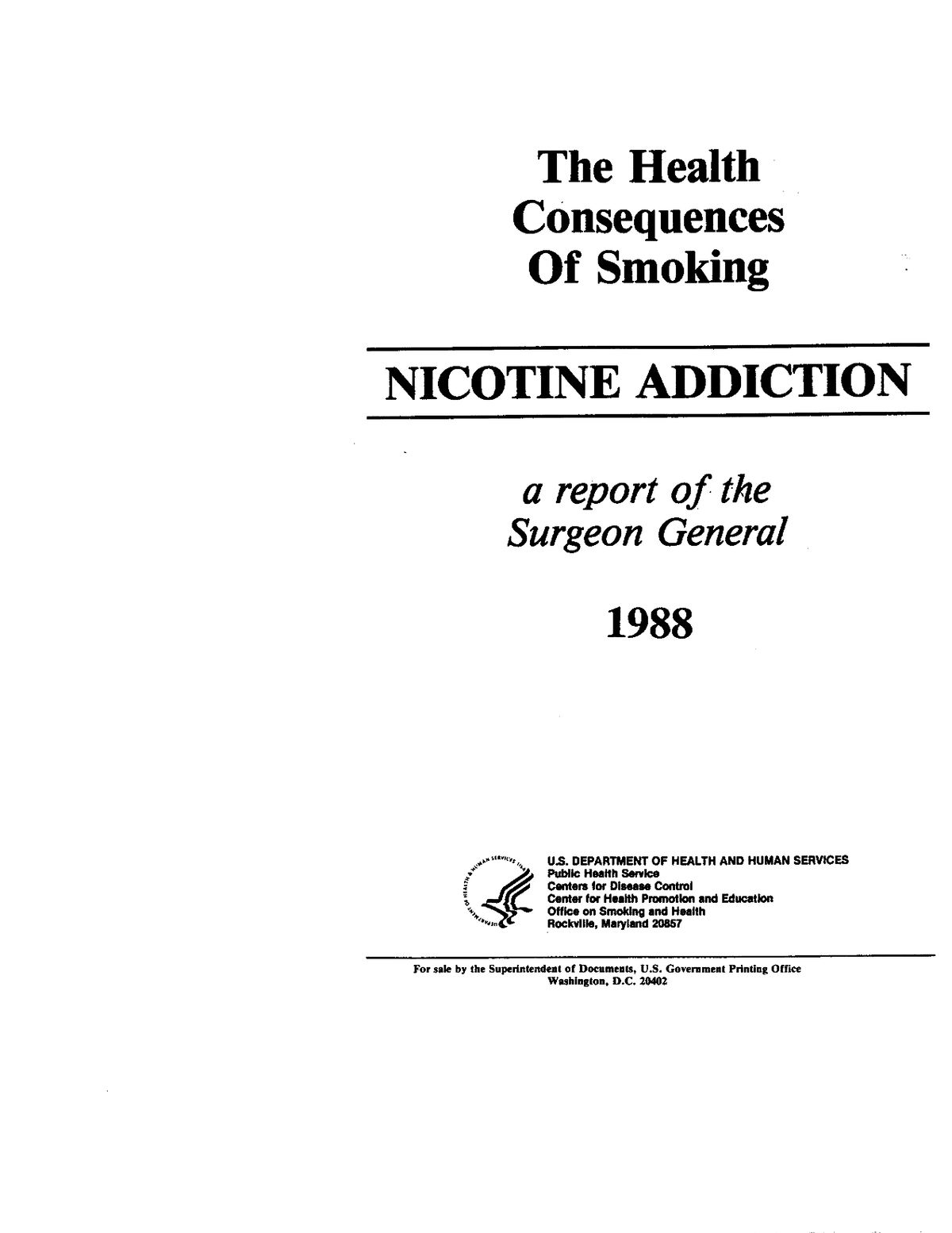
Image context: the cover image reproduces the opening page of the 1988 Surgeon General report discussed throughout this article, used here as the primary visual anchor for a document-centered close reading rather than as generic tobacco-era illustration.
Timeline anchors before interpretation
- 1964: the first Surgeon General smoking report judged cigarettes dangerous but worked within an older distinction between “habituation” and “addiction,” leaving nicotine conceptually short of the strongest addiction language.[1][3]
- 1980: DSM-III recognized tobacco dependence, reflecting a broader psychiatric and scientific shift away from the old habit-versus-addiction split.[1][4]
- 1988: the Surgeon General’s nicotine-addiction report stated three headline conclusions, including that cigarettes and other forms of tobacco are addicting and that nicotine is the drug in tobacco that causes addiction.[1]
- 2010: the Surgeon General’s How Tobacco Smoke Causes Disease chapter on nicotine addiction treated the 1988 framework as the baseline and extended it into receptor biology, learning, and relapse science.[4]
- 2022: a retrospective review concluded that the 1988 report largely held up after three more decades of research, including in the era of e-cigarettes.[5]
What the primary source actually does
A close reading shows that the 1988 report is less a moral warning than a classification document. Early in the report, the key move is laid out with unusual clarity. After reviewing expert concepts of dependence, it identifies three primary criteria for drug dependence: highly controlled or compulsive use, psychoactive effects, and drug-reinforced behavior.[1] It then treats tolerance, physical dependence, relapse, and craving as additional evidence that helps characterize the disorder.[1][4]
That matters because the report is not arguing from social disapproval. It is arguing from mechanism.
Its three overall conclusions are presented in a stripped, almost legal style:
- Cigarettes and other forms of tobacco are addicting.
- Nicotine is the drug in tobacco that causes addiction.
- The pharmacologic and behavioral processes that determine tobacco addiction are similar to those that determine addiction to drugs such as heroin and cocaine.[1]
The boldest phrase is the heroin-and-cocaine comparison. Read carelessly, it sounds like a public-shock line. In context, it is doing a narrower and more technical job. The report is not claiming identical social effects, intoxication patterns, or legal status. It is claiming that the underlying dependence logic belongs in the same scientific family: rapid delivery to the brain, reinforcement of repeated use, tolerance with repeated exposure, withdrawal on abstinence, and relapse after attempts to stop.[1][4][5]
Why this language shift was such a big deal
The strongest historical reading is that 1988 did not discover nicotine from scratch. It ratified a conceptual fight that had been delayed for years.
Kozlowski’s 2021 review argues that the 1964 committee’s language was shaped in part by Maurice Seevers, whose conflicts and intellectual commitments helped keep cigarettes in the older “habituation” box even while other evidence already supported addiction language.[3] That helps explain why the 1988 report reads with such definitional force. It is cleaning up an inherited ambiguity.
The report also reveals what public-health officials had learned by the late 1980s from cessation failure itself. If smoking were mainly a problem of information, then decades of accumulating evidence on cancer, cardiovascular disease, and premature mortality should have made quitting relatively straightforward. The report instead takes the opposite lesson: difficulty quitting is itself evidence about the drug.[1]
That is why the document keeps returning to pharmacokinetics. Nicotine delivered through inhaled tobacco reaches the brain quickly; quick reward timing strengthens reinforcement; repeated dosing across the day sustains both drug effect and dependence maintenance.[1][4] In other words, the cigarette is not just a toxic object. It is a highly efficient nicotine-delivery device.
The policy consequences are already visible inside the report
The report’s most interesting policy passages are not hidden in the appendices. They sit near the front, in plain language. Once tobacco is defined as addiction rather than habit, several policy implications follow almost automatically.
1) Youth prevention becomes more urgent than simple adult advice
The report explicitly says prevention of initiation must be a priority because nicotine addiction is hard to overcome once established, and because most cases begin during childhood and adolescence.[1] That is a very different framing from “tell people smoking is unhealthy.” It treats early uptake as the front end of a dependence pipeline.
2) Warning language must change
The Secretary’s transmittal letters state that a warning label on the addicting nature of tobacco use should rotate with existing package and advertising warnings.[1] That recommendation matters less as a single legal demand than as evidence of how the classification shift was meant to travel into public communication.
3) Cessation becomes treatment, not mere advice
If nicotine dependence shares core features with other drug addictions, then failed quit attempts are not just personal inconsistency. They are expected features of the condition. The report therefore points toward behavioral and pharmacologic treatment, broader availability of cessation support, and more serious clinical handling of relapse.[1][4]
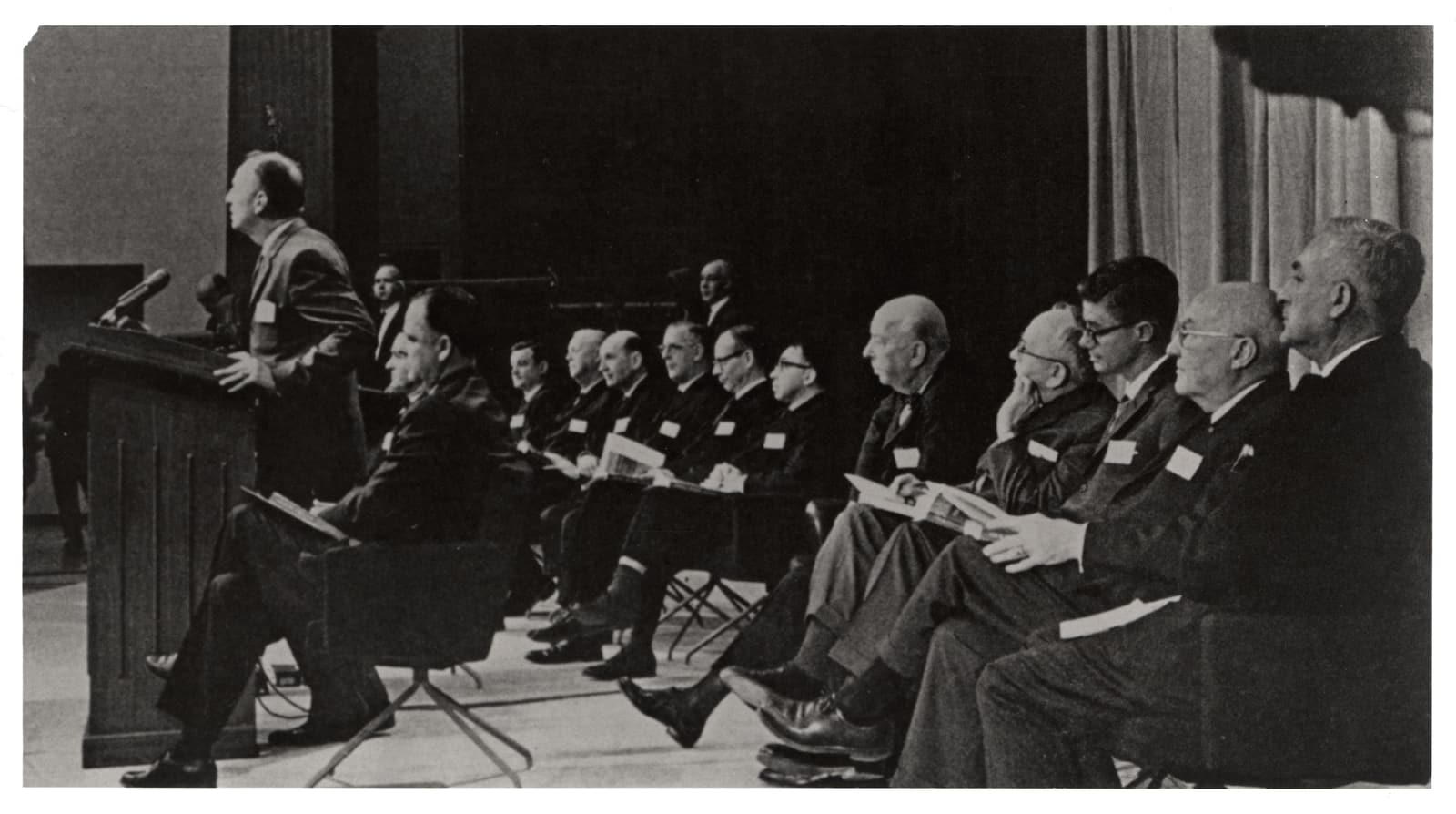
A document-era institutional scene keeps the conceptual hinge visible:
Two strong interpretations, and where each is right
Interpretation A: the report was mainly rhetorical repackaging
There is truth here. By 1988, smoking’s harms were already well established, and researchers had been discussing tobacco dependence for years.[1][3][4] The report did not invent nicotine.
What this reading misses is that classification language changes what institutions feel obliged to build. Calling smoking a “habit” supports education and persuasion. Calling it “addiction” supports surveillance of youth uptake, product regulation, cessation treatment, and more realistic expectations about relapse.
Interpretation B: the report was the real turning point because it changed the policy grammar
This is the stronger interpretation. The report converted a dispersed scientific case into official, durable public-health language. The point was not just to describe tobacco more accurately. It was to make a different regulatory and clinical vocabulary legitimate.[1][3][5]
That is why the document still feels contemporary. Many current nicotine debates repeat the same tension: should product regulation focus mainly on toxic exposure, or also on dependence potential and delivery design? The 1988 answer is clear. Addiction potential is not a side issue. It is the organizing issue.[1][4][5]
Why this still matters in 2026
CDC still estimated 11.6% of U.S. adults, about 28.8 million people, smoked cigarettes in 2022, and cigarette smoking still kills more than 480,000 Americans each year.[6] Those numbers explain why the 1988 conceptual shift remains live rather than archival. A classification that changes how we think about persistence, relapse, and initiation still changes what kind of policy seems proportionate.
The 2022 retrospective on the report’s durability concluded that the central claims held up well, even after major new research and new nicotine products.[5] The details of nicotine science have become much richer since 1988. The basic insight has not weakened: if a product delivers nicotine rapidly, repeatedly, and at scale, you are not dealing only with consumer preference. You are dealing with a dependence-forming system.
Bottom line for 2026
Read closely, the 1988 nicotine-addiction report is the moment when federal smoking language stops treating persistence mainly as a failure of judgment and starts treating it as the expected behavior of an addictive delivery system. That is why the report still matters. It did not simply say smoking was bad. It changed what kind of problem smoking was.
Sources
- U.S. Department of Health and Human Services. The Health Consequences of Smoking: Nicotine Addiction. A Report of the Surgeon General (1988 PDF)
- National Library of Medicine, Profiles in Science. The Health Consequences of Smoking: Nicotine Addiction: A Report of the Surgeon General (catalog entry and document set)
- Kozlowski LT. Nicotine Addiction, Maurice Seevers, and the First Surgeon General Report on Cigarette Smoking and Health: Conflicting Terms and Interests (J Stud Alcohol Drugs, 2021, PMID: 34343086)
- U.S. Department of Health and Human Services. How Tobacco Smoke Causes Disease — Chapter 4, “Nicotine Addiction: Past and Present” (2010)
- West R. The 1988 US Surgeon General's report Nicotine Addiction: how well has it stood up to three more decades of research? (Addiction, 2022, PMID: 34817099)
- CDC. Burden of Cigarette Use in the U.S.
- CDC. A History of the Surgeon General’s Reports on Smoking and Health