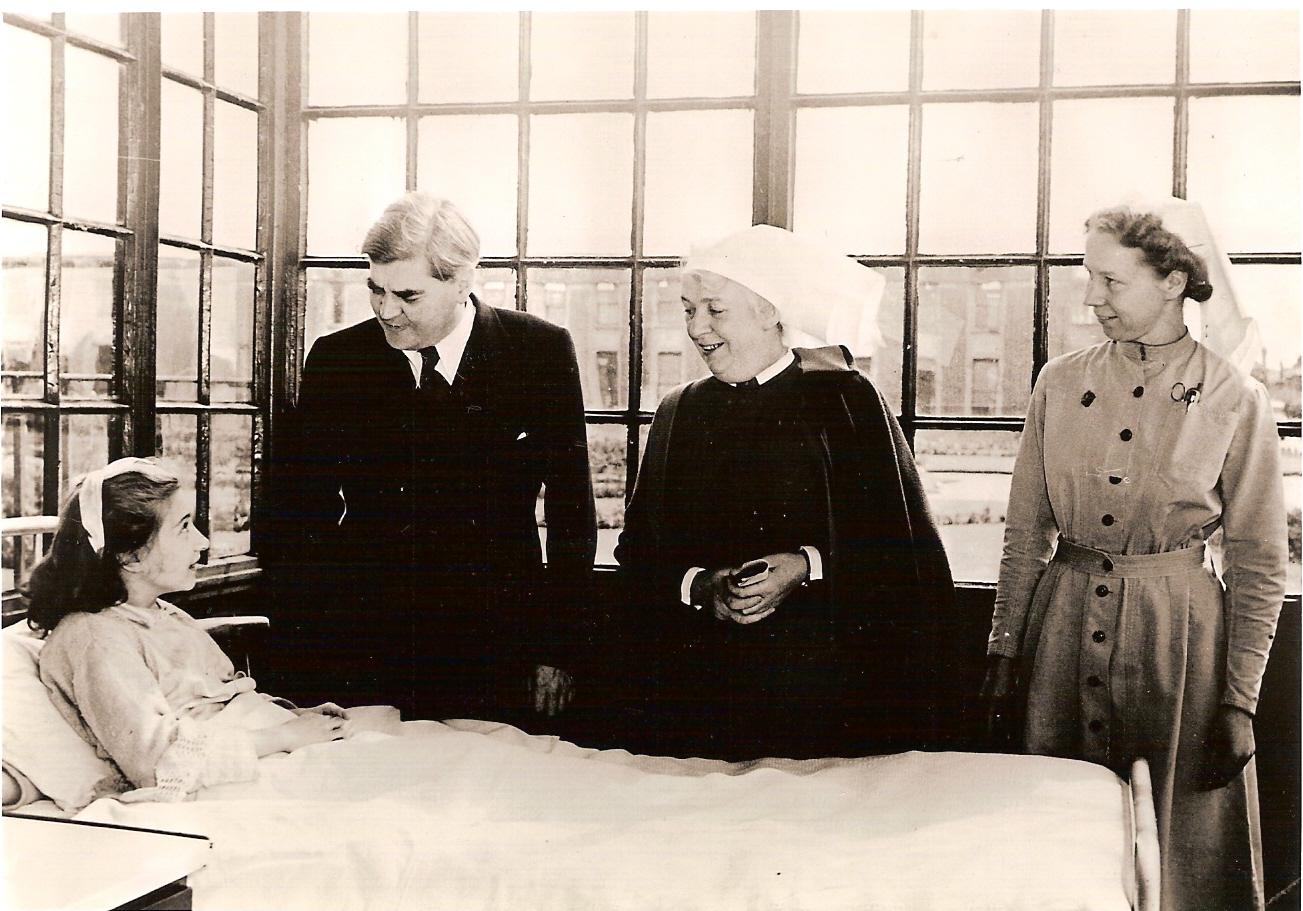
On July 5, 1948, at Park Hospital near Manchester, Health Minister Aneurin Bevan leaned toward a young patient while a matron and nurse stood beside the bed. The photograph is intimate: four people in a sunlit ward, with a national promise reduced to the scale of a conversation.[5]
The statute behind that scene is less simple. The National Health Service Act 1946 begins in the singular—a comprehensive health service, a ministerial duty, services free of charge—and then divides delivery among institutions that were neither owned nor governed in the same way. Hospitals crossed into public ownership. Family doctors entered through locally administered arrangements rather than becoming a salaried state workforce. Councils retained community services that reached homes, schools, streets, and maternity clinics.[1][3][4]
That is the sharp question hiding inside the familiar birthday story: what, exactly, did the Act make national? Read closely, it nationalized the guarantee and political responsibility more completely than it nationalized the workforce. One entitlement sat above three service structures. That settlement made a nationwide launch possible; it also preserved boundaries that later reformers would spend decades trying to cross.
Begin with the duty, not the birthday
The Act received royal assent on November 6, 1946, twenty months before the first-day photograph. Its long title promises a comprehensive health service for England and Wales—not, as shorthand sometimes suggests, one statute for the entire United Kingdom. Scotland followed under separate 1947 legislation, and Northern Ireland under its own 1948 act.[1][3]
Section 1 gives the Minister of Health a duty to establish a service directed toward both “physical and mental health” and toward the “prevention, diagnosis and treatment” of illness. Its second subsection says the services are to be free of charge unless the Act expressly provides otherwise.[1] Those clauses do more than announce generosity. They define breadth along three axes at once: population, kinds of health need, and stages of care.
The most revealing words are administrative. The Minister must “provide or secure” effective provision.[1] The phrase leaves room between public responsibility and direct public employment. The state cannot disclaim the result, but it need not deliver every consultation, ambulance journey, vaccination, or hospital stay through one chain of command. The rest of the Act fills that space with different machinery.
April 30, 1946: Bevan defended separation as design
The Commons second-reading debate on April 30, 1946 shows that Parliament saw the seam before the service existed. Bevan described hospitals, general practice, and local-authority health centres as distinct instruments. Critics called the arrangement a trichotomy. His reply was emphatic: “It is not a trichotomy at all.”[2]
His reasoning matters more than the label. Complete administrative unification, he argued, would become paper planning. Regional hospital bodies could not sensibly perform every immediate personal service, while councils already had the local reach to run maternity and child-welfare clinics, nursing, and other community work. Health centres were supposed to connect these worlds: councils would provide the premises, and family doctors would use shared diagnostic facilities without becoming council employees.[2]
This is where the founding argument becomes more interesting than a contest between nationalization and private medicine. The bill tried to standardize the public claim on care while preserving different operating forms. Bevan denied that difference had to mean disconnection. Later history would test that confidence.
Hospitals crossed the ownership line
Part II is the Act's most direct nationalizing move. It makes the Minister responsible for hospital and specialist services, transfers voluntary and municipal hospitals to the Minister, and creates Regional Hospital Boards, Hospital Management Committees, and separate boards for teaching hospitals.[1]
The design therefore combines central ownership with regional administration. A charitable hospital or council institution no longer depends on its old revenue base or local eligibility rules; it belongs to a common service. Yet Whitehall is not shown running every ward. Regional and hospital bodies remain between the ministerial duty and the bedside.
This lane dominates the founding photograph because a hospital makes reform visible. A bed, patient, nurse, and visiting minister can stand for the whole service. But the Act itself refuses that compression. Hospital care is only one part of what comprehensive means.
General practice entered by arrangement, not absorption
Part IV uses a different legal grammar. Instead of transferring family practices to the Minister, it requires Executive Councils to make arrangements for general medical services. Dental, pharmaceutical, and supplementary ophthalmic services sit in the same broad family of locally administered arrangements.[1]
Bevan told the Commons that a general practitioner would not contract directly with the Ministry or fall under the local authority's medical officer. A new executive council would sit between practice and state, with professional representatives occupying half its places. He also rejected a wholly salaried service and proposed that capitation remain the main source of GP remuneration.[2]
There is an important timing boundary here. The November 1946 Act established the route through arrangements and councils; it did not freeze every employment and payment term on its pages. Negotiation continued before July 1948. The eventual political settlement guaranteed that GPs would not become employees of central government, local government, or a new NHS administration.[4] Historians consequently describe general practice as separately administered within the founding service.[3]
The compromise had force in both directions. It preserved clinical independence and made participation more acceptable to a profession wary of salaried state control. It also meant that a patient could move between a publicly owned hospital and an independently organized family practice while the institutions followed different budgets, records, and lines of authority. Universal entitlement did not erase the handoff.
Community health stayed with councils
Part III assigns local health authorities a dense set of services: health centres; care of mothers and young children; midwifery; health visiting; home nursing; vaccination and immunization; ambulances; prevention, care, and aftercare; and domestic help.[1] These were not marginal extras. They were the parts of the service most likely to meet a person away from a hospital bed.
The council lane explains why “national” cannot be read simply as “run from the centre.” Local government retained operational responsibility because proximity carried practical value. A health visitor needed to reach a household. An ambulance needed local organization. A clinic needed to know its neighborhood. Bevan's debate speech treated that local capacity as an argument against forcing every service through hospital administration.[2]
The cost was another institutional boundary. In founding logic, health centres were meant to be bridges where council facilities and family practice could meet. But co-location was an aspiration, not the same thing as shared management, records, or accountability. The 1946 architecture made cooperation necessary without making it automatic.[2][4]
The promise was unified; the handoffs were not
The later name for this design—the tripartite NHS—captures what Bevan resisted saying aloud. Historical reviews describe a universal, comprehensive, tax-funded service whose hospitals were nationalized, GPs administered separately, and local authorities left with community and public-health functions.[3] The description is not a verdict that the founding settlement failed. It is a map of what the settlement joined and what it left apart.
That distinction matters because speed and neatness were competing goods. Between royal assent in November 1946 and launch in July 1948, the government had to turn a mixed field of voluntary hospitals, municipal institutions, independent practices, pharmacies, clinics, and council services into a public entitlement. Requiring every component to adopt one ownership and employment model might have produced a cleaner chart and no service ready to open. The tripartite compromise let existing capacity enter under a common promise.
Its seams were real. In 1974, reorganization formally ended the original tripartite administration by bringing hospital and community health services into a new hierarchy, although general practice remained organizationally distinct.[3][4] Later integration policy kept returning to the same basic difficulty: a patient's needs cross institutional boundaries more easily than money, authority, and information do.[4]
The strongest close reading therefore avoids two myths. The NHS was not merely a collection of existing providers with a new badge: the Act transferred hospitals, imposed a ministerial duty, and made free comprehensive service a national claim.[1] Nor was it a single state organization in which every clinician and service acquired the same status. Its unity lived first in entitlement and accountability.
Return to the photograph and the distinction becomes visible. Bevan stands in the hospital lane, where public ownership could be staged at a bedside. Outside the frame were the family doctor, health visitor, pharmacist, midwife, ambulance crew, and council clinic. The 1946 Act made all of them part of one promise without making them one kind of institution. That was the NHS's founding achievement—and its founding coordination problem.
Sources
- UK Parliament, National Health Service Act 1946, enacted text — ministerial duty, free-service clause, hospital transfer, local-authority functions, and family-practitioner arrangements.
- UK Parliament, “National Health Service Bill,” House of Commons debate, April 30, 1946 — Bevan's defense of the three delivery instruments, executive councils, health centres, and GP remuneration.
- Martin Gorsky, “The British National Health Service 1948–2008: A Review of the Historiography,” Social History of Medicine 21(3), 2008 — founding settlement, tripartite administration, and the 1974 reorganization.
- Rod Sheaff and colleagues, “The policy context,” in Integration and Continuity of Primary Care, NIHR Journals Library, 2015 — the 1946 GP settlement, council community services, and the coordination consequences of organizational separation.
- University of Liverpool Faculty of Health & Life Sciences, “Aneurin Bevan, Minister of Health, on the first day of the National Health Service, 5 July 1948 at Park Hospital” — source page for the archival photograph.