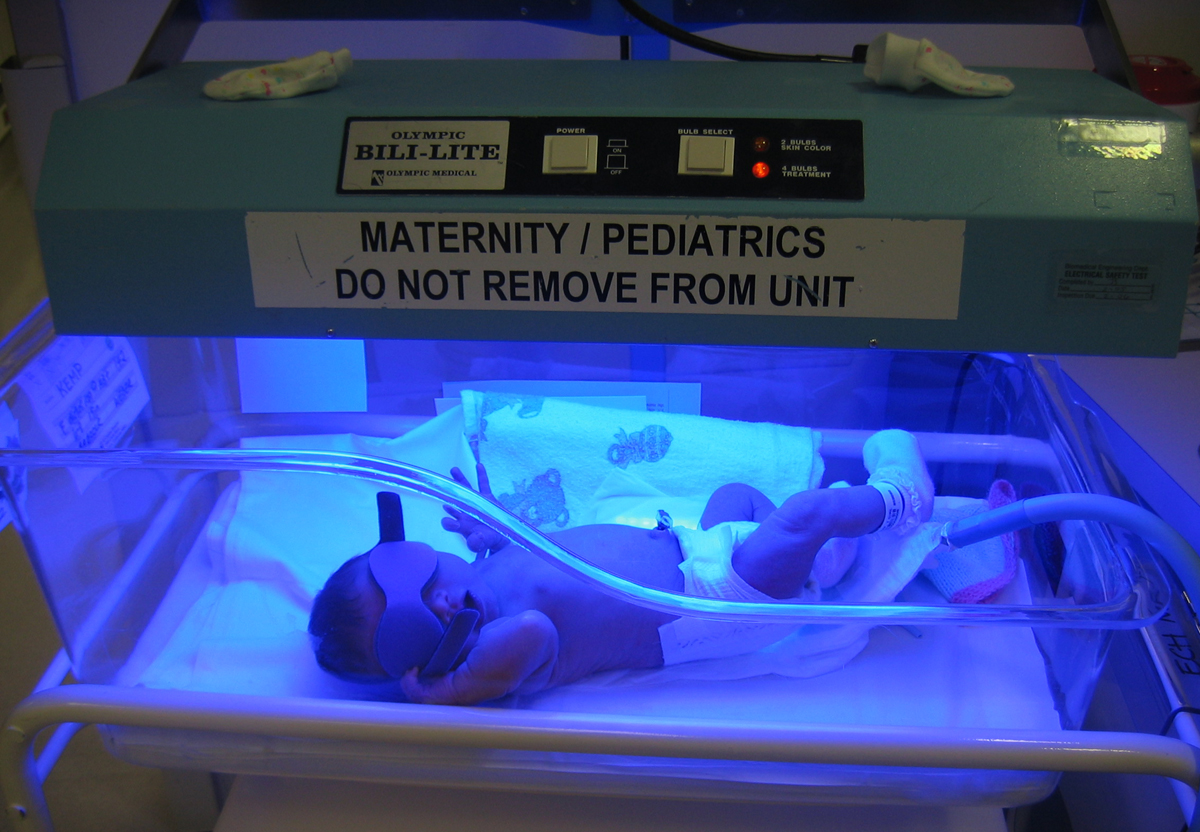
Neonatal phototherapy is easy to misunderstand because its surface appearance looks almost too simple. A jaundiced newborn lies under blue light, the care team watches bilirubin levels, and the yellow color recedes. That visual simplicity has always invited the wrong explanation. The treatment does not work because light "warms" the baby, dries the skin, or generally stimulates recovery. It works because photons reach bilirubin in the skin and change the molecule into forms that can leave the body more easily than the original unconjugated pigment could.[1][2][4]
That mechanism matters because newborn jaundice is not mainly a color problem. It is a timing problem in bilirubin handling. In the first days of life, bilirubin production is high, hepatic conjugation is still immature, and a subset of infants can accumulate enough unconjugated bilirubin for neurologic injury to become the real threat.[3][4] Phototherapy became important when medicine realized it could act upstream of that injury without waiting for the liver to do all the work on its own.
Timeline anchors for the mechanism
- 1947: exchange transfusion was already being used as a successful treatment for severe neonatal jaundice before phototherapy existed as a standard bedside tool.[3]
- Mid-1950s: staff in a neonatal ward associated sunlight exposure with lower bilirubin levels, the observational hinge later formalized in research histories of phototherapy.[2]
- May 24, 1958: Cremer, Perryman, and Richards published "Influence of light on the hyperbilirubinaemia of infants" in The Lancet, the canonical turning point from observation to intervention.[1]
- 2020: the 60-year historical review by Hansen and colleagues described phototherapy as a standardized treatment that has rescued millions of infants and tracked the development of light-source calibration over time.[2]
- 2022: the American Academy of Pediatrics revised its hyperbilirubinemia guideline for infants 35 or more weeks of gestation, tightening the follow-up and escalation logic around when phototherapy starts and how rebound risk is judged.[5]
1. The real danger is unconjugated bilirubin reaching the wrong tissue
Most newborn jaundice is common physiology before it becomes pathology. NCBI's neonatal jaundice overview notes that roughly 60% of term newborns and 80% of preterm newborns develop visible jaundice in the first week, while only a smaller share progress to treatment-level hyperbilirubinemia.[3] That imbalance is the first clue that skin color alone is not the disease. The clinical problem is rising unconjugated bilirubin, produced from heme breakdown at a moment when neonatal handling capacity is still immature.[3][4]
The newborn system is particularly exposed for several reasons that stack together. Red-cell turnover is high. Hepatic conjugation is not yet operating at mature capacity. Enterohepatic circulation can return bilirubin back into the system. In that setting, unconjugated bilirubin can keep circulating longer than clinicians want.[3][4] The reason this matters is not cosmetic. The NCBI references on neonatal jaundice and unconjugated hyperbilirubinemia both frame the real hazard the same way: if bilirubin rises far enough in the wrong infant, unbound unconjugated bilirubin can cross the blood-brain barrier and contribute to acute bilirubin encephalopathy and kernicterus.[3][4]
That is why phototherapy belongs in a mechanistic story, not in a comfort-care story. It is not trying to make the baby look less yellow for appearance's sake. It is trying to pull bilirubin out of a biologic lane that can end in brain injury.
2. Light works because the skin becomes the treatment surface
Cremer's 1958 paper matters because it made a decisive move in treatment logic.[1] Before that point, severe jaundice could demand much more invasive rescue, including exchange transfusion.[3] The new idea was that clinicians did not need to wait for bilirubin to reach the liver, nor did they need to replace blood first, if they could instead alter bilirubin where it was already sitting close enough to the skin for light to reach it.[1][2]
The mechanism later became clearer than the first paper could make it. The historical review by Hansen and colleagues describes phototherapy as a branch of "photobiology" that learned how different light sources interact with bilirubin, including fluorescent tubes across a 400-520 nm range.[2] NCBI's unconjugated hyperbilirubinemia chapter states the clinically used band more narrowly as blue-green light around 460-490 nm, where bilirubin absorption is strongest and phototherapy can convert bilirubin into lumirubin and other more water-soluble photoisomers.[4]
That conversion is the whole trick. Ordinary unconjugated bilirubin is hard to clear because it depends on hepatic conjugation. Under phototherapy, part of that bilirubin pool is reshaped into products the body can excrete more readily in urine and stool without waiting for the same enzymatic bottleneck.[4] Read this way, the treatment is elegant rather than magical. The lamp does not cure the underlying reason bilirubin rose. It temporarily opens an alternate exit route.
The article's image belongs here for exactly that reason.[6] A baby under blue light is not receiving a symbolic treatment. The skin itself has become a reaction field.
3. Why timing, exposure, and follow-up matter more than the color blue by itself
Once the mechanism is understood, the operational rules become easier to read. Phototherapy works only if enough of the infant's skin is exposed to enough effective light for long enough to keep bilirubin moving down faster than ongoing production and recirculation push it up.[2][4] The treatment therefore behaves less like a pill and more like a calibrated environmental intervention. Wavelength matters. Surface area matters. Distance and device quality matter. Ongoing hemolysis matters. So does the hour of life at which treatment begins.
The AAP's implementation FAQ after the 2022 guideline revision makes that timing logic explicit.[5] If phototherapy has to begin before 24 hours of age, the infant is more likely to have hemolysis and to carry higher rebound risk afterward.[5] The same FAQ explains why clinicians compare the current bilirubin level with the threshold that originally triggered phototherapy: it helps account for both the early start and the current risk position at once.[5]
That is the practical boundary many simplified retellings miss. Phototherapy is powerful, but it is not a one-switch antidote. It is a bridge that buys time while clinicians identify the driver of bilirubin accumulation, decide whether the infant is stabilizing, and organize follow-up after the light is stopped.[3][5] In other words, the lamp is part of a workflow.
4. What phototherapy changed in the history of newborn care
The 2020 historical review is useful because it keeps the scale of the change in view without flattening the mechanism.[2] Phototherapy did not abolish severe neonatal jaundice. It reorganized the default rescue path. Exchange transfusion stayed important for the most dangerous cases, but bedside light made it possible to treat many infants earlier and less invasively than before.[2][3]
That shift was bigger than a device improvement. It changed where treatment happened and what counted as therapeutic action. Older rescue logic was blood-centered: remove bilirubin-laden blood, replace it, and control the crisis from the circulation outward.[3] Phototherapy introduced a skin-centered detour. Instead of replacing blood first, clinicians could illuminate tissue, transform bilirubin chemistry in place, and keep the infant out of the escalation lane if the response came early enough.[2][4]
This is also why discharge systems and bilirubin measurement now matter so much. The AAP FAQ emphasizes that all newborns should have bilirubin measured before discharge and that follow-up timing should be guided by that result and communicated clearly to the outpatient clinician.[5] Once a therapy exists that can interrupt the mechanism, the quality of care depends on whether the system identifies the infant in time to use it.
Neonatal phototherapy therefore deserves to be remembered as more than "blue lights for jaundice." It is a precise workaround for an immature metabolic window. Light succeeds because it changes bilirubin's shape before the newborn liver can finish the job on its own. That is why a treatment that looks visually gentle became one of the most consequential bedside interventions in newborn medicine.[1][2][4][5]
Sources
- R. J. Cremer, P. W. Perryman, and D. H. Richards, "Influence of light on the hyperbilirubinaemia of infants" (The Lancet, 1958) - the original paper that established light exposure as a treatment intervention for neonatal hyperbilirubinemia.
- Thor Willy Ruud Hansen, M. Jeffrey Maisels, Finn Ebbesen, Hendrik J. Vreman, David K. Stevenson, Ronald J. Wong, and Vinod K. Bhutani, "Sixty years of phototherapy for neonatal jaundice - from serendipitous observation to standardized treatment and rescue for millions" (Journal of Perinatology, 2020) - historical review of the discovery, standardization, wavelengths, device evolution, and clinical impact of neonatal phototherapy.
- Betty Ansong-Assoku, Mohammad Adnan, Sharon F. Daley, and Pratibha A. Ankola, "Neonatal Jaundice" (StatPearls, NCBI Bookshelf, updated 2024) - clinical overview of newborn bilirubin physiology, treatment thresholds, and the neurologic risk of severe hyperbilirubinemia.
- Anand Singh, Thoyaja Koritala, and Ishwarlal Jialal, "Unconjugated Hyperbilirubinemia" (StatPearls, NCBI Bookshelf, 2023) - mechanism-focused review on bilirubin handling, kernicterus risk, and the blue-green wavelength logic behind phototherapy and lumirubin formation.
- American Academy of Pediatrics, "Frequently Asked Questions About the 2022 AAP Guideline on the Management of Hyperbilirubinemia" (last updated July 17, 2025) - implementation notes on early-start phototherapy, rebound risk, threshold comparison, universal predischarge bilirubin measurement, and follow-up planning.
- Wikimedia Commons, "File:Bili light with newborn.jpg" - documentary image source page for the hospital phototherapy photograph used in this article.