A laboratory report records a delay in clotting. Is a necessary protein scarce, or is something interfering with the reaction? A mixing study asks what changes when the laboratory adds plasma containing the normal complement of clotting factors.[1]
The experiment is small enough to fit in a tube. Its interpretation depends on what was added, when the mixture was tested and what the patient had received before the blood was drawn. An apparently reassuring result can change after incubation. Even then, the pattern guides the next investigation rather than naming a disease.[2][5]
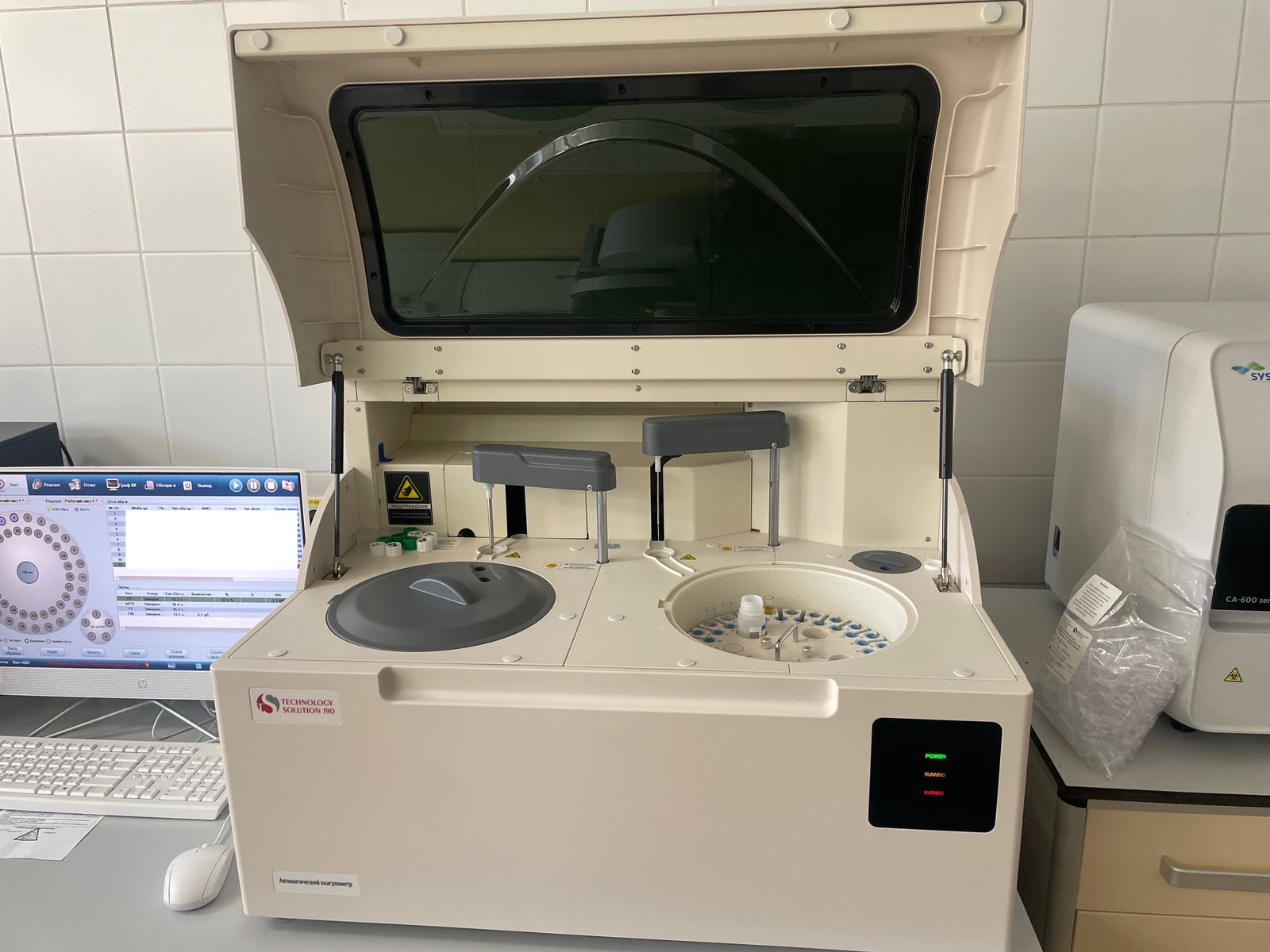
What the second sample supplies
The activated partial thromboplastin time, usually shortened to aPTT, is one of the screening tests that can lead to a mixing study. In the conventional experiment, equal volumes of patient plasma and normal pooled plasma are combined: a 1:1 mixture. The laboratory repeats the prolonged test on that mixture.[4]
Consider a simplified case in which the patient sample has virtually no activity of one necessary factor, while the normal plasma has approximately 100%. Equal mixing supplies roughly 50% activity in the combined sample. That can be enough for the clotting time to return to the expected range. The added plasma has supplied what the original sample lacked.[4]
An inhibitor can interfere with the reaction despite that addition. Failure to correct therefore points toward inhibition. These are qualified inferences: the 2024 International Council for Standardization in Haematology recommendations stress local validation of the method and interpretation thresholds. “Correction” needs a laboratory definition; a shorter time alone does not establish it.[4]
Why the clock keeps running
The most revealing result can be a mixture that corrects at first and later becomes abnormal. Some antibodies against factor VIII act in a time-dependent way. Newly supplied factor can initially support clotting, then lose activity as the antibody has time to act.[1]
The World Federation of Hemophilia's 2020 guidelines explicitly warn against excluding a factor VIII inhibitor on the basis of an immediately normal mixture. They describe how incubation at 37°C for one to two hours can reveal the inhibitory effect. The same mixture can therefore answer differently depending on when it is tested.[1]
The first result asks what the added plasma can do promptly; the later result asks whether that function persists. A temporary correction leaves that second question open.
The sample arrives with a history
Before interpreting the pattern, the laboratory needs to know what could already be influencing it. ARUP Consult's guidance, updated in December 2025, emphasizes anticoagulant medicines, recent transfusion, factor replacement and specimen handling. Each can affect coagulation results. The relevant history travels with the tube even though it cannot be seen in the plasma.[2]
This changes the meaning of an abnormal result. The workup must account for whether the person is bleeding, has had thrombosis or has no symptoms, alongside which screening tests are prolonged. ARUP describes different follow-up investigations for those settings, including factor activity, lupus anticoagulant and inhibitor testing.[2]
A laboratory value detached from those circumstances has lost part of its evidence. The mixing experiment becomes useful when it is read as a response under known conditions, with the patient's treatment and presentation still in view.
An inhibitory pattern has more than one explanation
Acquired hemophilia A is one important possibility: antibodies neutralize factor VIII. But an inhibitor-like mixing result does not identify that antibody. The 2020 international recommendations on acquired hemophilia distinguish factor inhibitors, lupus anticoagulants and pharmacological anticoagulants as possible contributors to a prolonged aPTT.[5]
The name “lupus anticoagulant” is particularly easy to misread. It can prolong this laboratory test without indicating a bleeding tendency. Factor XII deficiency can also prolong aPTT without causing the bleeding pattern associated with deficiencies of other factors. A long clotting time is therefore not a universal measure of how readily someone will bleed.[5]
Those recommendations also caution that mixing tests cannot, on their own, establish or exclude acquired hemophilia A. Specific factor activity assays should proceed in parallel when that diagnosis is being investigated. A neat correction-or-inhibition label cannot carry the whole diagnostic burden.[5]
The next test is part of the answer
The Swiss Society of Hematology's April 2025 consensus makes the sequence concrete. In its acquired-hemophilia workup, the mixing assay is optional; factor VIII activity and testing for a factor VIII inhibitor have their own places. It calls for confirmation in an experienced reference centre and again says that specific factor assays should run in parallel.[6]
That arrangement explains the mixing study's enduring value and its limit. It is a controlled change to a sample, useful for deciding which explanation deserves closer investigation. It does not measure every part of clotting, identify every interfering substance or replace the clinical assessment.
The instructive question is what the second sample changed—and whether that change lasted. Supplying normal plasma turns a delay into an experiment. Following the response through time makes the experiment more informative. Knowing which question remains unanswered makes it useful to the patient.
Sources
- Alok Srivastava et al., WFH Guidelines for the Management of Hemophilia, third edition (2020), chapter 3, “Correction studies”—mixing logic, incubation and recommendation 3.2.9.
- ARUP Consult, “Prolonged Clotting Time Evaluation” (updated December 2025)—clinical context, medication effects, specimen handling and follow-up testing.
- Bondarev.gal, “Coagulation analyzer” (photograph, February 22, 2025), Wikimedia Commons—image description, provenance and CC BY 4.0 attribution.
- Dorothy M. Adcock et al., ICSH recommendations for the performance and interpretation of aPTT and PT mixing tests, International Journal of Laboratory Hematology (2024)—normal pooled plasma, mixing ratios and validated interpretation.
- Andreas Tiede et al., “International recommendations on the diagnosis and treatment of acquired hemophilia A,” Haematologica (2020)—differential diagnosis, mixing-test limitations and parallel factor assays.
- Alessandro Casini for the Working Party on Hemostasis, Swiss Society of Hematology, “How to diagnose and treat acquired hemophilia,” version 3.0 (April 8, 2025)—diagnostic sequence and specialist confirmation.