Methadone maintenance is often argued about as if the question were whether one opioid can morally replace another. That framing misses the health mechanism. The intervention changed opioid-use-disorder care because it changed the clock: a person cycling through short-acting heroin or fentanyl exposure, withdrawal, craving, risk, and illegal supply pressure could be stabilized by a long-acting medication delivered inside a supervised treatment system.[1][2][4]
That does not make methadone simple or harmless. It is a full opioid agonist with overdose risk, drug-interaction risk, and a difficult induction period that requires clinical judgment. But the public-health idea is not "more opioid." It is controlled opioid agonist treatment: replace a volatile exposure pattern with enough pharmacologic continuity to suppress withdrawal and craving, reduce illicit opioid use, keep people connected to care, and lower the risk that leaving treatment becomes the next emergency.[2][3][4]
The timeline matters. Methadone had U.S. approval as an analgesic in 1947. Vincent Dole and Marie Nyswander began Rockefeller University studies in 1962, with clinical work starting in late 1963 and a first report in 1965. Federal regulation then hardened around the treatment between 1970 and 1974, turning methadone maintenance into a specialized, program-based system rather than an ordinary office prescription.[1] Contemporary SAMHSA clinical guidance still treats methadone as opioid-treatment-program care: long-acting, useful, and safety-sensitive enough to require structured assessment, monitoring, and patient education.[5]
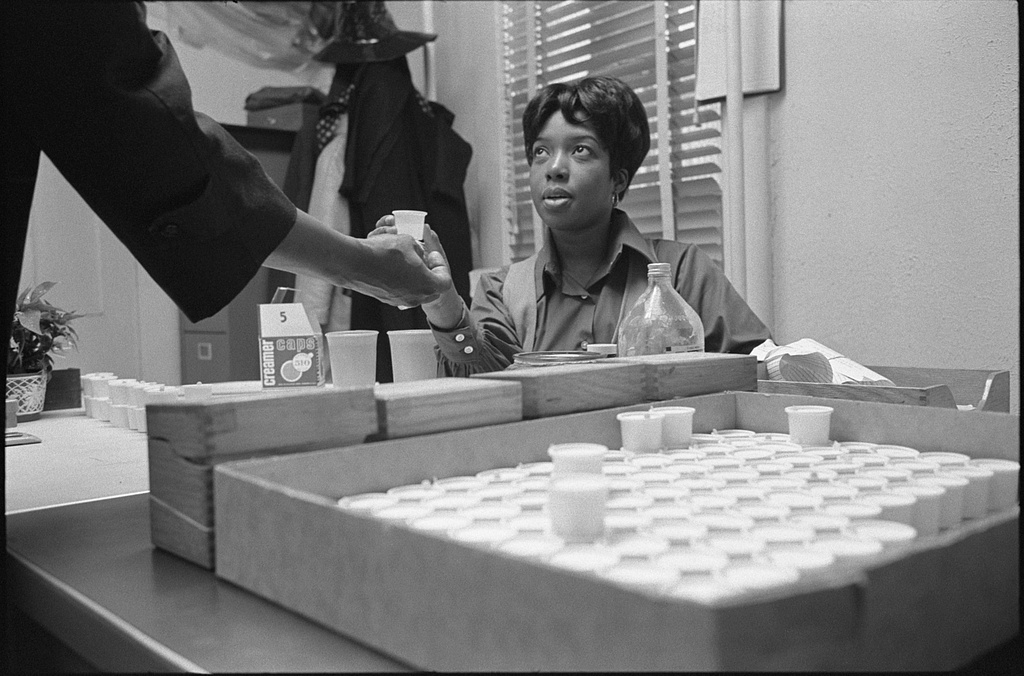
Image context: the cover is a real 1971 U.S. News & World Report / Library of Congress negative from a Washington, D.C. clinic. It belongs here because the article's subject is not the molecule alone. It is the clinical handoff, supervision, and continuity that made the medication into a treatment system.[6]
The old failure was a repeating short cycle
Opioid dependence can look chaotic from outside, but the body experiences it as a grim schedule. Short-acting opioids produce a cycle of intoxication, falling blood levels, withdrawal, craving, relief seeking, and renewed exposure. In a legal prescription context, that cycle can still be dangerous. In an illicit market, it also means uncertain potency, adulteration, infection risk from injection, criminal-legal exposure, unstable income strategies, and a daily narrowing of attention around avoiding withdrawal.
Dole and Nyswander's contribution was to treat that repeating cycle as a medical target rather than as a character defect. The National Academies history of federal methadone regulation describes their work as a shift from detoxification to maintenance: methadone had been used to withdraw patients over 7 to 10 days, but the Rockefeller studies showed that it could also maintain selected patients with intractable heroin addiction instead of repeatedly pushing them through withdrawal and relapse.[1]
That is the first causal move. Detoxification asks the body to become drug-free quickly, then hopes the person can survive the same environment with less physiologic support. Maintenance asks a different question: what if the unstable street cycle is itself a treatable exposure? A long-acting medication cannot solve housing, trauma, pain, poverty, stigma, or criminalization. It can, however, make the next day less dominated by withdrawal and the next decision less dominated by urgent supply.
The National Academies' 2019 consensus report gives the modern clinical frame. Opioid use disorder is a chronic brain disease that can be treated with medications; methadone and buprenorphine alleviate withdrawal symptoms, reduce craving, and reduce the response to future opioid use.[2] That is why the article's title emphasizes the clock. Methadone's practical health effect is temporal before it is moral: it stretches the interval between crisis states so care has somewhere to happen.
Retention is not a paperwork outcome
The strongest evidence for methadone maintenance is not that it makes every social outcome improve at once. It is narrower and more important: it keeps more people in treatment and reduces heroin use compared with approaches that do not use opioid replacement therapy.[3]
The Cochrane review is useful because it keeps the claim bounded. It included 11 randomized clinical trials with 1,969 participants and found methadone maintenance statistically more effective for treatment retention and for suppressing heroin use measured by self-report and urine or hair testing. Its pooled result for heroin use was a risk ratio of 0.66 with a 95% confidence interval of 0.56 to 0.78.[3] The same review did not find a statistically significant superior effect on criminal activity or mortality in those trials, which is a reminder not to make one medication carry every social expectation.[3]
Retention can sound bureaucratic, but in opioid-use-disorder care it is a clinical mechanism. A person retained in treatment is reachable for dose adjustment, counseling if available, infectious-disease testing, pregnancy care, hepatitis C treatment, wound care, psychiatric care, housing referrals, and overdose-prevention planning. A person expelled from or unable to reach treatment is back in the short cycle with fewer buffers.
This is also why medication should not be held hostage to ideal wraparound services. The National Academies report explicitly rejected the idea that lack of behavioral intervention is a sufficient reason to withhold medication. Behavioral care can be valuable, and many patients need more than medication, but withholding methadone or buprenorphine because counseling is scarce turns a systems shortage into a patient-level danger.[2]
Mortality evidence points to continuity
The mortality evidence comes mainly from cohort studies, not simple placebo comparisons, because long-term treatment exposure is not easily randomized in the same way. That creates confounding risks: people in treatment and out of treatment may differ in severity, stability, and access. Still, the direction and size of the signal explain why continuity is central to the mechanism.
A 2017 BMJ systematic review and meta-analysis followed 122,885 people treated with methadone across 19 eligible cohorts. The pooled all-cause mortality rate was 11.3 deaths per 1,000 person-years during methadone treatment and 36.1 deaths per 1,000 person-years out of treatment, an unadjusted out-to-in rate ratio of 3.20 with a 95% confidence interval of 2.65 to 3.86.[4] Overdose mortality showed the same pattern: 2.6 deaths per 1,000 person-years in methadone treatment and 12.7 out of treatment, with an unadjusted out-to-in rate ratio of 4.80.[4]
Those numbers should not be read as a guarantee that a dose automatically protects every patient. They should be read as a continuity warning. The same review found particular risk around transition points: early methadone induction and the period after leaving treatment need clinical and public-health attention, not complacency.[4]
That boundary matters because methadone's strength and risk come from the same pharmacologic fact. A long-acting opioid agonist can smooth withdrawal and craving, but accumulation, sedation, other depressants, and variable tolerance can make early treatment dangerous if the system moves too fast or monitors poorly. A serious methadone program therefore has to be both access-oriented and safety-oriented. The answer to risk is not abandonment of treatment; it is careful admission, dose titration, monitoring, patient education, and continuity through interruptions.[5]
The clinic became part of the medicine
The Library of Congress photograph from January 5, 1971 is valuable because it shows methadone not as an abstract tablet in a policy fight but as a clinical handoff: nurse, patient, cup, room, and routine.[6] That routine was never incidental. The U.S. regulatory system made methadone for opioid-use-disorder treatment different from many other medications by tying it to opioid treatment programs, accreditation, registration, and rules around supervised and take-home dosing.[1][5]
That architecture has always carried a tradeoff. Supervision can protect patients during induction, support adherence, reduce diversion, and keep a program accountable. It can also become a barrier when daily attendance collides with work, caregiving, transportation, disability, rural distance, stigma, or clinic hours. In other words, the same clinic system that turns methadone into reliable care can also turn access into a test of endurance.
SAMHSA's TIP 63 methadone chapter is best read in that light. It describes methadone as the most studied OUD medication, notes its long track record, and then spends much of its attention on the practical safeguards: pharmacologic variability, gradual induction, respiratory-depression risk, drug interactions, informed consent, direct observation early in treatment, and safe storage for take-home doses.[5] That clinical detail does not erase the operational burden. A patient still needs a reachable program, an intake process that does not collapse under demand, a dose schedule that fits real life, and policies that do not push stable people out through humiliation or inconvenience.
The mechanism therefore has two layers. Pharmacology changes the body's clock. The clinic changes the care clock. The treatment works best when both clocks are synchronized: enough medication continuity to prevent recurrent withdrawal and craving, enough supervision to catch safety problems, and enough flexibility to keep the patient attached to care rather than punished for needing it.
What the substitution myth gets wrong
The simplest myth says methadone is just substituting one addiction for another. The evidence-led answer is not to pretend methadone is non-opioid. It is to distinguish compulsive, high-risk, unstable use from medically managed dependence inside treatment. Many chronic medications create physiologic dependence or require careful discontinuation; that fact alone does not make them failed medicine. The question is whether the treatment reduces harm, improves function, and keeps the patient safer than the untreated cycle.[2][3][4]
The opposite myth is also dangerous: methadone as stand-alone rescue. Methadone does not fix contaminated drug supply, homelessness, untreated pain, trauma, unemployment, hepatitis C, HIV risk, or punitive policy by itself. It creates a more stable platform from which those problems can be addressed. If the platform is inaccessible, underdosed, stigmatized, or interrupted, the mechanism weakens.
This is why the National Academies' access critique is so important. Its report concluded that medications for opioid use disorder save lives, but that most people who could benefit do not receive them and access is inequitable.[2] A medication that works only for people who can clear regulatory, geographic, financial, and social hurdles is not reaching its full public-health effect.
The practical lesson
Methadone maintenance should be understood as a time-and-continuity intervention. It replaces a short and unstable opioid cycle with a longer, supervised one; it makes retention a clinical good rather than a bureaucratic statistic; and it exposes the danger of treatment interruption. The medication matters, but the treatment is bigger than the medication.
That is why the 1971 clinic photograph still feels current. The cup is small. The system around it is not. Methadone maintenance works when the handoff becomes reliable enough to change a life rhythm: wake, dose, function, return, adjust, continue. It fails when public argument sees only the opioid and not the clock that treatment is trying to rebuild.
Sources
- Institute of Medicine, Federal Regulation of Methadone Treatment (1995), NCBI Bookshelf - history of methadone's 1947 approval, Dole and Nyswander's 1960s maintenance work, and the 1970-1974 regulatory regime.
- National Academies of Sciences, Engineering, and Medicine, Medications for Opioid Use Disorder Save Lives (2019), NCBI Bookshelf - consensus framing of OUD as treatable, medication evidence, retention, mortality, stigma, and access barriers.
- Mattick RP, Breen C, Kimber J, Davoli M, "Methadone maintenance therapy versus no opioid replacement therapy," Cochrane Database of Systematic Reviews, 2022 - review summary with trial count, retention and heroin-use findings, and evidence boundaries.
- European Union Drugs Agency, "Opioid substitution treatment (OST) to reduce mortality" - evidence summary reporting Sordo et al. 2017 mortality rates in and out of methadone and buprenorphine treatment.
- Substance Abuse and Mental Health Services Administration, "Chapter 3B: Methadone," Medications for Opioid Use Disorder (TIP 63), NCBI Bookshelf - pharmacology, dosing considerations, safety warnings, monitoring, and OTP practice context.
- Library of Congress, "A nurse hands a cup of methadone to a man in a medical clinic at 456 C St., N.W., Washington, D.C." - Warren K. Leffler photograph, January 5, 1971, source page for the cover image.