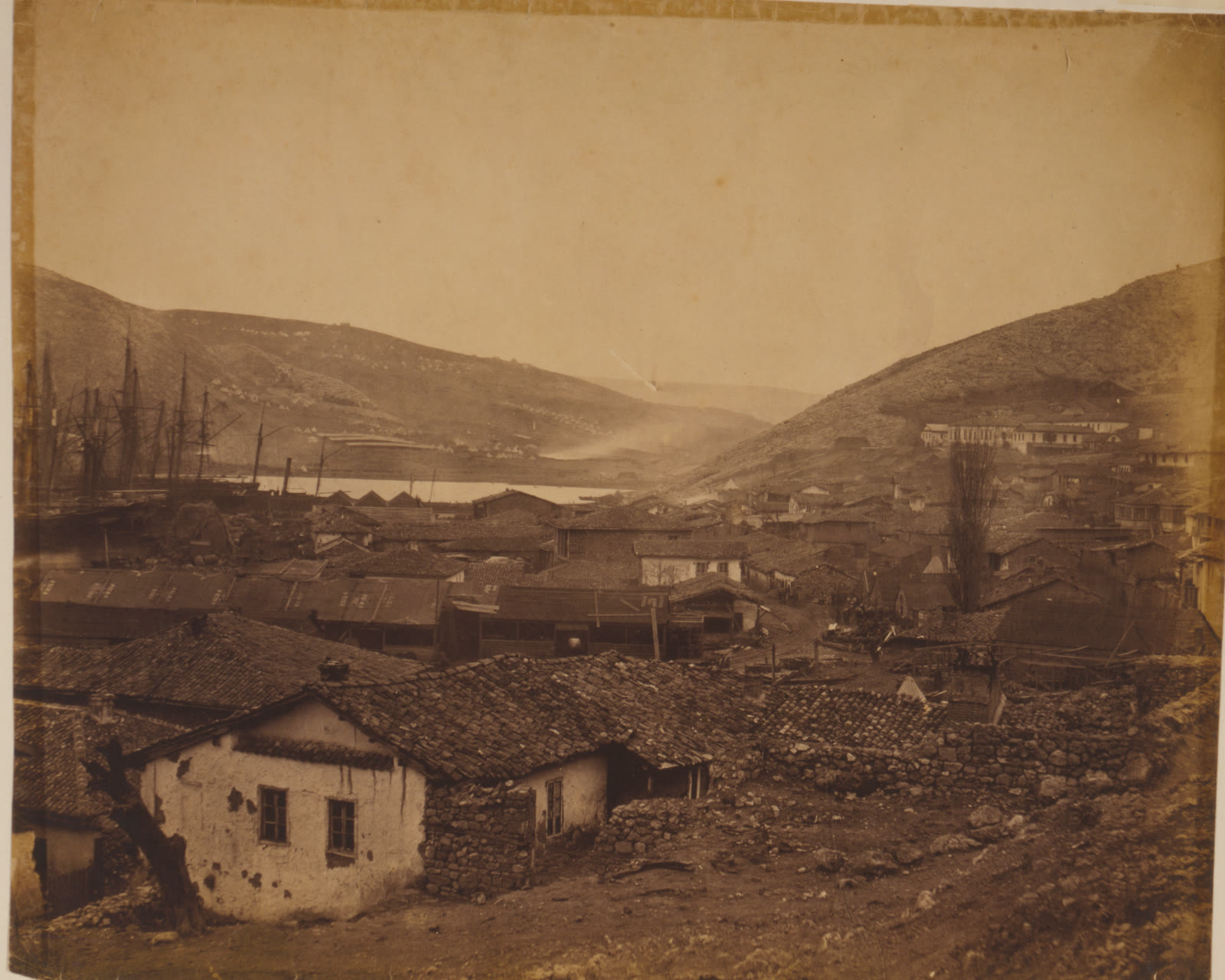
Roger Fenton's camera looks across Balaklava in 1855: roofs close to the lens, ships packed into the harbor, military tents stippling the hills, and—at the far right—the hospital named on the back of the print. Mary Seacole's British Hotel stood elsewhere, up the supply road at Spring Hill. It is not the hospital in this photograph, and there is no sound basis for claiming that it appears somewhere else in the frame.[1][7]
That separation matters because Seacole's memory has repeatedly collapsed it. In one version she founded a battlefield hospital and performed the same work as Florence Nightingale, only closer to the guns. In the hostile correction, the building becomes merely a bar, as though selling food and wine disproves every bandage applied, sick soldier assisted, or free remedy given. Seacole's own 1857 memoir supports neither simplification. The British Hotel was a commercial store, canteen, kitchen, and social refuge—not a ward hospital. Its proprietor also provided direct care at the sick wharf, along the road, in camps, and near fighting.[1][2]
The strongest historical reading keeps both facts in view. Seacole was not the uncredited founder of modern nursing, and her importance does not depend on taking that title from Nightingale. She was a Jamaican healer, businesswoman, author, and independent caregiver whose work crossed categories that later professional histories pulled apart. The argument over what to call her reveals almost as much about the politics of nursing memory as it does about Crimea.[3][4][5]
Before “nurse,” There Was “Doctress”
Mary Jane Grant was born free in Kingston, Jamaica, in 1805, to a Scottish father and a Creole mother whose name Seacole never gives in her memoir. Her mother ran a boarding house for invalid military officers and practiced as a “doctress.” Seacole describes learning care in that combined household, medical, and commercial setting: observing her mother, tending a growing collection of pets, and eventually treating people herself.[1]
That origin is easy to distort in opposite directions. Calling the practice mere domestic kindness strips it of learned skill, repeated experience, and the authority Caribbean patients gave doctresses. Calling it modern evidence-based medicine projects a later standard backward. Seacole's memoir recounts work during cholera outbreaks in Panama and Jamaica, but its cure stories are retrospective self-reports, not comparative clinical records. Some drugs she used belonged to a 19th-century pharmacopoeia that medicine later abandoned. Her experience deserves recognition; therapeutic efficacy still requires evidence that the memoir cannot supply.[1][4]
Commerce was not a detour from this care tradition. Seacole's mother housed and treated invalid officers. Seacole kept establishments in Jamaica and Panama, provisioned travelers, prepared food, sold goods, and treated illness. The same mixed model would reappear in Crimea. A modern job title asks whether she was a nurse or a hotelkeeper. Her working life answers that care and trade could occupy the same room.
The Refusal: What Is Recorded, What Is Inferred
After reports of British suffering in Crimea reached London in late 1854, Seacole sought a place in the war effort. Her memoir describes visits to the War Office, Sidney Herbert's household, the managers of the public Crimean Fund, and a woman connected with the next nursing contingent. None produced a post or passage. She then wondered whether her “duskier skin” explained the refusals.[1]
Two claims should be separated. The repeated rejection is part of Seacole's direct testimony, written while people who knew the episode were alive. Racial prejudice is her explicit and historically plausible interpretation. But the memoir does not quote an official admitting a racial motive, and the attempt came after Nightingale's first party had departed, when another contingent was full or preparing to leave. Lynn McDonald emphasizes the lateness and informality of Seacole's approach; celebratory accounts emphasize the racialized disbelief that an experienced Creole doctress encountered.[1][4]
The evidence does not require a choice between “race had nothing to do with it” and “every refusal is documented racism.” Timing and procedure could close a door that prejudice made harder to approach in the first place. Seacole herself briefly raised the question rather than claiming access to every official's mind. The exact verdict is repeated exclusion, a credible racial inference, and incomplete evidence about each decision-maker's motive.
Nor did Florence Nightingale personally turn Seacole away in London. When Seacole later stopped at Scutari with a letter of introduction, the two met; Nightingale arranged a bed for the night. Seacole was already bound for the front and did not ask to join the hospital staff there. The popular image of a single face-to-face rejection compresses several offices, intermediaries, and moments into a cleaner rivalry than the record supplies.[1][4]
Read the British Hotel's Floor Plan
Unable to enter the official system, Seacole formed a partnership with Thomas Day and traveled east. Their advertisement promised a mess table and “comfortable quarters” for sick and convalescent officers. At Spring Hill, on the route between Balaklava and the besieging army, the completed British Hotel was more practical—and more commercial—than that name suggests.[1]
Seacole wrote that the establishment cost £800. Its central iron building held counters, cupboards, shelves, and stored goods. Around it were a small kitchen, sleeping rooms for Seacole and Day, servants' quarters, a soldiers' canteen, stables, animal pens, and a yard. Officers came for meals, wine, clothing, equipment, and reminders of home. Soldiers could use the canteen. This was a supply business and restaurant, not a block of patient beds.[1][4]
The memoir is unusually clear about the clinical boundary. When an accident happened nearby, men brought the injured person to the hotel; if the injury was serious, the patient went across the road to the Land Transport Corps hospital. That transfer is decisive evidence against calling the British Hotel a hospital. It is equally good evidence that the hotel occupied a real place in the care pathway: first attention, assessment, comfort, and referral happened at its door.[1]
Seacole also wrote that she dispensed medicines, visited sick men in camp, waited with refreshments when trains of wounded passed, and kept a book containing the names of hundreds who sought help. Testimonials printed in the memoir praise her attention during diarrheal and cholera-like illness. Those pages establish that people understood themselves as her patients. They do not establish cure rates, diagnoses, ingredients, or counterfactual outcomes. Testimony can prove a caring relationship without proving that every medicine worked.[1][4]
The business model complicates any tidy charity story. Officers bought dinners and drinks; Seacole sometimes gave care, food, or remedies to men who could not pay. Commerce financed proximity, stock, transport, staff, and discretion. It also left Seacole and Day exposed when peace arrived and military customers disappeared. To erase the selling makes her independence unintelligible. To mention only the selling makes the care disappear.
What Happened Beyond the Counter
Before the hotel was ready, Seacole spent about six weeks helping at Balaklava's sick wharf. She described easing a wounded artilleryman's stiff dressing, giving tea, and assisting doctors as men were transferred from mules and ambulances to ships bound for general hospitals. The National Army Museum's wider account likewise places her on rides to distribute food and medicines, sometimes near the front and under fire.[1][2]
On 18 June 1855, before an assault on Sevastopol, she packed a shoulder bag with lint, bandages, needles, thread, and medicine while mules carried food and drink. Her memoir follows her toward Cathcart's Hill and the returning wounded. On 16 August, at the battle of the Chernaya, she again described moving through a landscape of casualties and giving aid. War correspondent William Howard Russell publicly vouched for her kindness and skill near the battlefield; his endorsement also prefaced her book.[1]
This was direct, mobile, and episodic care. It was not management of a military hospital, supervision of a nursing staff, sanitary reform across an institution, or a training system. Nightingale's work at Scutari involved those organizational responsibilities. Treating the women as contestants for one identical post misdescribes both.[2][4]
It also narrows wartime health history to the ward. Sick and wounded bodies moved through a chain: battlefield, stretcher, road, wharf, transport, hospital, and convalescence. Food, clean clothing, warmth, information, first aid, and human reassurance traveled along it too. Seacole worked in the chain's seams, where official provision was thin and a privately assembled store could become a care station without becoming a hospital.
Two Corrections That Can Both Overreach
The recuperative interpretation arose for a reason. Nursing histories centered a white English reformer while a celebrated Black Caribbean caregiver faded from British public memory. D. P. Griffon's influential 1998 historiographic essay pushed hard in the other direction, presenting Seacole's direct caregiving as more extensive than Nightingale's. Museums and nursing institutions now commonly name Seacole as nurse, healer, and pioneer.[2][3][6]
That reading restores forms of work an institution-first history undervalues: bedside attention, food, touch, mobility, vernacular medical knowledge, and emotional care. It also restores a Black woman's authorship. Wonderful Adventures was not merely evidence later historians discovered; it was Seacole's own attempt to place a Creole woman at the center of an imperial war story.[1]
The revisionist interpretation asks what was added during that restoration. McDonald's primary-source audit rejects claims that Seacole ran a hospital, received the medals she later wore, practiced evidence-based medicine, or exerted a documented global influence on nursing. On the hotel and clinical-evidence points, the correction is strong: Seacole's own floor plan, transfer practice, and testimonial method impose those limits.[4]
Revision can overreach when it treats the absence of later professional outputs as proof of negligible care. Seacole did not found a training school or publish mortality statistics. Neither was required for a sick soldier to receive food, a dressing, a visit, or a hand at the wharf. “Not Nightingale” is a boundary, not a verdict of insignificance.
John Wells and Michael Bergin widen the map further. They identify competing Crimean nursing narratives around Nightingale, Seacole, and the Irish Sisters of Mercy, arguing that present-day social struggles shape which one becomes national history. That third line exposes the cost of the famous binary: while public argument asks which of two women is the “real” heroine, Catholic nurses and many less memorialized caregivers again move offstage.[5]
How a Life Became a Nursing Symbol
Seacole returned to Britain in financial trouble after the war ended in 1856. Supporters organized public fundraising, and Wonderful Adventures appeared the next year with Russell's promotional preface. She was not obscure in her own lifetime. Her celebrity nevertheless ebbed after her death in 1881.[1][6]
The National Portrait Gallery traces a new phase to the 1970s, when Caribbean nurses visited and helped restore her London grave. Seacole became an emblem for Black nurses and for histories excluded from Britain's standard national story. Even her 1869 painted portrait acquired a second life after its rediscovery in the 2000s. It shows her wearing military medals that women were not awarded; the gallery says their origin is unknown. The picture is valuable precisely because it records commemoration, not because every symbol pinned to the coat is an official credential.[6]
That is the larger lesson of the dispute. Commemoration selects, compresses, and translates. It can repair an exclusion while introducing a new simplification. Accuracy is not an enemy of recognition. A stronger memorial account says exactly what made Seacole unusual: she crossed the Atlantic under her own direction, built a business close to a disastrous war, used it to provision and comfort soldiers, gave hands-on care beyond its counter, wrote herself into the record, and did all this while navigating the racial and gender limits of the British imperial world.[1][5][6]
Fenton's photograph offers the right final discipline. The formal hospital remains at the edge of the view. Seacole's hotel is elsewhere. Between them ran roads, ships, tents, stores, stretchers, and people whose needs did not respect institutional borders. Mary Seacole does not have to be moved into the hospital to belong in the history of care.
Sources
- Mary Seacole, Wonderful Adventures of Mrs. Seacole in Many Lands (1857), Project Gutenberg edition — primary account of her Jamaican practice, London refusals, British Hotel, field care, and public self-presentation.
- National Army Museum, “Crimean War” — campaign context and institutional account of Nightingale's hospital work and Seacole's mobile aid to soldiers.
- D. P. Griffon, “A Somewhat Duskier Skin: Mary Seacole in the Crimea,” Nursing History Review 6 (1998), PubMed record — influential recuperative interpretation emphasizing Seacole's direct caregiving.
- Lynn McDonald, “Mary Seacole and Claims of Evidence-Based Practice and Global Influence,” Nursing Open 3, no. 1 (2016) — revisionist primary-source audit and boundaries around the hotel, treatments, medals, and later influence.
- John S. G. Wells and Michael Bergin, “British Icons and Catholic Perfidy—Anglo-Saxon Historiography and the Battle for Crimean War Nursing,” Nursing Inquiry 23, no. 1 (2016) — analysis of the Nightingale, Seacole, and Sisters of Mercy narratives.
- National Portrait Gallery, “Mary Seacole by Albert Charles Challen” — biographical overview, 1970s revival, portrait history, and the uncertainty surrounding the medals shown in 1869.
- Library of Congress, Roger Fenton, General view of Balaklava, the hospital on the right (1855) — catalog record and high-resolution source for the article photograph.