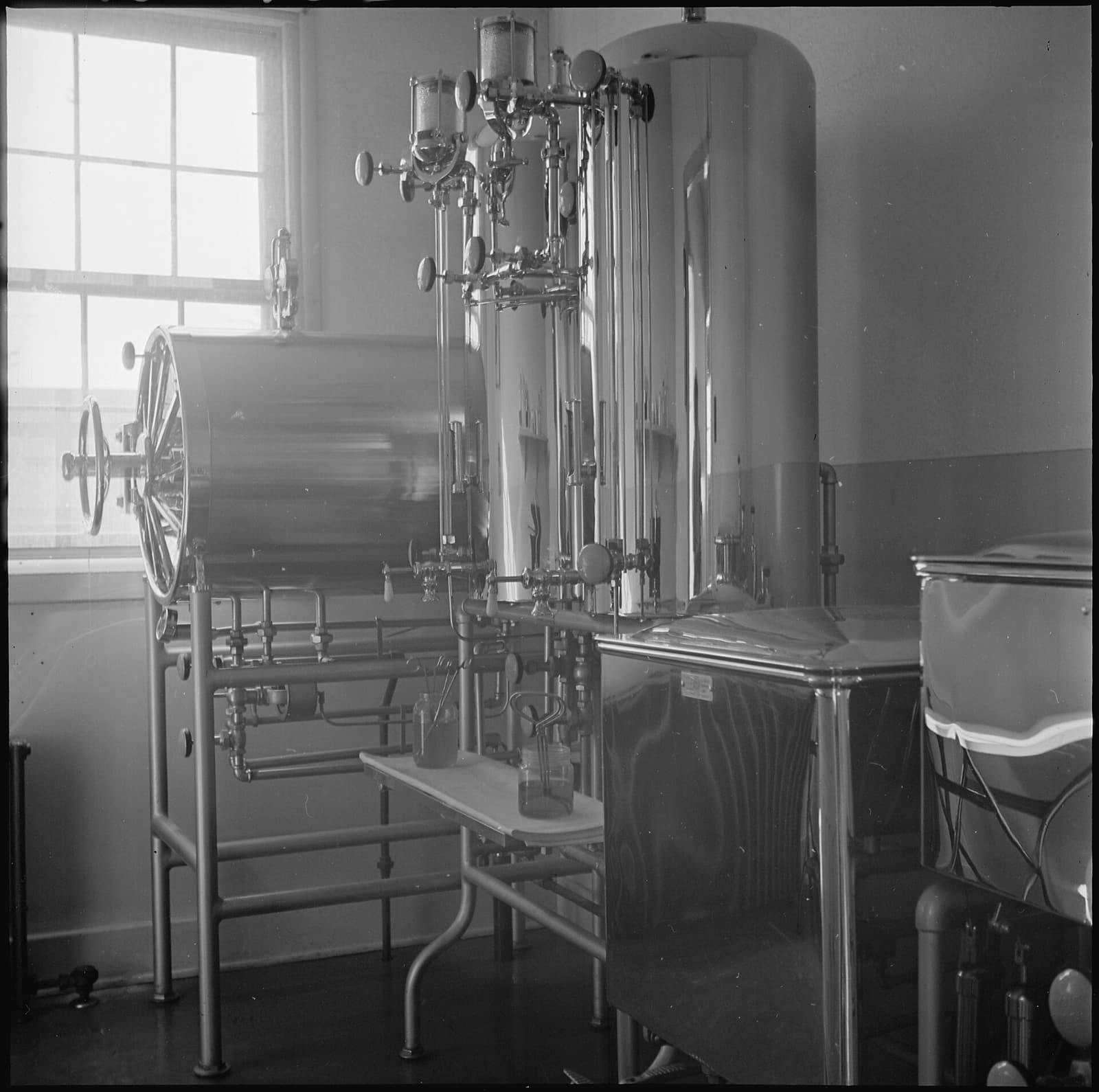
The machinery in the photograph looks persuasive: sealed tanks, polished pipes, handwheels, gauges. It was photographed in October 1945 at Amache, the incarceration camp in Colorado where the U.S. government held Japanese Americans during World War II. The National Archives describes the apparatus as autoclave equipment for sterilizing surgical bandages.[5]
Yet the picture cannot tell us whether any particular bandage came out sterile. Neither can a shut door, a pressure reading, or a strip of tape that changed color. Sterility is not a visible finish applied by a formidable machine. It is the result of a controlled chain in which a cleaned, compatible item is arranged so that saturated steam can touch it, held under validated conditions, and released only after several different kinds of evidence agree.
That chain explains the autoclave's great strength and its most common misunderstanding. Pressure is not the killing agent. Pressure makes hotter steam possible. The lethal work begins only when that steam reaches the load.
1879: pressure becomes a way to carry heat
The modern medical lineage begins in 1879, when Charles Chamberland, a physicist and biologist working with Louis Pasteur, designed a pressurized disinfection chamber while studying how to sterilize culture media. The Institut Pasteur records that the Chamberland autoclave quickly became important in bacteriology laboratories, surgical departments, and disinfection stations.[4]
Its logic resembles a pressure cooker, but the useful comparison stops at the door. At ordinary atmospheric pressure, liquid water boils at about 100°C. In a sealed chamber, higher pressure allows saturated steam to exist at higher temperatures. The U.S. Centers for Disease Control and Prevention therefore describes pressure as the means of obtaining the temperature required for rapid microbial killing—not as a sterilant in its own right.[1]
The distinction matters because a pressure gauge can report a chamber condition while saying nothing about whether steam reached the hinge of an instrument, the center of a wrapped pack, or the inside of a narrow channel. A load can be surrounded by pressure and still contain pockets where the sterilizing medium never made direct contact.
The lethal event is steam becoming water
When saturated steam meets a cooler instrument or textile, it condenses. That phase change transfers a large amount of energy to the surface. NHS England's steam-sterilization guidance makes condensation central: saturated steam is required so that enough energy passes into the load to achieve the intended lethality.[3]
At the microbial level, moist heat irreversibly coagulates and denatures enzymes and structural proteins. Moisture is why steam can kill rapidly at temperatures where dry heat would require a different exposure. It is also why “hot chamber” and “sterilized load” are not synonyms. The steam must be of suitable quality, must contact the relevant surfaces, and must remain at the validated temperature for the validated time.[1][3]
The CDC guideline gives two useful numeric anchors for wrapped healthcare supplies: a recognized minimum exposure of 30 minutes at 121°C in a gravity-displacement sterilizer, or 4 minutes at 132°C in a prevacuum sterilizer.[1] Those numbers describe particular cycle and load conditions; they are not universal settings. The exposure clock begins after the required condition has reached the load, so total cycle time is longer. Requirements change with the sterilizer, the material, the packaging, the load configuration, and features such as lumens. Facility procedures and the validated instructions from the device, packaging, and sterilizer manufacturers govern the actual cycle.[1][2][3]
Air is an invisible shield
Steam contact requires air removal. In a gravity-displacement autoclave, incoming steam pushes cooler air toward a drain. A dynamic-air-removal machine uses vacuum and pressure changes before the holding phase. Either design is trying to solve the same physical problem: air left inside a package or cavity can delay or prevent saturated steam from touching the surface beneath it.[1][3]
This is why loading is part of the mechanism. A tightly packed textile bundle, an instrument left assembled when its instructions require disassembly, an impermeable container, or a blocked channel can create a path steam cannot reliably enter. More chamber pressure does not repair a bad path. The sterilizer must remove air from the places that matter and replace it with steam.
The Bowie–Dick test used with dynamic-air-removal sterilizers illustrates the boundary between one check and the whole claim. NHS guidance says the test assesses whether air removal and steam penetration into a standardized pack are even and rapid. It also says what the test does not establish: that sterilization conditions were achieved in the clinical load.[3] Passing an air-removal test is necessary evidence about the machine's performance, not a certificate for every object processed later.
Sterilization starts before the chamber door closes
An autoclave is not a washing machine. Blood, tissue, salts, and other soil must be removed before sterilization. Both the CDC guideline and the World Health Organization's 2016 reprocessing manual place cleaning inside a larger, ordered workflow rather than treating the steam cycle as a reset button.[1][2]
That order has a causal purpose. Soil can keep steam away from a surface, shelter microorganisms, interfere with later processing, and make inspection unreliable. At the point of use, preventing debris from drying may preserve cleanability; in the reprocessing area, the device may need opening, flushing, brushing, or disassembly according to its validated instructions. Only then can the correct terminal process—steam sterilization when the item tolerates heat and moisture, or another validated method when it does not—do its assigned job.[1][2]
This is also why “sterilize everything longer” is not a safe rule. Steam can corrode or otherwise damage some devices, while heat- and moisture-sensitive equipment may require a low-temperature technology. A cycle must be lethal to microorganisms without making the instrument unsafe or nonfunctional. Compatibility is part of infection prevention, not an exception to it.[1]
The chain continues after exposure. The load must dry, cool, and retain an intact sterile barrier through handling and storage. A wet or damaged package is not rescued by the fact that its contents previously reached the holding condition; moisture or a breach can provide a route for later contamination.[2][3]
Three kinds of monitoring answer three different questions
The 2008 CDC guideline does not reduce release to a single indicator. It calls for mechanical, chemical, and biological monitoring because each observes a different part of the process.[1]
- Mechanical records show what the sterilizer measured: time, temperature, and pressure for the cycle.
- Chemical indicators show that a location encountered one or more selected process conditions. An external indicator can distinguish a processed package from an unprocessed one; an internal indicator provides evidence from inside the pack. A color change alone does not prove sterility.
- Biological indicators challenge the process with resistant bacterial spores. For steam cycles, the CDC identifies Geobacillus stearothermophilus. If those test spores survive, the result demands investigation; if they are inactivated, the test gives direct evidence of microbial killing under the conditions at the indicator's location.[1]
These checks overlap without becoming interchangeable. A printout can look normal while air prevents steam penetration. Indicator tape can change even when the full holding condition was not met. A biological indicator samples a deliberately chosen challenge point; it cannot rescue an item that was dirty, incompatible, incorrectly assembled, or placed outside the validated load pattern. Records also matter because a failed test may require staff to identify which loads were affected rather than treating the machine as a timeless black box.[1][3]
What the 1945 photograph gets right
Look again at Iwasaki's photograph. The pipes and valves show that sterilization is an engineered service, not a magic cabinet. Steam must be generated, admitted, distributed, measured, exhausted, and handled safely. The bandage packs implied by the archive caption add the less visible work: cleaning where applicable, folding, packaging, loading, cycle selection, monitoring, drying, storage, and traceability.[2][3][5]
The photograph also preserves a harder institutional fact. This sterilization equipment stood inside a camp created by forced removal and incarceration. Precision in the caption matters for the same reason precision matters in reprocessing: reassuring labels must not substitute for the underlying reality. The equipment's presence documents a healthcare system operating under confinement; it does not soften the conditions that made that system necessary.
The autoclave's durable lesson is narrower, but it travels. A gauge is not contact. Pressure is not sterilization. Tape is not proof. The reliable outcome comes from the chain: clean the item, create a path, remove the air, deliver suitable saturated steam, hold the validated conditions, dry and protect the package, and read the required forms of evidence before release.
Those steps are a causal explanation, not a do-it-yourself protocol. Clinical and laboratory sterilizers are pressure vessels operated by trained staff under device-specific instructions, local procedures, and applicable standards. The two famous temperature-and-time pairs explain why steam can work quickly; they do not authorize anyone to improvise a cycle.
Sources
- U.S. Centers for Disease Control and Prevention and Healthcare Infection Control Practices Advisory Committee, Guideline for Disinfection and Sterilization in Healthcare Facilities (2008; updated PDF) — steam's mode of action, cycle variables, device compatibility, air removal, exposure examples, and mechanical, chemical, and biological monitoring.
- World Health Organization and Pan American Health Organization, Decontamination and Reprocessing of Medical Devices for Health-care Facilities (2016) — international guidance on the full reprocessing sequence, from cleaning and inspection through packaging, sterilization, storage, and quality systems.
- NHS England, Health Technical Memorandum 01-01: Management and Decontamination of Surgical Instruments Used in Acute Care, Part C: Steam Sterilization (2016) — saturated-steam condensation, air removal, penetration tests, load design, validation, and operational boundaries.
- Institut Pasteur, “Charles Chamberland, the inventor of sterilization tools” — institutional history of Chamberland's 1879 work on culture-media sterilization and the autoclave that entered laboratories and surgical services.
- U.S. National Archives via Wikimedia Commons, “Granada Relocation Center, Amache, Colorado. Autoclave equipment for sterilizing surgical bandages” — Hikaru Iwasaki's October 1945 archival photograph, NARA identifier 539923.