Karl Landsteiner's 1901 paper is easy to remember as a naming event: A, B, O, later AB, and the beginning of modern blood typing. Read closely, it is stranger and more useful than that. The paper is not written like a triumphant classification chart. It is a compact argument about a visible reaction: serum from one apparently healthy person can make another healthy person's red blood cells clump.[1]
That observation changed transfusion because it attacked the old assumption that human blood was basically interchangeable. Before the ABO system, disastrous transfusion outcomes could look mysterious, technical, or simply unlucky. Landsteiner's move was to make one part of the danger appear in a dish before it appeared in a patient. If red cells clumped when mixed with another person's serum, then incompatibility was not a vague bedside misfortune. It was a reproducible laboratory event.[1][2][3]
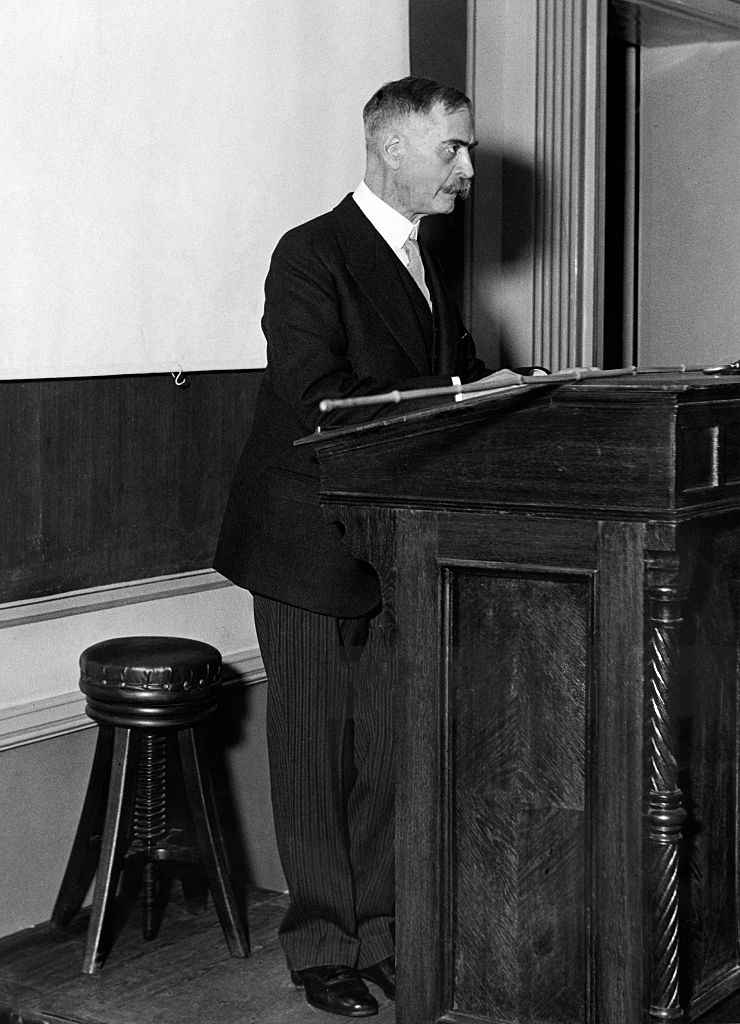
Image context: the cover uses a real 1930 archival photograph of Landsteiner in Stockholm. It fits the article because the Nobel ceremony came after the discovery had already been absorbed into medical infrastructure: a small visual test had become part of the ordinary grammar of safe transfusion.[5]
The timeline matters. In 1900, Landsteiner had already reported that normal human serum could agglutinate red cells from other people.[1] In 1901, he published the fuller paper laying out tables of reactions among healthy adults, puerperal patients, placental blood, and additional combinations.[1] In 1930, the Nobel Prize recognized him "for his discovery of human blood groups," with the Nobel summary explaining the practical point plainly: different people's red cells sometimes clumped when mixed, and compatible grouping made safer transfusion possible.[2] The discovery did not leap instantly from Vienna to every hospital ward, but the conceptual door had opened. Blood was no longer one red substance. It had relational properties.
The paper starts by refusing the disease-only explanation
Landsteiner's first important move is negative. He separates his observation from the idea that agglutination is mainly a feature of abnormal or febrile blood.[1] That distinction is crucial. If clumping were only a sign of disease, it would not reorganize transfusion practice. It would be another pathological curiosity. Landsteiner instead keeps returning to "apparently healthy" people and to the fact that normal sera can behave differently toward normal red cells.[1]
That is the hinge of the paper. The reaction is not framed as dirt, weakness, fever, or degeneration. It is framed as difference. The source of danger is not that one participant is sick. The danger is that two healthy people's blood can be immunologically mismatched.
His method is deliberately small. He mixed roughly equal amounts of serum and a suspension of blood cells in saline, then watched for agglutination in hanging drops or test tubes.[1] The table form looks modest, but it is doing the article's main work. Each plus sign turns a private biological difference into a public mark. One person's serum reacts with some cells and not with others. Another person's cells resist one serum and clump under another. The result is a grid of compatibility and incompatibility, not a story about one exceptional patient.
The tables are the argument
The most modern thing about the 1901 paper is not the vocabulary. Landsteiner's group labels do not yet look exactly like the later ABO shorthand. The modern thing is the matrix logic.
The tables ask the reader to stop thinking about blood in isolation. A red cell sample does not have its full meaning by itself. A serum sample does not have its full meaning by itself. Meaning appears in the crossing: whose serum meets whose cells, and what happens when they meet.[1] That is why the paper matters for transfusion beyond its historical priority. It teaches medicine to treat compatibility as a relationship that has to be tested.
NCBI's blood-group chapter describes the later mature interpretation: ABO antigens sit on red cells, while naturally occurring anti-A and anti-B antibodies can appear in serum against the ABO antigens a person lacks.[3] In modern terms, group A serum carries anti-B; group B serum carries anti-A; group O serum carries both; group AB carries neither anti-A nor anti-B.[3] Landsteiner did not need the full molecular vocabulary to find the operating pattern. He had the reaction.
This is why the paper's caution is part of its strength. Landsteiner writes with uncertainty about the source of the agglutinins and about possible explanations.[1] He does not pretend to have solved all of immunology. But he has found a regularity strong enough to guide practice: some mixtures are visibly unsafe in a way that other mixtures are not.[1][3]
Transfusion became a matching problem
The later clinical system built directly on that relational insight. Before transfusion, modern practice determines the recipient's ABO type and Rh D status, then performs a cross-match to see whether donor red cells agglutinate with the recipient's serum.[4] The language sounds procedural because the procedure is the safety achievement. A dangerous immune reaction is moved upstream into a small controlled mixture.
NCBI's transfusion chapter explains the mechanism: when incompatible donor red cells enter a patient who already has antibodies against that antigen, antibodies bind the cells, may activate complement, and can rapidly destroy the cells.[4] ABO incompatibility is especially dangerous because ABO antigens are densely expressed and most people have enough preformed anti-A or anti-B antibody to produce severe acute hemolysis if the wrong red cells are transfused.[3][4]
That gives the 1901 paper its enduring clinical shape. Landsteiner did not only classify people. He made a testable boundary between people. The important unit was not "blood type" as personality trivia or identity label. It was the answer to a practical question: can this donor's red cells survive in this recipient's serum?
That boundary also explains why blood typing never became a one-and-done magic word. ABO is the most important blood-group system for transfusion, but it is not the only one.[3][4] Modern cross-matching exists because a donor unit can still be incompatible through antigens not captured by the first ABO/Rh label.[4] In that sense, Landsteiner's deeper legacy is not a finished list of letters. It is a discipline of proving compatibility before exposure.
The discovery still warns against clerical confidence
One line from the modern NCBI chapter should make any reader pause: routine typing and cross-matching should prevent ABO reactions, but clerical error can still put "the wrong blood" into a patient.[4] Another chapter states the same point more sharply: ABO antigens remain central in transfusion medicine, and incompatible ABO transfusion deaths are often tied to clerical error.[3]
That is the hard afterlife of Landsteiner's finding. Once compatibility becomes knowable, the risk does not disappear. It moves into systems: labels, tubes, wristbands, orders, unit release, bedside verification, and the handoff between laboratory and ward. The 1901 discovery made the hidden biological mismatch visible. It did not abolish the human work of keeping that visibility attached to the right patient.
The best mechanism-first reading of Landsteiner, then, is not "he discovered blood types." That is true, but thin. The stronger reading is that he changed the moral and operational status of transfusion. After agglutination could be shown among healthy people, a bad outcome was no longer just a tragic uncertainty of medicine. It was increasingly a preventable failure to test, match, label, or verify.
That is why a few small tables from Vienna still feel modern. They show medicine at the moment it learns to distrust visual sameness. Blood looks alike until serum and cells are made to answer each other. Landsteiner's achievement was to make that answer visible early enough to matter.[1][2][3][4]
Sources
- Karl Landsteiner, "On Agglutination Phenomena of Normal Human Blood" (English translation of the 1901 Wiener Klinische Wochenschrift paper), used for the primary-source reading of serum-red-cell mixing, tables, and Landsteiner's transfusion inference.
- Nobel Prize Outreach, "Karl Landsteiner - Facts," covering the 1930 Nobel Prize, the prize motivation, and the basic explanation that clumping of red blood cells led to compatible transfusion.
- Laura Dean, "Chapter 5: The ABO blood group," Blood Groups and Red Cell Antigens, NCBI Bookshelf, covering ABO history, antigens, antibodies, hemolysis, nomenclature, and clinical significance.
- Laura Dean, "Blood transfusions and the immune system," Blood Groups and Red Cell Antigens, NCBI Bookshelf, covering type-and-cross-match practice, agglutination during cross-match, and immune-mediated transfusion reactions.
- Wikimedia Commons, "File:Karl Landsteiner 1930.jpg," archival portrait source page for the article image.