Hurricane Katrina did not reveal that hospitals need evacuation plans. They already had plans. The harder lesson was that an evacuation plan is not a single decision to leave. It is a dependency map: power must keep ventilators and elevators useful, water must keep toilets and cooling possible, phones or radios must connect a building to command, vehicles must reach the loading point, and receiving facilities must have beds, staff, and records ready enough to continue care.
That chain began to break after Katrina made landfall on August 29, 2005, and the levee failures pushed floodwater into New Orleans. In the days that followed, hospitals and nursing homes faced the worst version of a problem emergency planners usually try to avoid: moving medically fragile people after the surrounding city had already lost many of the systems that make movement safe.[1][2]
Before the water: sheltering in place was the default
Hospitals are not ordinary buildings in a storm. Evacuating them before landfall can harm patients, especially those on oxygen, dialysis, ventilators, monitors, IV medications, or complex nursing routines. Administrators have to weigh the risk of staying against the risk of moving people whose care depends on machines, medications, and staff attention. GAO's February 2006 review found that hospital and nursing-home administrators often treat evacuation as a last resort, with emergency plans designed primarily around sheltering in place.[1]
That logic was not irrational. If a building can survive wind and keep utilities, it may be safer to shelter than to move intensive-care patients into ambulances during a hurricane. The problem in New Orleans was that Katrina turned a shelter decision into a utility-collapse decision. Once infrastructure failed, the building was no longer simply a refuge. It became an island that had to keep acting like a hospital without the ordinary city beneath it.
GAO framed the decision factors clearly: administrators had to consider whether they had enough resources to stay, the risks of moving patients, the availability of transportation, the availability of receiving facilities, and the destruction of facility or community infrastructure.[1] Katrina compressed all of those questions into the same few days.
August 29 to September 2: the hospital becomes an island
The storm's medical story cannot be separated from the city's flood story. After landfall and levee failure, access routes changed, communications degraded, and ordinary resupply became uncertain. The health-care system then had two simultaneous jobs. It had to keep existing patients alive inside damaged or isolated buildings, and it had to move some of them out through a city where the usual patient-transfer machinery had disappeared.
The federal evacuation system also had a boundary that mattered. GAO reported that the National Disaster Medical System could help evacuate hospital patients, but its support did not solve every link in the chain. In later GAO findings, the critical limitation was that federal patient evacuation effectively began at a mobilization center, such as an airport, and did not necessarily provide the short-distance ambulances or helicopters needed to move patients from facilities to that center.[1] That gap turns out to be decisive: a patient is not "evacuated" when an aircraft exists somewhere. A patient is evacuated when the bedside-to-aircraft path exists.
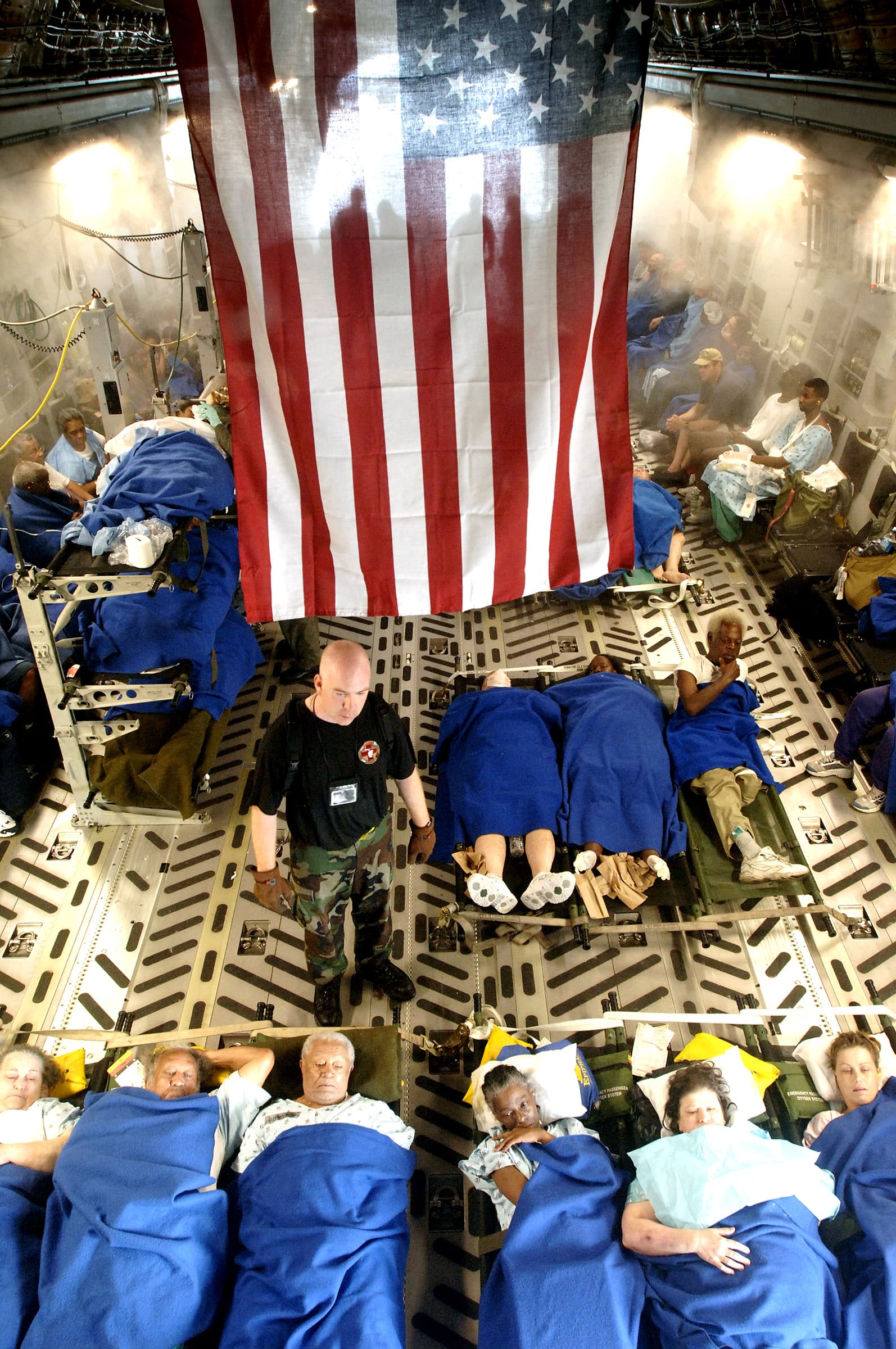
The Commons photograph used here shows one successful endpoint of that path: sick and injured evacuees being prepared for a C-17 flight, with Air Force medical teams caring for patients before transport.[5] But the photograph also shows why the endpoint should not be mistaken for the whole system. Before an aircraft can matter, patients have to be selected, documented, stabilized, physically carried or rolled out, transferred to staging, matched to a destination, and watched throughout delays.
September 2005: surveillance had to be rebuilt after care moved
Katrina also damaged public health's ability to see what was happening. CDC's New Orleans illness-and-injury surveillance report covered September 8 through September 25, after the emergency had already shifted into a dispersed medical response.[3] The numbers in that report matter, but the operational lesson may matter more: CDC noted that manual collection and entry at that scale required substantial personnel resources, and that the evacuation of New Orleans created unforeseen complications in maintaining surveillance.[3]
That is a second dependency chain. After evacuation, care does not end; it becomes harder to track. Patients appear at airports, shelters, military medical staging areas, temporary clinics, distant hospitals, and later home communities. Chronic disease does not pause for disaster administration. Medication lists, dialysis schedules, oxygen needs, wound care, infection control, and mental-health needs have to travel with the person or be reconstructed under pressure.
The CDC report is careful about its limits. It said the enumeration was incomplete because of heavy patient volume and limited resources, that misclassification was possible, and that pre-hurricane baseline data were not available to measure increases in illness and injury.[3] Those caveats are not weaknesses in the report. They are part of the event reconstruction. A disaster large enough to evacuate a city is also large enough to damage the measurement system that tells responders where illness is concentrating.
Mortality showed who the system failed first
The later mortality analysis by Brunkard, Namulanda, and Ratard identified 971 Katrina-related deaths in Louisiana and 15 deaths among evacuees in other states for the period they studied.[4] Drowning was the largest cause category, followed by injury and trauma, with heart conditions also prominent. The age pattern was stark: 49 percent of victims were at least 75 years old.[4]
The hospital-evacuation lesson sits inside that broader mortality pattern. Vulnerable people were not vulnerable only because they were frail. They were vulnerable because their survival depended on continuity: a dry room, a working elevator, charged equipment, transportation, staff who could stay, a way to call for help, a destination that could receive them, and records that explained what care they needed. When any one dependency failed, another part of the system had to compensate. When many failed together, evacuation became rescue under medical conditions.
This is why the event should not be reduced to a morality play about whether any one facility should have left earlier. Earlier evacuation can be lifesaving, but it can also kill if it sends unstable patients into roads, heat, darkness, or receiving sites that cannot handle them. The real policy question is sharper: what conditions would have made the decision less binary? More resilient backup power. Fuel and water assumptions that match flood duration rather than storm duration. Communications that do not depend on one network. Pre-identified patient transport resources. Receiving agreements that work when a whole region is affected. Clear federal, state, and local roles for the short trip from hospital to mobilization center.
February 2006: the capacity loss continued after the evacuation
Six months later, GAO described a New Orleans health system still structurally diminished. Charity and University Hospitals, together known as the Medical Center of Louisiana at New Orleans, had served as a major safety-net institution before Katrina, with more than 25,000 inpatient admissions, over 300,000 clinic visits, and 135,000 emergency visits in fiscal 2004.[2] After the disaster, that system and its Level I trauma unit were forced to close.[2]
The bed numbers make the aftermath concrete. GAO reported that staffed hospital beds in the City of New Orleans were about 80 percent lower in February 2006 than before Katrina. Of nine acute-care hospitals in the city before the storm, only three had reopened by February 22, 2006, at about 456 staffed beds. The table listed 2,269 staffed beds before Katrina in Orleans Parish facilities and 456 after, a decline of 1,813.[2]
That postscript changes how the evacuation should be remembered. The crisis was not only the dramatic movement of patients in the first week. It was also the loss of local health-care capacity after the cameras moved on. Emergency departments that remained open faced ambulance offload delays and patients housed in emergency departments because staffed beds were not available. Safety-net clinics were also sharply reduced; GAO reported that 19 of 90 clinics were open after the hurricane, generally at less than half of pre-Katrina capacity.[2]
What the event teaches
Katrina made a basic health-system truth visible: evacuation is care delivery in motion. It is not logistics separate from medicine. A hospital evacuation plan has to ask who can safely move, who cannot move without specialty transport, who needs electricity minute by minute, who needs refrigeration for medication, who needs dialysis within a fixed interval, who needs a nurse during transport, who has no family contact, and who will be harmed by waiting in a staging area.
The strongest preparedness lesson is therefore not "always evacuate" or "always shelter." It is to define the threshold where sheltering stops being care. If the building loses cooling, water, sewer function, elevators, power redundancy, medication access, communications, or staffing relief, the decision changes. A plan that names those thresholds before the storm gives clinicians and administrators something better than improvisation.
The Air Force evacuation photograph is powerful because it shows competent care under pressure.[5] But the photograph also asks a quieter question: what had to fail before a hospital patient reached an aircraft floor? Katrina's hospital evacuations remain important because they exposed that answer. In a disaster, the vulnerable patient is carried not by a stretcher alone, but by an entire chain of dependencies. The chain has to be designed before the water rises.
Sources
- U.S. Government Accountability Office, "Disaster Preparedness: Preliminary Observations on the Evacuation of Hospitals and Nursing Homes Due to Hurricanes" (GAO-06-443R, February 16, 2006) - decision factors, shelter-in-place assumptions, transportation and receiving-facility constraints.
- U.S. Government Accountability Office, "Hurricane Katrina: Status of the Health Care System in New Orleans and Difficult Decisions Related to Efforts to Rebuild It Approximately 6 Months After Hurricane Katrina" (GAO-06-576R, March 28, 2006) - post-Katrina hospital, bed, emergency-care, and safety-net capacity data.
- Centers for Disease Control and Prevention, "Surveillance for Illness and Injury After Hurricane Katrina - New Orleans, Louisiana, September 8-25, 2005," MMWR (October 14, 2005) - surveillance burden, limitations, and post-evacuation public-health tracking.
- Joan Brunkard, Gonza Namulanda, and Raoult Ratard, "Hurricane Katrina deaths, Louisiana, 2005," Disaster Medicine and Public Health Preparedness (2008) - mortality categories, age distribution, and preparedness implications.
- Wikimedia Commons, "Hurricane Katrina Medical Evacuees.jpg" - U.S. Air Force photograph by Master Sgt. Lance Cheung documenting medical evacuation from New Orleans after Katrina.