Insulin is often remembered as a miracle date: January 1922, one injection, one rescue, modern diabetes begins. The archival record supports a sharper reconstruction. The Toronto group had already shown in dogs during the summer of 1921 that pancreatic extract could lower blood sugar. What they had not yet solved was the harder clinical problem: how to make that extract potent enough, clean enough, and repeatable enough to survive the trip from dog room to hospital ward.[1][2][3]
That distinction matters because it changes where the real hinge sits. The first injection given to Leonard Thompson on January 11, 1922 was not a theatrical triumph. It produced a biochemical nudge and no meaningful clinical turnaround. The extract was still too dirty and too weak for the bedside. The decisive turn came only after James Collip's purification work and Walter Campbell's second round of injections beginning on January 23, 1922, when glycosuria nearly disappeared, ketones vanished, blood sugar fell from .520 to .120, and Thompson brightened almost immediately.[2][3][6]
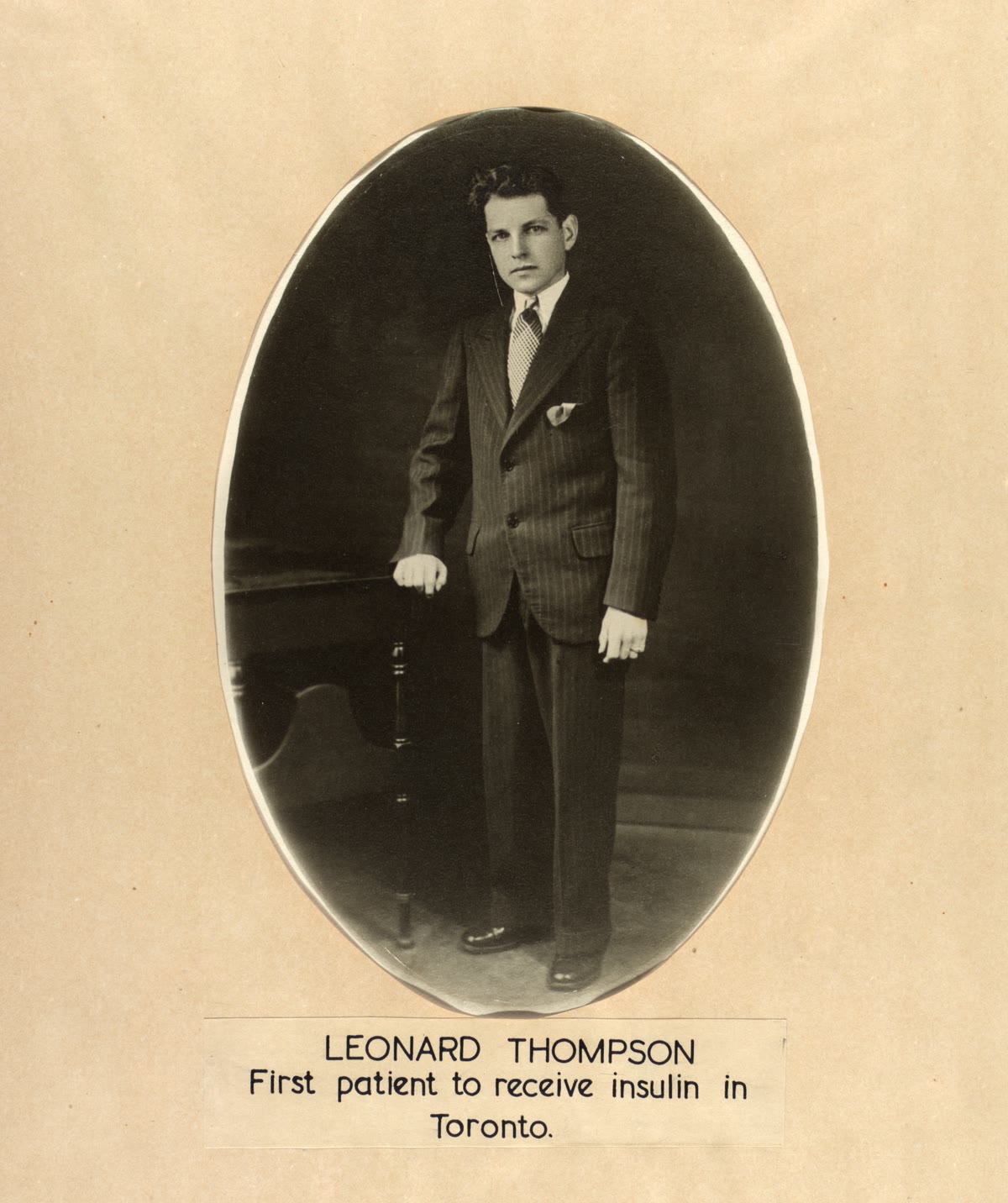
Image context: the cover uses a real archival photograph of Leonard Thompson from the University of Toronto collections via Wikimedia Commons. That choice keeps the article anchored to the patient rather than the legend. The discovery only became medical history in the strong sense when someone in a hospital bed could live with it, not merely when a laboratory notebook showed a promising fall in a dog's blood sugar.[7]
Timeline anchors before the hinge
- May 17, 1921: Banting and Best performed their first pancreatectomy experiment in Toronto and began the summer sequence that would lead to the early extract trials.[1]
- July 30-August 7, 1921: after major setbacks with duct ligation and dying dogs, they saw sugar-lowering effects in diabetic dogs including 410, 406, and the yellow collie 408.[1]
- Second week of December 1921: Collip joined the team in Toronto, began rabbit testing for potency, and started improving extract preparation as the work accelerated.[4]
- December 21, 1921: Joseph Gilchrist became the first diabetic human to receive the extract, given by mouth, with no benefit.[2][4]
- January 11, 1922: Leonard Thompson received the first injection of the Toronto extract; blood sugar fell about 25%, but no clear clinical benefit followed.[2][3]
- January 23, 1922: Campbell began the second, purified trial on Thompson using Collip's extract; the response was immediate and unmistakable.[2][3][6]
- Spring 1922: demand outran supply, producing an "insulin famine" in Toronto and forcing the team and Connaught to treat manufacturing as a second discovery problem.[5]
The timeline shows why the discovery is best read as an event chain rather than a single eureka. Dog experiments established possibility. Human failure established the boundary. Purification established therapy. Manufacturing established survival at scale.
1. The summer dogs proved a physiological effect, not yet a treatment
The summer of 1921 was brutal, improvised, and full of dead dogs.[1] Banting and Best worked in overheated rooms, bought replacement animals on Toronto streets, and lost time when Banting realized in early July that he had failed properly to ligate the ducts in his first series.[1] The point is not romance. It is that the famous discovery began inside experimental instability. Even after the theory sharpened, the execution kept failing.
The breakthrough sequence arrived only at the end of July and the start of August. On July 30, Banting and Best injected extract from a degenerated pancreas into diabetic dog 410. The result looked promising enough to excite them, even though the animal was infected and the measurements were technically crude.[1] On August 1, diabetic dog 406 briefly revived before dying.[1] Then came the yellow collie, Dog 408, which received multiple injections from August 3 to August 7. In the notebook language of the period, the extract they called "isletin" appeared to lower blood sugar.[1]
That is where heroic retellings often stop. But the same sources make the limitation plain. Dog 408 died during the experiments, and autopsy showed widespread infection.[1] Dog 410 died too.[1] The Toronto team had strong reason to believe they were touching the pancreas's internal secretion, yet they did not possess anything a clinician could responsibly hand to a patient with confidence. The summer result was proof of principle under animal conditions, not a finished drug.
2. December 1921 made the bottleneck visible: potency could be tested, but the bedside still could not trust the product
Collip's arrival in December 1921 matters because the project was shifting from surgery and rough extract work into biochemistry.[4] The Fisher exhibition's archival summary is clear on this point. Collip joined in the second week of December, worked separately from the dog quarters, and helped produce a rapid rabbit test that showed whether a batch could lower blood sugar in both diabetic and normal rabbits.[4] That sounds technical and secondary. It was neither. If the team could not quickly distinguish potent from weak batches, human use would remain guesswork.
The same month also produced an important failure that usually gets buried under the January story. On December 21, 1921, Banting gave extract by mouth to his classmate Joseph Gilchrist, the first diabetic human to receive it, and nothing useful happened.[2][4] The team did not yet know that insulin could not be administered orally.[4] This failed test is worth keeping in view because it shows that the path to Leonard Thompson was not a straight line from dog to cure. Even by late December, the Toronto group was still learning what route, what concentration, and what preparation might actually work in a person.
3. Leonard Thompson's first injection on January 11 was a boundary event, not a triumph
Leonard Thompson was fourteen, admitted to Toronto General Hospital on December 2, 1921, and close to death by early January.[2][3] He weighed 65 pounds on admission. He was pale, his hair was falling out, his abdomen was swollen, and he smelled of acetone on the breath.[2] The 1922 case material quoted in the exhibition adds another detail that makes the ward scene unmistakable: he was dull, talked slowly, and was willing to lie about all day.[2]
That is the patient who received the first injection on January 11 under Walter Campbell's supervision.[2][3] The extract, as later described, was "a murky light-brown liquid containing much sediment."[2] The result was not nothing. Sugar excretion fell slightly and blood sugar dropped by about 25%.[2] But the source record is explicit: no evident clinical benefit followed.[2] Other accounts add that contaminants caused a local abscess.[3]
This failed first injection is the most important correction to the miracle version of insulin history. The Toronto group did not move from starving children to salvation in one clean motion. The hospital itself demonstrated the remaining problem. A pancreatic extract could alter chemistry without yet functioning as dependable medicine. January 11 mattered because it exposed the bottleneck in human form. The extract was real enough to act, impure enough to disappoint, and therefore close enough to success that purification now became the entire story.
4. January 23, 1922 was the real clinical hinge because purification and patient care finally aligned
Campbell's second round of treatment, starting on Monday, January 23, 1922, was different in one decisive respect: the extract had been improved by Collip.[2][3][6] Here the sources converge tightly. The Leonard Thompson page says that after the second series of injections, Thompson's blood sugar dropped to normal in one day and his condition improved immediately.[3] The exhibition's narrative page quantifies the turn more sharply: glycosuria nearly disappeared, ketones disappeared, and blood sugar fell from .520 to .120, that is, to normal range.[6]
Those numbers mattered because they linked three things at once. First, the extract still had the same physiological target the dogs had hinted at in 1921. Second, the ward could now tolerate the material. Third, the patient improved in a way nobody in the corridor had to romanticize. A biochemical effect had become a clinical event.
This is why the January 23 turn should be read as more than one dramatic injection. It was the first day the laboratory, the biochemist, and the clinic were finally speaking the same language. Banting and Best had carried the work from dog surgery to extract making. Collip had made the extract cleaner and more potent. Campbell had translated that into repeatable treatment in the ward. The event belongs to a team and to a sequence, not to a single isolated gesture.[2][3][4][6]
The Nobel presentation speech the following year preserves how quickly the importance became visible. It explicitly marked the first successful injection into a fourteen-year-old youth on January 23 and the following days, then described the normalization of blood sugar, the near disappearance of sugar in the urine, and the checking of acidosis.[6] Even that ceremonial summary, however, does something useful for a modern reader: it admits that much prior work had nearly reached the same goal and that Toronto's achievement was a culmination as well as a breakthrough.[6]
5. The event did not end in January because a therapy is not finished when one patient responds
Success in Thompson's bed created a second emergency: supply.[5] The manufacture page from the Toronto exhibition states the problem bluntly. Once clinical benefit had been proven, the plan was to make insulin in large quantities, yet Collip could not immediately produce it in large batches using the same method, and Toronto fell into an "insulin famine" in the spring of 1922.[5] That phrase matters. It reminds us that insulin's history is not only the story of discovery. It is also the story of whether purification can be routinized, patented defensively, and scaled without private monopoly swallowing the treatment.
That aftershock helps explain why Leonard Thompson's case still matters. The first successful patient did not merely prove that the pancreatic secretion existed. He proved that medicine had crossed into a new obligation. Once one dying teenager could be turned around, diabetes care could no longer be organized as slow starvation alone. The question became who could get extract next, who could make it reliably, and how fast the bottleneck could be widened.[2][5]
Why this event reconstruction matters now
Insulin's earliest history still offers a clean lesson in how medical breakthroughs actually harden. A striking animal result is not enough. A brave first human trial is not enough. Even a dramatic recovery is not enough. The chain has to hold from experimental signal to purified preparation to bedside supervision to repeatable manufacturing.[1][2][3][4][5]
That is why the right hinge in January 1922 is not "first injection" in the abstract. The stronger hinge is narrower: the moment a crude pancreatic extract stopped behaving like an interesting laboratory substance and started behaving like a usable therapy in a public hospital ward. Leonard Thompson's case is where that boundary finally became visible.
Sources
- Thomas Fisher Rare Book Library, University of Toronto, "III. The Summer of 1921" - archival reconstruction of Banting and Best's dog experiments, including Dogs 410, 406, and 408.
- Thomas Fisher Rare Book Library, University of Toronto, "First Clinical Trials" - archival summary of Joseph Gilchrist's oral trial, Leonard Thompson's January 11 injection, and the January 23 turnaround.
- Thomas Fisher Rare Book Library, University of Toronto, "Leonard Thompson" - patient-record overview documenting the January 11 and January 23, 1922 treatment sequence.
- Thomas Fisher Rare Book Library, University of Toronto, "V. Growing the Team" - Collip's December 1921 arrival, rabbit testing, and the failed oral trial on Joseph Gilchrist.
- Thomas Fisher Rare Book Library, University of Toronto, "The Manufacture of Insulin" - the spring 1922 production crisis, the Toronto "insulin famine," and the shift toward scaled manufacturing and patent control.
- Nobel Prize Outreach, "Physiology or Medicine 1923 - Presentation Speech" - contemporaneous Nobel framing of the January 23, 1922 successful treatment and its clinical significance.
- Wikimedia Commons, "File: Leonard Thomson patient Insulin P10046 0001.jpg" - archival photograph source page for the Leonard Thompson image used in this article.